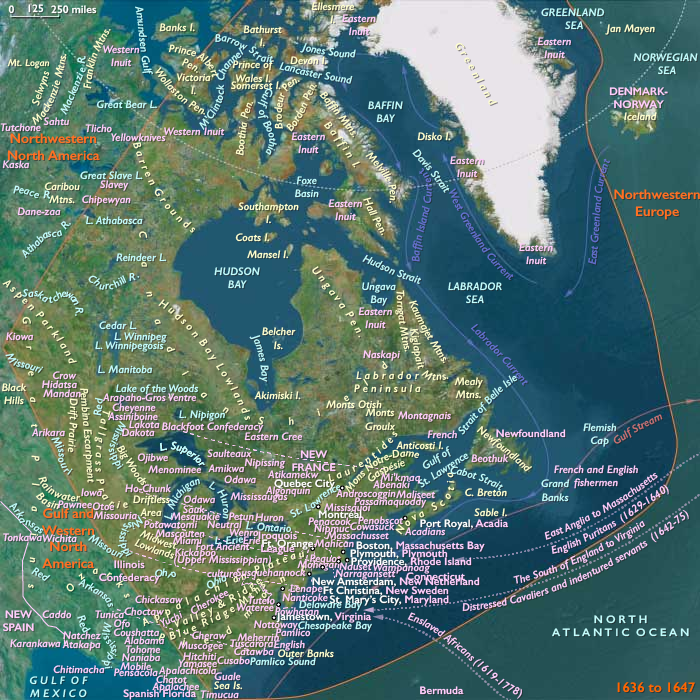
The English Province of Maryland declares war …
Years: 1642 - 1642
The English Province of Maryland declares war on the Susquehannock in 1642.
Locations
Groups
Topics
Subjects
Regions
Subregions
Related Events
Filter results
Showing 10 events out of 32127 total
The epidemics in China lighten only somewhat in 1642, when the locus of infection spreads to the Yangtze Delta.
The Jewish population of China has by 1642 reached about five thousand, mostly in Kaifeng.
Located along the southern bank of the Yellow River, Kaifeng is flooded in 1642 by the Ming Dynasty army with water from the Yellow River to prevent the peasant rebel Li Zicheng from taking over.
Roughly half of the six hundred thousand residents of Kaifeng are killed by the flood and the ensuing peripheral disasters such as famine and plague, making it one of the deadliest single acts of war in history (excluding systematic genocide) and the second greatest single loss of human life of its time.
The flooding of the city destroys the synagogue as well as Jewish records, books, and burial grounds, bringing an end to the "golden age" of the Jewish settlement of China.
Sometimes referred to as a natural disaster due to the role of the Huang He river, the flood, with a death toll of some three hundred thousand, is currently listed as the seventh deadliest natural disaster in history.
Moskvitin had in 1641 reported his discoveries to Prince Shcherbatov, the Muscovite voivode in Tomsk.
A year later he brings news about the eastern sea to Moscow.
Based on his account, the first Russian map of the Far East is drawn in March 1642.
Protestant Transylvania during the Thirty Years Wa has successfully kept the Catholic Habsburgs from effectively enforcing the Counter-Reformation in Hungary, of which Transylvania was formerly its eastern part.
Transylvania, under the leadership of György I Rákóczi (1591-1648), has gained international stature as a champion of Protestantism and has attracted the attention of the Swedes, who have marched victoriously through Silesia to Moravia, taking the city of Leipzig in 1642.
Night Watch or The Night Watch or The Shooting Company of Franz Banning Cocq (Dutch: De Nachtwacht), the common name of one of the most famous works by Dutch painter Rembrandt van Rijn, may be more properly titled The Company of Frans Banning Cocq and Willem van Ruytenburch.
The painting is renowned for three elements: its colossal size (three hundred and sixty three by four hundred and thirty-seven centimeter, or eleven feet ten inches by fourteen feet four inches), the effective use of light and shadow, and the perception of motion in what would have been, traditionally, a static military portrait.
This painting, completed in 1642, at the peak of the Dutch Golden Age, depicts the eponymous company moving out, led by Captain Frans Banning Cocq (dressed in black, with a red sash) and his lieutenant, Willem van Ruytenburch (dressed in yellow, with a white sash).
With effective use of sunlight and shade, Rembrandt leads the eye to the three most important characters among the crowd, the two gentlemen in the center (from whom the painting gets its original title), and the small girl in the center left background.
Behind them the company's colors are carried by the ensign, Jan Visscher Cornelissen.
The militiamen are also called Arquebusiers, after the arquebus, a sixteenth-century long-barrelled gun.
Night Watch is today on prominent display in the Rijksmuseum, Amsterdam, the Netherlands, being the most famous painting in their collection.

The Philadelphia area had been the location of the Lenape (Delaware) village Shackamaxon prior to the arrival of Europeans.
Fifty families on a ship captained by George Lamberton settle in 1642 at the mouth of Schuylkill River around to establish a trading post at what is today Philadelphia.
The Dutch and Swedes who are already in the area burn their buildings.
A court in New Sweden is to convict Lamberton of "trespassing, conspiring with the Indians."
The New Haven Colony gets no support from its New England patrons: Puritan Governor John Winthrop is to testify that the "Delaware Colony" "dissolved" owing to “summer sickness and mortality”.
While New Haven is to retreat from the venture, the Lenape agreement, which places no westward limit on the land west of the Delaware, is to be the legal basis for a Connecticut "sea to sea" claim of owning all the land on both sides of the Delaware from the Atlantic Ocean to the Pacific Ocean.
A permanent settlement on the Island of Montreal is created in 1642 by a French tax collector and Jesuit named Jérôme le Royer de la Dauversière, whom with the Parisian priest Jean-Jacques Olier had formed the idea of establishing at Montreal several communities: one of priests to convert the natives, one of nuns to nurse the sick, and one of nuns to teach the local children of the natives.
Olier has involved some of his wealthy penitents, while Dauversière has found support from the Baron de Fanchamp.
Others have joined in, one being Angélique Bullion, and six persons had formed the Société Notre-Dame de Montréal.
They have raised between them seventy-five thousand livres.
Le Royer de la Dauversière, through Charles Lallemant, had in 1639 obtained the Seigneurial title to the Island of Montreal in the name of the Société de Notre-Dame de Montréal to establish a Roman Catholic mission for evangelizing natives.
He also recruits Paul Chomedey de Maisonneuve and Jeanne Mance to engage in the undertaking.
Maisonneuve is the first governor of Ville-Marie, the original name for the settlement that is later to become Montreal.
Colonists from Bristol, England, had settled an area first called Agamenticus, meaning "beyond-the-hill-little-cove," the Abenaki name for the York River; they name the new settlement after their city of origin.
Envisioning a great city arising from the wilderness, Sir Ferdinando Gorges, Lord Proprietor of Maine under the Plymouth patent, names the capital of his province Gorgeana.
By charter of King Charles I, Gorgeana—now York, Maine—becomes in 1642 the first incorporated city in America.
D'Aulnay had returned to France in the early winter of 1641 to obtain additional power, and La Tour had sought the aid of his New England neighbors.
As a result of negotiations with the New England governor, a body of Boston merchants had made a visit to Fort La Tour for purposes of trade, and while at sea, on their return, met d'Aulnay himself, who informed them that La Tour was a rebel, and showed them a confirmation of the order issued the year before for his arrest.
D'Aulnay lays siege to Fort La Tour wth five hundred men in armed ships, but aid comes from New England, and he is driven away.
Six hundred Amsterdam Jews, under invitation from the East India Company, settle in 1642 in the Dutch colony of Pernambuco (Recife), Brazil, administered by the Prince of Nassau from 1637.
Aboab da Fonseca is appointed rabbi.
Most of the European inhabitants of the town are Sephardic Jews from Portugal who had been banned by the Inquisition to this town at the other side of the Atlantic Ocean.