
John Tengo Jabavu, a mission-educated teacher and …
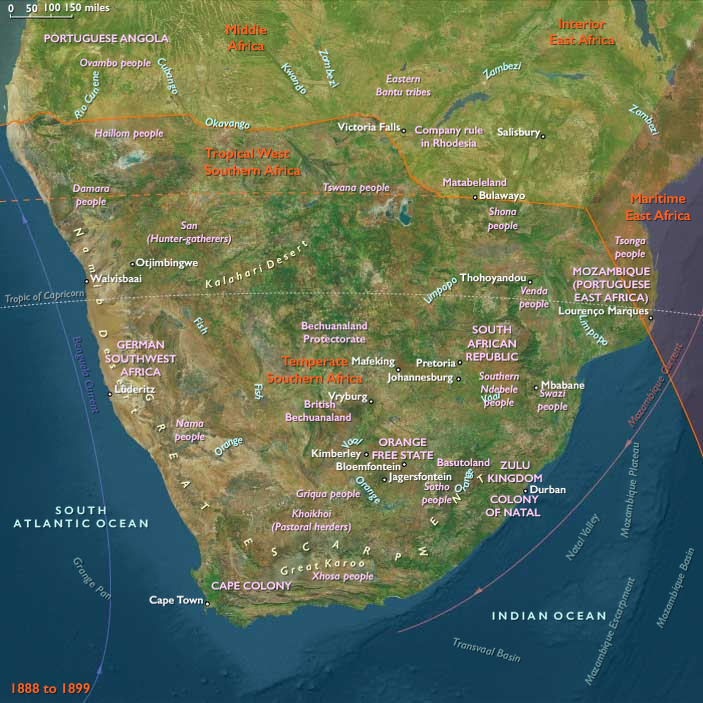
Years: 1888 - 1899
John Tengo Jabavu, a mission-educated teacher and vice president of the NEA, had founded his own newspaper, Imvo Zabantsundu (Native Opinion) in 1884.
Jabavu uses the newspaper as a forum through which to express African grievances about the pass laws; "location" regulations; the unequal administration of justice; and what are considered "anti-native" laws, such as the one passed in 1887 by the Cape Parliament at Rhodes's behest that had raised the property qualification for voters and had stricken twenty thousand Africans off the rolls.
Through these organizations and newspapers, and others like them established in the late nineteenth century, Africans protest their unequal treatment, pointing out in particular contradictions between the theory and practice of British colonialism.
They call for the eradication of discrimination and for the incorporation of Africans into colonial society on an equal basis with Europeans.
By the end of the nineteenth century, after property qualifications have again been raised in 1892, there are only about eight thousand Africans on the Cape's voting roll.
People
Groups
- Khoikhoi
- Indian people
- Sotho (Basotho or Basuto) people
- Swazi
- Zulu people
- Xhosa people
- Shona people
- Afrikaners
- Boers
- Britain (United Kingdom of Great Britain and Ireland)
- Cape Colony, British
- Zululand
- Zulu, Kingdom of the
- Zimbabwe, Ndebele Kingdom of
- South African Republic (the Transvaal)
- Swaziland, Kingdom of
- Swaziland, Kingdom of
- Natal Colony, British
- Orange Free State, Republic of the (Boer Republic)
- Basutoland
- British South Africa Company (SAC)
- Rhodesia, Company rule in
Topics
Commodoties
Subjects
Regions
Subregions
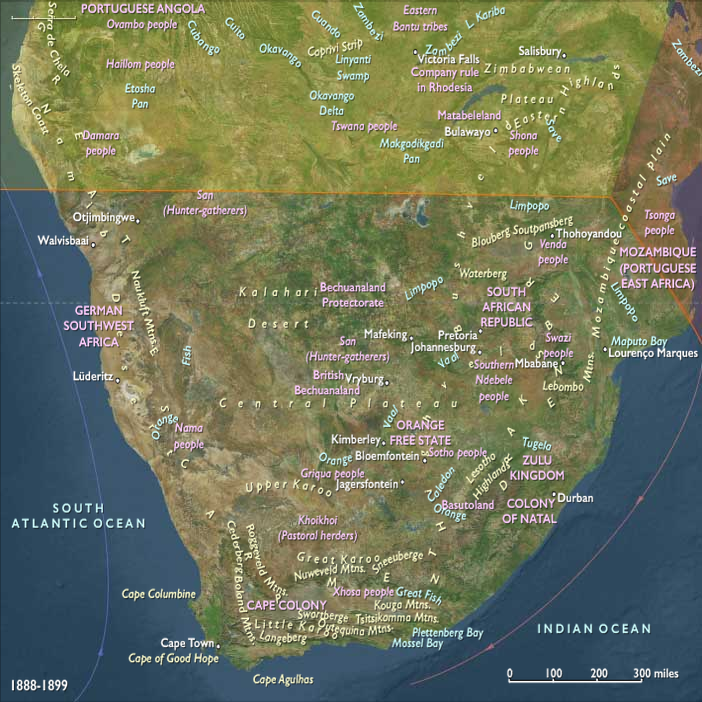
Years: 1888 - 1899
People
Groups
- Khoikhoi
- Indian people
- Sotho (Basotho or Basuto) people
- Swazi
- Zulu people
- Xhosa people
- Shona people
- Afrikaners
- Boers
- Britain (United Kingdom of Great Britain and Ireland)
- Cape Colony, British
- Zululand
- Zulu, Kingdom of the
- Zimbabwe, Ndebele Kingdom of
- South African Republic (the Transvaal)
- Swaziland, Kingdom of
- Swaziland, Kingdom of
- Natal Colony, British
- Orange Free State, Republic of the (Boer Republic)
- Basutoland
- British South Africa Company (SAC)
- Rhodesia, Company rule in
Topics
Commodoties
Subjects
Regions
Subregions