
The first certain attestation of chariots, and …
Years: 1629BCE - 1486BCE
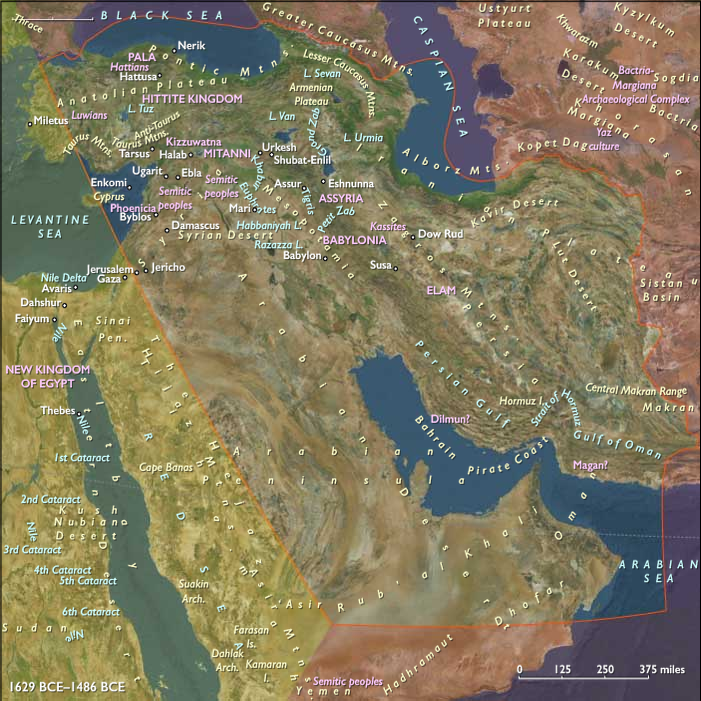
The first certain attestation of chariots, and the oldest testimony of chariot warfare in the Ancient Near East, is the Anitta text, written in the Old Hittite language (between about 1750 BCE and 1500 BCE), mentioning forty teams of horses at the siege of Salatiwara, a city of Bronze Age Anatolia.
The ostensible author, Anitta, is a king of Kussara, a city that has yet to be identified.
This text seems to represent a cuneiform record of Anitta's inscriptions at Kanish, perhaps compiled by Hattusili I, one of the earliest Hittite kings of Hattusa, who flourished in the late seventeenth century.
Since only teams are mentioned rather than explicitly chariots, the presence of chariots in the eighteenth century BCE is considered somewhat uncertain.
The Hittites are thought to have had the first constitutional monarchy, consisting of a king, royal family, the pankus (who monitor the king's activities), and a periodically rebellious aristocracy.
The Hittites also make huge advances in legislation and justice, producing the Hittite laws.
These laws rarely use death as a punishment.
For example, the punishment for theft is to pay back the amount stolen.
The Hittite laws have been preserved on a number of Hittite cuneiform tablets found at Hattusa (CTH 291-292, listing 200 laws).
Copies have been found written in Old Hittite as well as in Middle and Late Hittite, indicating that they would have been valid throughout the duration of the Hittite Empire, from about 1650 BCE to around 1100 BCE.
Hittite law concedes that enslaved people are human beings, although of an inferior order.
The laws are not formulated in the second person, that is, "You shall not do X", but as case laws; they start with a condition, and a ruling follows, e.g.
"If anyone tears off the ear of a male or female slave, he shall pay 3 shekels of silver.” The laws show an aversion to the death penalty, the usual penalty for serious offenses being enslavement to forced labor.
They are preserved on two separate tablets, each with approximately two hundred clauses, the first categorized as being ‘of a man’; the second ‘of a vine’; a third set may have existed.
The laws may be categorized into eight groups of similar clauses.
These are separated for the most part by two types of seemingly orphaned clauses: Sacral or incantatory clauses, and afterthoughts.
These eight main groups of laws are: I Aggression and assault: Clauses 1 - 24 II Marital relationships: Clauses 26 - 38 III Obligations and service - TUKUL: Clauses 39 - 56 IV Assaults on property and theft: Clauses 57 - 144 V Contracts and prices: Clauses 145 - 161 VI Sacral matters: Clauses 162 - 173 VII Contracts and tariffs: Clauses 176 - 186 VIII Sexual relationships - HURKEL: Clauses 187 – 200, including the criminalization of bestiality (except with horses and mules).
The death penalty is a common punishment among sexual crimes.
Locations
People
Groups
Topics
Commodoties
Subjects
- Origins
- Commerce
- Watercraft
- Environment
- Labor and Service
- Conflict
- Faith
- Government
- Custom and Law
- Technology
Regions

Subregions
Years: 1629BCE - 1486BCE
Locations
People
Groups
Topics
Commodoties
Subjects
- Origins
- Commerce
- Watercraft
- Environment
- Labor and Service
- Conflict
- Faith
- Government
- Custom and Law
- Technology
Regions
Subregions