
The forces of Poland-Lithuania, as the union …
Years: 1410 - 1410
July
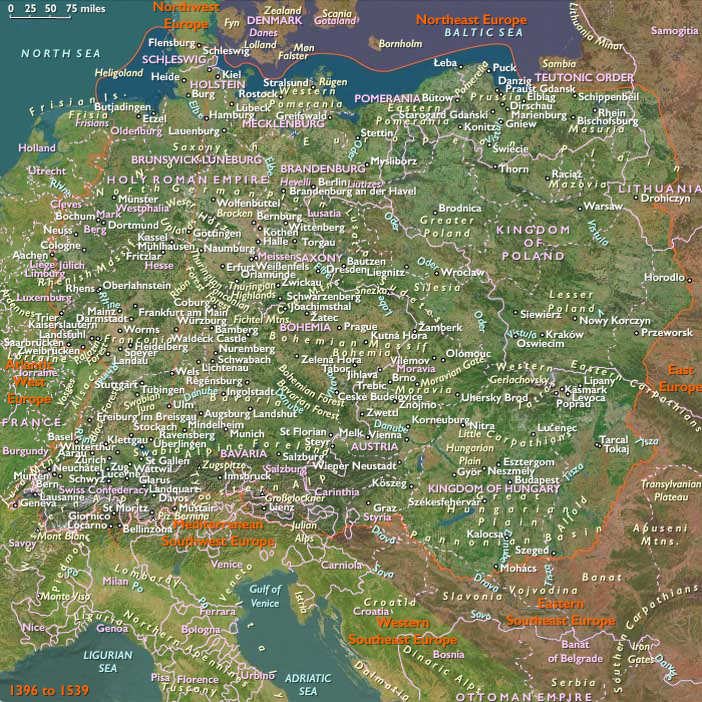
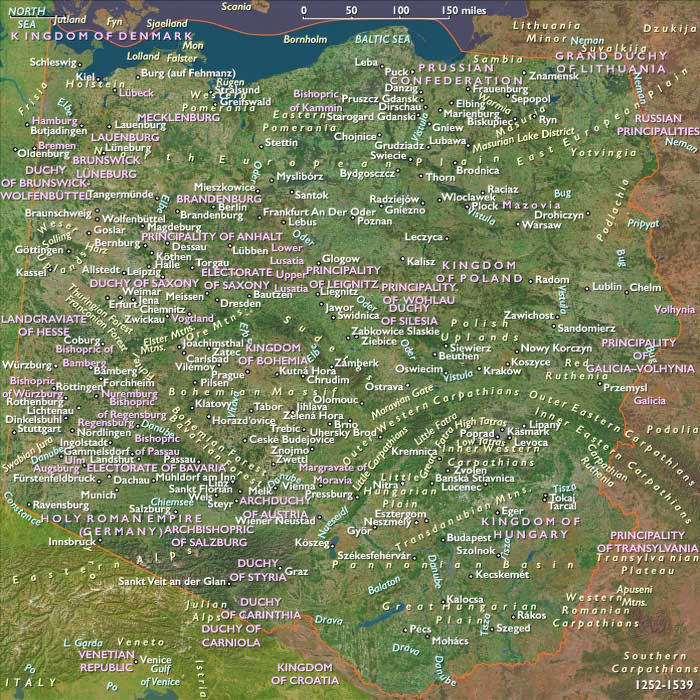
The forces of Poland-Lithuania, as the union of Poland and Lithuania begins to be called, led by Jogaila, break the power of the Teutonic Knights on July 15, 1410, at the Battle of Tannenberg, sometimes called the Battle of Grunwald/Grunfelde (the conflict’s location lies between the two East Prussian villages of Grunwald and Tannenberg/Stebark), thereby checking the Knights' eastward expansion along the Baltic.
The order’s grand master and the majority of its commanders are killed during the ten-hour battle.
The defeat of the Teutonic Knights is resounding.
About eight thousand of the Order’s soldiers have been killed and an additional fourteen thousand taken captive.
According to Teutonic payroll records, only fourteen hundred and twenty-seven men reported back to Marienburg to claim their pay.
Of twelve hundred men sent from Danzig, only three hundred returned.
According to different sources, some two hundred or four hundred brothers of the Order were killed, including much of the Teutonic leadership—Grand Master Ulrich von Jungingen, Grand Marshal Friedrich von Wallenrode, Grand Komtur Kuno von Lichtenstein, Grand Treasurer Thomas von Merheim, Marshal of Supply Forces Albrecht von Schwartzburg, and ten of the komturs.
Markward von Salzbach, Komtur of Brandenburg (Ushakovo), and Heinrich Schaumburg, voigt of Sambia, are executed by order of Vytautas after the battle.
The bodies of von Jungingen and other high-ranking officials are transported to Marienburg Castle for burial on July 10.
The bodies of lower-ranking Teutonic officials and twelve Polish knights are buried at the church in Tannenberg.
The rest of the dead are buried in several mass graves.
The highest-ranking Teutonic official to escape the battle is Werner von Tettinger, Komtur of Elbing (Elbląg).
Polish and Lithuanian forces take several thousand captives.
Among these are Dukes Konrad VII of Oels (Oleśnica) and Casimir V of Pomerania.
Most of the commoners and mercenaries are released shortly after the battle on condition that they report to Kraków on November 11, 1410.
Only those who are expected to pay ransom are kept.
Considerable ransomsare recorded; for example, the mercenary Holbracht von Loym had to pay sixty times the number of one hundred and fifty Prague groschen, amounting to more than thirty kilograms of silver.
Locations
People
Groups
- Teutonic Knights of Prussia, or Monastic state of the Teutonic Knights (House of the Hospitalers of Saint Mary of the Teutons in Jerusalem)
- Moldavia, Principality of
- Poland of the Jagiellonians, Kingdom of
- Lithuania, Grand Duchy of
Topics
- Ostsiedlung (German: Settlement in the East), a.k.a. German eastward expansion
- Polish–Lithuanian–Teutonic War
- Grunwald, Battle of
Commodoties
Subjects
Regions
Subregions
Years: 1410 - 1410
July
Locations
People
Groups
- Teutonic Knights of Prussia, or Monastic state of the Teutonic Knights (House of the Hospitalers of Saint Mary of the Teutons in Jerusalem)
- Moldavia, Principality of
- Poland of the Jagiellonians, Kingdom of
- Lithuania, Grand Duchy of
Topics
- Ostsiedlung (German: Settlement in the East), a.k.a. German eastward expansion
- Polish–Lithuanian–Teutonic War
- Grunwald, Battle of
Commodoties
Subjects
Regions
Subregions