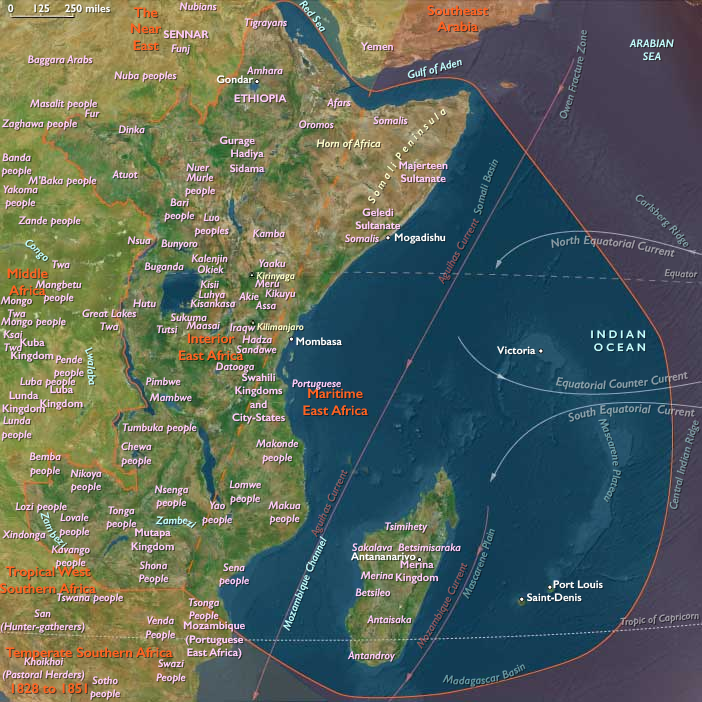
The Fur clans of Darfur, renowned as …
Years: 1717 - 1717
The Fur clans of Darfur, renowned as cavalrymen, frequently ally with or oppose their kin, the Kanuri of Borno, in modern Nigeria.
After a period of disorder in the sixteenth century, during which the region had been briefly subject to Bornu, the leader of the Keira clan, Sulayman Solong (1596-1637), had supplanted a rival clan and become Darfur's first sultan.
Sulayman Solong had decreed Islam to be the sultanate's official religion.
However, large-scale religious conversions had not occurred until the reign of Ahmad Bakr (1682-1722), who has imported teachers, built mosques, and compelled his subjects to become Muslims.
Locations
Groups
Commodoties
Subjects
Regions
Subregions
Related Events
Filter results
Showing 10 events out of 28289 total
The Silent Sejm (also Dumb Sejm and, literally, Mute Sejm), the name given to the session of the Sejm (parliament) of the Polish-Lithuanian Commonwealth of February 1, 1717, marks the beginning of the Russian Empire's increasing influence and control over the Commonwealth.
To prevent the use of liberum veto from disrupting Sejm proceedings, the session is turned into a confederated sejm. (It is also a pacification sejm).
Threatened by a strong Russian army, with Russian soldiers "guarding" the proceedings, the Silent Sejm is known as such because only the speaker (marshal of the Sejm) Stanisław Ledóchowski (podkomorzy krzemienicki), and a few selected other deputies are allowed a voice, outlining the terms of the settlement.
The terms themselves are significantly designed by Peter the Great.
The Sejm lasts for one day only, or more precisely, six hours.
The Silent Sejm marks the end of Augustus II's attempts to create an absolute monarchy in Poland; he will subsequently focus his efforts on securing the succession of his son to the Polish throne.
While some beneficial reforms are passed (such as the establishment of standing taxes for the military), the Sejm is regarded negatively by modern historians.
The reduction in the size of the army and the establishment of Russia's position as the settlement's guarantor reinforces Commonwealth military inferiority compared to its neighbors, and unofficially, puts it in the position of a Russian protectorate.
The Russian tsar, as the guarantor, now has a convenient excuse to intervene in Polish politics at will.
With a reduced army, removal of Saxon troops and the right to form confederations, the nobility and the king have less power to fight one another—or, not coincidentally, to resist outside forces.
Russian troops will remain in the Commonwealth for two years, supporting opposition to Augustus, and Russia will soon reach an agreement with other powers to put an end to further attempts at the reform and strengthening of the Commonwealth.
Thus, the Silent Sejm is regarded as one of the first precedents for the Russian Empire dictating Polish internal policy, and a precursor to the partitions of Poland, which will erase the Commonwealth from world maps by 1795.
Johann Sebastian Bach, Court Organist and Concertmaster to the main Court of William Ernest, Duke of Saxe-Weimar, gains some notoriety outside of the immediate circles where he lives and works (namely the areas that comprise the modern state of Thuringia) in 1717 when the diplomat, musician, music theoretician, and Cantor (church) of the old St. Mary's Cathedral, Hamburg (which will be dismantled in 1805), Johann Mattheson publishes his Das Beschützte Orchestre, oder desselben Zweyte Eröffnung: Worinn Nicht nur einem würcklichen galant-homme ... sondern auch manchem Musico selbst die alleraufrichtigste und deutlichste Vorstellung musicalischer Wissenschaften ... ertheilet ... .
In Part I, Chapter V, p. 222 of this treatise, Mattheson states "Ich habe von dem berūhmten Organisten zu Weimar/hrn. Joh. Sebastian Bach/Sachen gesehen..." ("I have of the organist to Weimar/Mr. Joh. Sebastian stream/things seen ...").
In the same work, he also catalogues all the famous organists of the current and former ages.
Thus, for the first time, the name of Johann Sebastian Bach appears in print.
In autumn of this year, Bach is invited to a keyboard instrument contest to take place in the capital city of the Electorate of Saxony, Dresden, between himself and the French Royal Court Organist and Keyboardist Louis Marchand, who is at this time towards the end of a long concert tour of the Holy Roman Empire.
When Bach arrives, however, he learns that his rival had left the night before, thus aborting the contest and by default acknowledging his inferiority to Bach's skills.
Pamheiba of Kangleipak makes Hinduism the official religion later during his reign and converts nearly all the Meitei people to Hinduism.
Born in Manipur to Pitambar Charairongba on December 23, 1690, he had been crowned Meidingu ("king") on Wednesday, the 23rd of thawan, 1631 Saka Era (August 28, 1709).
Hindu missionaries from Sylhet in Bengal had during the early eighteenth century arrived in Manipur to spread Gaudiya Vaishnavism.
They are led by Shantidas Goswami and his associate Guru Gopal Das, who had succeeded in converting the King from the old Meitei religion to Vaishnavism in 1710.
Relations between France and Great Britain have improved following the death of Louis XIV and Queen Anne.
George I and the new French Regent, Philippe II, Duke of Orléans, are cousins and each faced threats to their regime.
Orléans is concerned that his domestic enemies, in particular the Duke of Maine, will combine with Spain to overthrow him, while George I wishes to persuade the French to withhold support for any further Jacobite risings.
According to the Duc de Saint-Simon, who opposes the Alliance, the British Ambassador to Paris, the Earl of Stair, had argued that the short-term advantage to both regimes of an alliance outweighed their traditional differences.
Orléans agrees, as does his secretary Guillaume Dubois, the future Cardinal, who (together with James Stanhope, 1st Earl Stanhope, the English Secretary of State), is generally regarded as the principal author of the Triple Alliance.
Saint-Simon, who loathes Dubois, argues that the Bourbon Kingdoms of France and Spain should be perpetual allies, but this takes no account of present realities.
In an attempt to maintain the agreement of the 1713 Treaty of Utrecht, the Netherlands, Britain and France, concerned about Spain becoming a superpower in Europe, form the Triple Alilance on January 4, 1717 against Spain to secure the succession of Hanover to the British Throne and the House of Orleans to the French Throne, should Louis XV die.
As a result, militarization takes place, causing great havoc to civilians.
This enrages Spain and other states, leading to brinkmanship.
Britain, in particular, has become very concerned by Spanish ambitions in the Mediterranean Sea and Russian expansion in the Baltic and dispatches fleets to both as a preventative measure.
The French navy, badly weakened from the recent war, cannot offer much support.
Later in the year, to strengthen the Treaty of Utrecht, Britain, France and Austria contemplate ceding Sicily to the Holy Roman Emperor Charles VI.
This arrangement displeases Spain, who wants to recover the island.

The Casa de Contratación had fallen into bureaucratic gridlock by the late seventeenth century, and the Spanish empire as a whole was failing, due primarily to Spain's inability to finance both war on the Continent and a global empire.
More often than not, the riches transported from Manila and Acapulco to Spain are officially signed over to Spain's creditors before the Manila galleon made port.
In the eighteenth century, the new Bourbon rulers reduce the power of Seville and the Casa de Contratacion.
They move the Casa in 1717 from Seville to ...
...Cádiz, diminishing Seville's importance in international trade.
The private bank set up by John Law in 1716 has developed the use of paper money.
Law in August 1717 conceives a joint stock trading company, the Compagnie d'Occident (Company of the West,) a grandiose project meant to generate private prosperity and state income in France through colonial and commercial exploitation of French Louisiana.
Law is named the Chief Director of this new company, which is granted a trade monopoly of the West Indies and North America by the French government.
Shares in what will become known as the Mississippi Scheme initially sell for five hundred livres.
The Yamasee as a people have always been ethnically mixed, and in the aftermath of the Yamasee War they split apart.
About a third of the survivors had chosen to settle among the Lower Creek, eventually becoming part of the emerging Creek confederacy.
Most of the rest, joined by Apalachicola refugees, had moved to the vicinity of St. Augustine in the summer of 1715.
Despite several attempts to make peace, by both South Carolinians and Yamasee individuals, conflict between the two will continue for decades.
The Yamasee of Spanish Florida will in time be weakened by disease and other factors, and the survivors will become part of the Seminoles.
St. Denis had returned to San Juan Bautista and married Manuela in early 1716.
He travels in the years 1716-1717 to East Texas to participate in the founding of six missions and a presidio.
He returns in April 1717 to San Juan Bautista, but with the death of Louis XIV and the conclusion of the War of Spanish Succession, French-Spanish cooperation has ended.
St. Denis is then sent to Mexico City for a second time but escapes before being hauled to Spain as a prisoner.
Bienville is restored to the governorship in 1717 under the Mississippi Scheme.