
Liberal hopes for German unification had not …
Years: 1852 - 1863
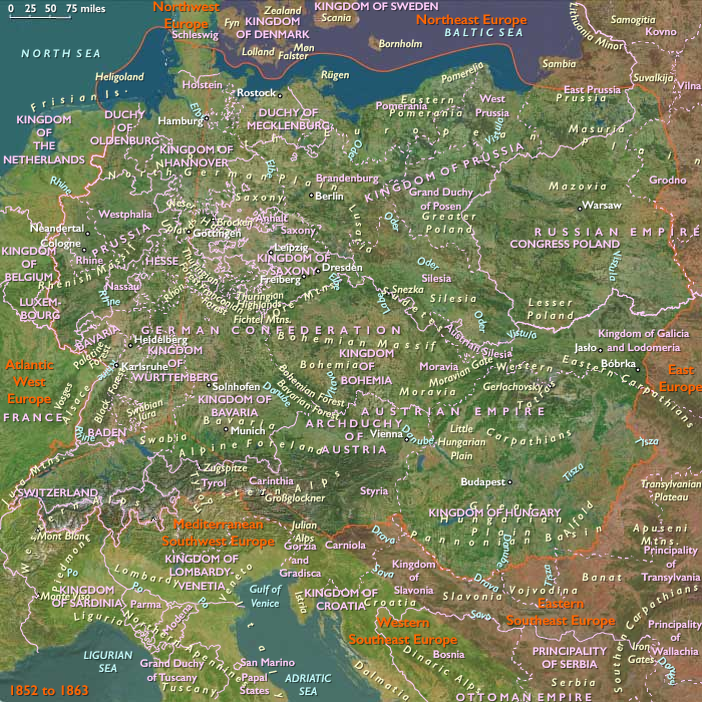
Liberal hopes for German unification had not been met during the politically turbulent 1848-49 period.
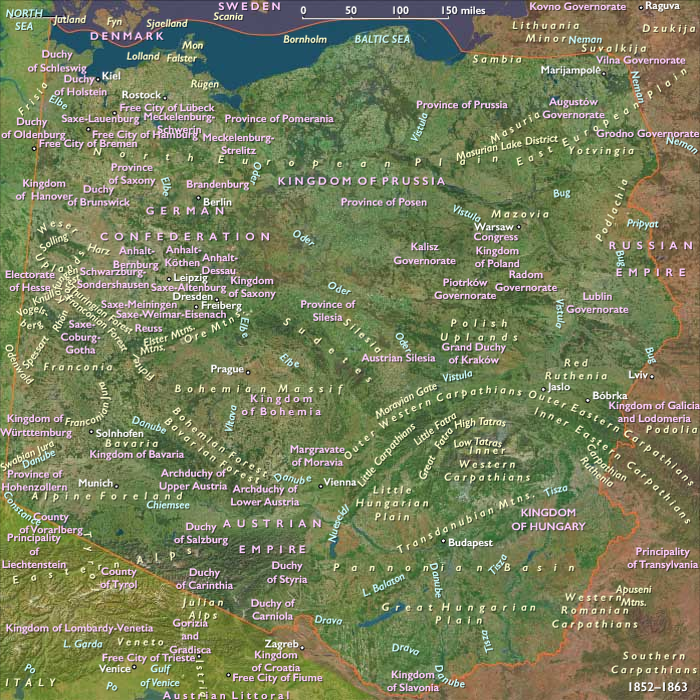
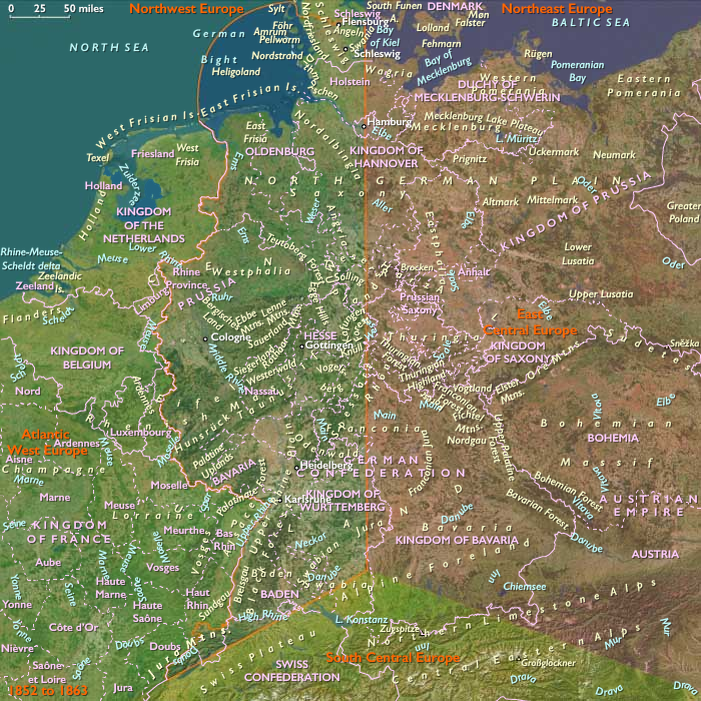
A Prussian plan for a smaller union had been dropped in late 1850 after Austria threatened Prussia with war.
Despite this setback, desire for some kind of German unity, either with or without Austria, grows during the 1850s and 1860s.
It is no longer a notion cherished by a few, but has proponents in all social classes.
An indication of this wider range of support is the change of mind about German nationalism experienced by an obscure Prussian diplomat, Otto von Bismarck.
He had been an adamant opponent of German nationalism in the late 1840s.
During the 1850s, however, Bismarck concludes that Prussia will have to harness German nationalism for its own purposes if it is to thrive.
He believes too that Prussia's well-being depends on wresting primacy in Germany from its traditional enemy, Austria.
A Prussian plan for a smaller union had been dropped in late 1850 after Austria threatened Prussia with war.
Despite this setback, desire for some kind of German unity, either with or without Austria, grows during the 1850s and 1860s.
It is no longer a notion cherished by a few, but has proponents in all social classes.
An indication of this wider range of support is the change of mind about German nationalism experienced by an obscure Prussian diplomat, Otto von Bismarck.
He had been an adamant opponent of German nationalism in the late 1840s.
During the 1850s, however, Bismarck concludes that Prussia will have to harness German nationalism for its own purposes if it is to thrive.
He believes too that Prussia's well-being depends on wresting primacy in Germany from its traditional enemy, Austria.
People
Groups
Topics
Subjects
Regions
Subregions
Related Events
Showing 10 events out of 16184 total
Years: 1852 - 1863
People
Groups
Topics
Subjects
Regions
Subregions