
The landowners among the Spanish colonists had …
Years: 1492 - 1503
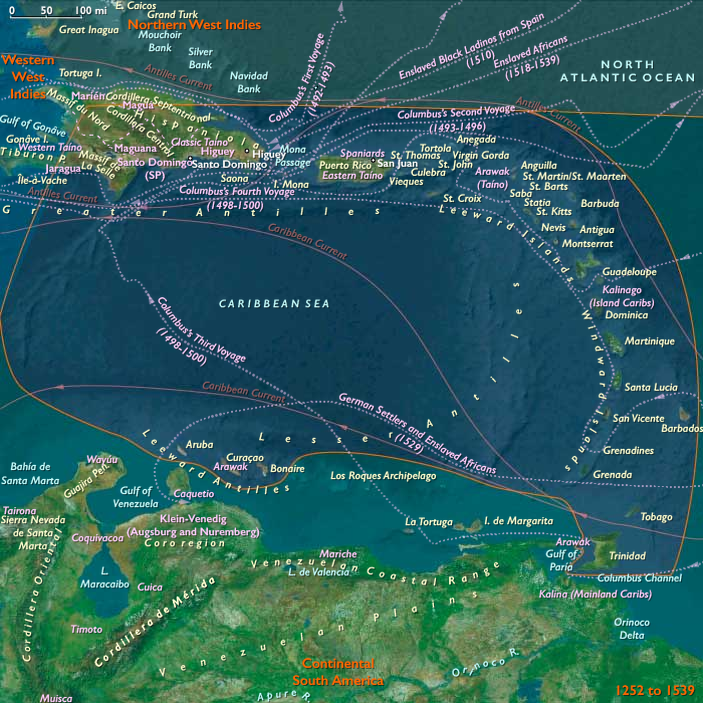
The landowners among the Spanish colonists had successfully conspired against Columbus as early as the 1490s.
His successor, Francisco de Bobadilla, is appointed chief justice and royal commissioner by the Spanish crown in 1499.
Bobadilla sends Columbus back to Spain in irons; Queen Isabella soon orders him released.
Bobadilla, who had proved an inept administrator, is replaced in 1503 by the more efficient Nicolas de Ovando, who assumes the titles of governor and supreme justice.
Because of his success in initiating reforms desired by the crown—the encomienda system among them—Ovando receives the title of Founder of Spain's Empire in the Indies.
Locations
People
Groups
- Guanahatabey
- Taíno
- Aragon, Crown of
- Castile, Crown of
- Santo Domingo, Captaincy General of
- Spain, Habsburg Kingdom of
- Spaniards (Latins)
Topics
Commodoties
Subjects
Regions

Subregions
Related Events
Filter results
Showing 10 events out of 21 total
Mediterranean Southwest Europe (1492–1503 CE): Cultural Renaissance, Religious and Political Conflict, and Artistic Flourishing
The era 1492–1503 CE in Mediterranean Southwest Europe is characterized by remarkable cultural advancements, artistic and architectural achievements, intense religious and political conflicts, and important scholarly innovations.
Artistic and Architectural Achievements
Fra Giovanni Giocondo, a skilled engineer and architect, plays a significant role during this period. His earlier engagements include Verona's Loggia del Consiglio and fortifications in Treviso. Giocondo significantly impacts Venice with his successful redirection of the Brenta River, enhancing the city's safety and economic stability. His scholarly contributions include detailed studies of Roman antiquities, influencing Renaissance architectural thought profoundly.
Architecturally, the exuberant Spanish Gothic, known as the Isabelline style, emerges prominently, exemplified by Valladolid’s Colegio di San Gregorio, characterized by elaborate decoration and intricate designs influenced by Moorish Mudejar artistry.
Religious and Political Conflicts
The Italian Wars (1494–1559) significantly reshape the political landscape. Initiated by dynastic claims, particularly those of Charles VIII of France and Louis XII, these conflicts expand into broader European power struggles involving Spain, France, the Holy Roman Empire, and the Papal States. These wars reflect shifting alliances and continual betrayals, underscoring the volatility of political power in the region.
Simultaneously, the completion of the Reconquista in Spain with the fall of Granada in 1492 marks a critical religious and political milestone. This era sees increased religious tensions, reflected in the completion and compilation of the Extravagantes communes, further solidifying canon law within Christendom.
Literary and Scholarly Innovations
The printing of the first complete Hebrew Bible at Soncino in 1488 by Joshua Solomon ben Israel Nathan Soncino represents a significant scholarly achievement, symbolizing advancements in printing technology and religious scholarship.
Matteo Maria Boiardo's epic poem, Orlando Innamorato, continues to influence literary circles significantly, merging chivalric romance with classical humanist traditions, setting a foundation for later Renaissance literature.
Economic and Technological Advances
Economic growth, particularly in Genoa, is illustrated by the emergence of modern lottery systems. Initially a political mechanism, the Genoese lottery evolves into a widespread financial and gambling institution across Europe, impacting both economic and cultural practices.
Legacy of the Era
The era 1492–1503 CE in Mediterranean Southwest Europe encapsulates an essential transition from medieval structures to Renaissance innovations, significantly shaped by cultural, artistic, religious, and political developments. This dynamic period lays crucial foundations for Europe's intellectual, cultural, and political landscapes well into the sixteenth century.v
Mediterranean Southwest Europe (1504–1515 CE): Religious Persecution, Theatrical Innovations, and Cultural Shifts
The era 1504–1515 CE in Mediterranean Southwest Europe sees significant religious persecution, particularly affecting Jewish communities, alongside notable developments in theatrical arts and stagecraft, reflecting broader cultural shifts.
Religious Persecution and Expulsions
The beginning of the Spanish expulsions of the Jews in 1504 severely affects Jewish communities in southern Italy and Sicily. Major centers of Jewish culture, including Palermo, Naples, Amalfi, Bari, Brindisi, and Taranto, previously thriving during the Middle Ages, are decimated under Spanish rule. This persecution represents a substantial demographic and cultural loss for the region, effectively ending centuries of vibrant Jewish presence.
Innovations in Theater and Stagecraft
Italian humanists' exploration of classical Greek and Roman texts leads, around 1508, to major innovations in theatrical staging and design. Descriptions of ancient illusionistic techniques inspire the use of unified perspective settings and elaborate stage machinery. Innovations include the revival of the classical periaktoi, three-sided revolving prisms used to swiftly change scenery, along with the introduction of a proscenium frame and front curtain, significantly enhancing audience engagement and theatrical realism.
Lighting also becomes essential to theatrical productions, owing to the predominantly indoor settings of Renaissance theaters. The use of candles and oil lamps becomes integral, influencing stage direction, atmosphere, and dramatic effects.
Cultural Shifts and Intellectual Developments
The period further marks a shift towards more secular and humanist intellectual pursuits across Mediterranean Southwest Europe, influenced significantly by rediscovered classical texts. This intellectual climate encourages advancements in both scholarly work and creative artistic expression, laying the groundwork for ongoing developments throughout the sixteenth century.
Legacy of the Era
The era 1504–1515 CE highlights a period of transition characterized by stark contrasts—intense religious persecution on one hand and vibrant cultural and artistic innovation on the other. These developments reflect the complex interplay of continuity and change shaping the cultural and intellectual identity of Mediterranean Southwest Europe.
Mediterranean Southwest Europe (1516–1527 CE): Cultural Crisis, Mannerism, and Jewish Flourishing
The era 1516–1527 CE in Mediterranean Southwest Europe witnesses a significant cultural shift marked by the emergence of Mannerism, a crisis of artistic confidence, and the thriving of Jewish communities in central Italy.
Artistic Crisis and the Rise of Mannerism
By the early 16th century, young artists face a profound crisis, perceiving that Renaissance art had already reached a pinnacle of technical perfection. With anatomical precision, refined expressions of emotion, and mastery of perspective seemingly exhausted by masters such as Michelangelo, Raphael, and Andrea del Sarto, artists begin seeking new forms of expression.
Mannerism emerges in response to this artistic saturation. Characterized by exaggerated proportions, heightened emotionality, and intentional complexity, Mannerist artworks diverge from classical ideals. The term derives from the Italian maniera, denoting a sophisticated or artificial style, and is embraced by Giorgio Vasari, who later describes this phase as la maniera moderna ("the modern style").
Flourishing Jewish Communities
Despite continued persecutions elsewhere, Jewish life flourishes in central Italy during this period, particularly in Mantua, which boasts Italy’s second-largest Jewish community after Venice. Other vibrant centers include Urbino, Ferrara, Florence, Spoleto, Siena, and Ancona. These communities become significant cultural and intellectual hubs, providing sanctuary and fostering scholarship, religious study, and artistic contributions.
Intellectual and Cultural Legacy
This period symbolizes a critical turning point, reflecting a broader European shift from classical Renaissance ideals to more complex and self-conscious cultural expressions. The contrast between artistic anxiety and cultural flourishing within specific communities encapsulates the multifaceted character of this transformative era, setting the stage for further intellectual and artistic evolution in Mediterranean Southwest Europe.
Mediterranean Southwest Europe (1528–1539 CE): Michelangelo’s Mannerism and the Aftermath of War in Italy
The era 1528–1539 CE in Mediterranean Southwest Europe witnesses profound artistic innovations, political upheavals, and cultural transformations. Dominated by the enduring influence of Michelangelo Buonarroti, the period also reflects deep scars from the devastating War of the League of Cognac, notably the traumatic Sack of Rome and the end of the Florentine Republic, reshaping both the political landscape and artistic expression.
Michelangelo and the Rise of Mannerism
From an early age, Michelangelo develops an innovative and intensely personal style, widely admired and relentlessly imitated by his contemporaries. His defining quality, known as terribilità—an awe-inspiring grandeur infused with emotional intensity—sets a new artistic standard that other artists continually strive to emulate.
Michelangelo’s celebrated masterpieces, especially the frescoes on the Sistine Chapel ceiling, profoundly influence aspiring artists. Figures such as the monumental Ignudi and the powerful depiction of the Libyan Sibyl establish benchmarks of anatomical precision and expressive dynamism, becoming focal points for artistic study and emulation.
His architectural innovations, particularly the bold vestibule of Florence’s Laurentian Library, combine dramatic spatial tension with unprecedented formal inventiveness, significantly influencing subsequent architects and artists. Similarly, his sculptural forms adorning the Medici tombs in Florence’s Sagrestia Nuova epitomize a dynamic emotional intensity that marks a departure from earlier Renaissance classicism.
Michelangelo’s later work, prominently exemplified by The Last Judgment (begun in 1536), signals the emergence of Mannerism—an artistic movement characterized by elongated proportions, exaggerated emotions, and complex, often unsettling compositions. Michelangelo’s highly personal style thus shapes the direction of European art, even as it prompts eager young artists to copy—and sometimes even to steal—his drawings, actions that Michelangelo himself finds deeply irritating.
The Sack of Rome and Political Turmoil
Simultaneously, the War of the League of Cognac (1526–1530) leaves a deep imprint on Mediterranean Southwest Europe. Triggered by Pope Clement VII’s effort to curb the influence of Holy Roman Emperor Charles V in Italy, the conflict culminates dramatically with the infamous Sack of Rome in 1527. Imperial troops—many unpaid and undisciplined—plunder Rome, inflicting devastating destruction, massacres, and widespread suffering, and effectively ending Rome's Renaissance golden age.
The shockwaves reverberate beyond Rome. The Florentine Republic, allied with the League against Charles V, collapses in the war’s aftermath, as imperial and papal forces besiege and ultimately recapture the city in 1530. In 1532, Pope Clement VII transforms Florence into a hereditary monarchy under the Medici, marking a decisive end to its republican tradition and significantly altering the political and cultural trajectory of the region.
Legacy of the Era
The period 1528–1539 CE thus emerges as a critical turning point in Mediterranean Southwest Europe. Michelangelo’s profound influence establishes Mannerism as a dominant artistic language, shaping cultural expression for decades. Concurrently, the destructive War of the League of Cognac, the catastrophic Sack of Rome, and the loss of the Florentine Republic fundamentally reshape Italy’s political landscape, embedding deep social and cultural shifts that would profoundly affect future generations.
Mediterranean Southwest Europe (1552–1563 CE): Cultural Flourishing and Religious Transformation
The era 1552–1563 CE in Mediterranean Southwest Europe sees notable developments in artistic, cultural, and religious spheres. While Italy's commedia dell'arte emerges as a defining theatrical innovation, the Iberian Peninsula experiences significant social and religious transformations, and key Mediterranean islands witness the consolidation of Spanish rule and continued integration into broader European trends.
Emergence of Commedia dell'Arte in Italy
The innovative theatrical tradition of commedia dell'arte, meaning "professional comedy," flourishes significantly after 1550 among actors outside courtly and academic traditions. Although Ruzzante (Angelo Beolco; 1502–1542) is regarded as an influential precursor, the fully improvisational nature of commedia dell'arte distinguishes it from his partially scripted performances.
Unlike the refined commedia erudita, commedia dell'arte features spontaneous dialogue (commedia all'improviso) performed around a loosely defined scenario (a soggetto). Stock characters like the boastful captain, lecherous old men, passionate lovers, spirited young women, and humorous servants (zanni, notably Arlecchino or Harlequin) captivate audiences through lively wit, energetic performances, and comedic routines called lazzi. Actors rigorously train in mime, acrobatics, dialects, and classical literature, emphasizing ensemble dynamics and improvisational skill.
Religious and Social Transformations in Iberia
The Iberian Peninsula witnesses important religious and cultural developments amid the ongoing Counter-Reformation. The Council of Trent, nearing completion in this era, deeply influences religious practice, leading to intensified measures against perceived heresies and heightened scrutiny of converted populations. This religious climate reinforces social conservatism, significantly shaping Iberian culture and society.
In 1559, King Philip II of Spain reinforces the Spanish Inquisition’s authority, culminating in increased persecution of conversos, moriscos, and other marginalized groups. Cultural expression and intellectual activities become highly regulated, marking a significant shift toward conservative orthodoxy.
Artistic Developments and Influences
This period witnesses significant artistic contributions that further shape the Mannerist style across Italy and Iberia. The Spanish artist El Greco (Domenikos Theotokopoulos) begins his early training, later revolutionizing Spanish painting with his elongated figures and dramatic use of color and light. In Italy, artists like Giorgio Vasari continue to define and document Mannerist ideals, contributing profoundly to European artistic heritage.
Mediterranean Islands under Spanish Rule
In the broader Mediterranean region, Sicily, Sardinia, and the Balearic Islands experience strengthened integration into the Spanish empire, further embedding Spanish administrative practices, language, and cultural influences. The University of Messina, established earlier, gains prominence, serving as a center for learning and the dissemination of Spanish and Catholic influence throughout Sicily.
Legacy of the Era
The period 1552–1563 CE profoundly shapes the cultural, social, and religious landscape of Mediterranean Southwest Europe. The rise of commedia dell'arte significantly influences European theatre, while religious conservatism in Iberia defines cultural and social structures that persist for generations. Concurrently, artistic innovation and strengthened Spanish governance across the Mediterranean islands establish enduring cultural and administrative legacies.
Mediterranean Southwest Europe (1564–1575 CE): Cultural Innovations and Artistic Transformation
The period 1564–1575 CE in Mediterranean Southwest Europe witnesses notable innovations and artistic transformations, highlighted by developments in music, theater, continued shifts in religious and cultural spheres across Italy, the Iberian Peninsula, key Mediterranean islands, and significant advances in Malta under the Knights Hospitaller.
Rise and Influence of the Castrati
The emergence of castrati—male singers castrated before puberty to preserve their soprano or contralto voice ranges—becomes a prominent, though controversial, phenomenon in Italy. Initially referenced vaguely, by this era castrati gain substantial prominence. Their distinctive vocal power arises from the combination of an unbroken voice and mature lungs and chest capacity, enabling extraordinary musical performances. Notably, Cardinal Ippolito II d'Este, famed builder of Villa d'Este at Tivoli, had introduced castrati to other Italian courts, reflecting their growing desirability and status in elite musical circles. By 1574, castrati have spread as far as the ducal chapel at Munich, significantly influencing European music traditions.
Artistic Developments and Mannerism
Artistic trends in this period continue to embrace and evolve Mannerist aesthetics, characterized by elongated figures, dynamic poses, and intensified emotional expressions. Prominent figures, such as El Greco (Domenikos Theotokopoulos), further develop this style, influencing painting significantly across Spain and Italy. In Florence and Rome, artistic circles actively debate classical versus Mannerist ideals, profoundly shaping European artistic tastes.
Cultural and Social Dynamics in Iberia
In Iberia, cultural life remains deeply shaped by the Counter-Reformation and the continued strengthening of conservative religious policies under King Philip II of Spain. The Spanish Inquisition remains a powerful force, exerting strict control over intellectual and cultural expressions. Despite this restrictive atmosphere, significant literary and artistic creativity continues, often navigating carefully within established orthodox boundaries.
Mediterranean Integration and Governance
Throughout this era, the Mediterranean islands—including Sicily, Sardinia, and the Balearic Islands—continue their integration under Spanish rule. These territories increasingly reflect Spanish cultural and administrative practices, reinforced through centralized governance and consistent enforcement of Catholic orthodoxy.
Malta and the Knights Hospitaller
Significant developments occur in Malta, which has become the strategic home of the Knights Hospitaller. After being granted the island by Emperor Charles V in 1530, the Knights establish formidable fortifications, hospitals, and infrastructure. The building and fortification of Valletta, named after Grand Master Jean de la Valette, begin in 1566 under the supervision of military engineer Francesco Laparelli and continue under Girolamo Cassar, who completes the city in 1571. Valletta quickly becomes the home port of one of the Mediterranean’s most powerful navies and is known as Superbissima, "Most Proud." Its hospitals, particularly the renowned Sacra Infermeria, become advanced centers for medical education and care, housing Schools of Anatomy, Surgery, and Pharmacy. The city emerges as a vibrant hub of art and culture, notably with the completion of the Conventual Church of St. John in 1577, later renowned for works by Caravaggio and other masters.
Legacy of the Era
The period 1564–1575 CE stands out for its profound cultural innovations, particularly through the controversial yet influential rise of the castrati, contributions to the ongoing artistic evolution of Mannerism, and remarkable advancements in Malta under the Hospitaller Order. Simultaneously, Iberia’s complex cultural climate and the deeper integration of Mediterranean islands into the Spanish empire set lasting social and cultural foundations for the region
Mediterranean Southwest Europe (1576–1587 CE): Cultural Flourishing and Trans-Mediterranean Exchanges
The era 1576–1587 CE in Mediterranean Southwest Europe marks a vibrant cultural flourishing, with significant advancements and exchanges across Italy, the Iberian Peninsula, and the strategic island of Malta. This period is highlighted by the dynamic expansion of the commedia dell'arte, the introduction of coffee to European society, and continued infrastructural and cultural growth in Malta under the Knights Hospitaller.
Commedia dell'Arte and Theatrical Innovation
This era sees major Italian commedia dell'arte companies flourish, notably the Gelosi (the "Jealous"), Confidenti (the "Confident"), Uniti (the "United"), Desiosi (the "Desired"), Accesi (the "Inspired"), and Fideli (the "Faithful"). The Compagnia dei Gelosi, formed around 1568 under the leadership of scenario writer Flaminio Scala, gains immense popularity throughout Italy and beyond. Renowned for improvisational performances, quick wit, and social commentary, these troupes significantly influence European theatre. Another leading troupe, the Compagnia degli Uniti, emerges prominently under the guidance of Drusiano Martinelli and his wife, Angelica. Their performances are celebrated for their sophisticated wit and cultural refinement, and notable actor Silvio Fiorillo gains recognition for his innovative portrayals of stock characters like the boastful Capitano Mattamoros and the quirky Pulcinella.
Introduction of Coffee to Europe
Coffee arrives in Europe for the first time during this era through the vibrant trade connections between Venice and the Ottoman Empire. Initially imported from North Africa, Egypt, and the Levant, coffee becomes a luxury beverage for Venice's elite. Venetian merchants capitalize on its exotic appeal, charging premium prices and helping to popularize the beverage across Europe, laying the foundations for the continent’s enduring coffee culture.
Continued Developments in Malta
Under the stewardship of the Knights Hospitaller, Malta continues its transformation into a fortified bastion and cultural hub. The newly established capital city, Valletta, completed in 1571, solidifies its reputation as Superbissima("Most Proud"). Valletta's formidable fortifications, designed initially by Francesco Laparelli and completed by Girolamo Cassar, secure the island against persistent Mediterranean threats. Concurrently, the island's Sacra Infermeria advances as a leading European medical facility, housing prominent schools of anatomy, surgery, and pharmacy. Malta becomes renowned not only for its defensive might but also as a center of Renaissance art and culture, particularly with the completion of the ornate Conventual Church of St. John in 1577, which soon houses masterpieces by artists such as Caravaggio.
Iberian Cultural Dynamics and Artistic Trends
In Iberia, cultural activities unfold amidst continuing strictures imposed by the Spanish Inquisition and the Counter-Reformation. Nevertheless, this era sees sustained literary and artistic output, carefully navigating the balance between orthodoxy and creative expression. The visual arts, especially influenced by the enduring Mannerist style, continue to flourish, reflecting the complex socio-political environment under the reign of King Philip II of Spain.
Integration of Mediterranean Islands
Spanish administrative and cultural practices deepen their roots across Mediterranean islands such as Sicily, Sardinia, and the Balearic Islands. These territories increasingly reflect Castilian norms, consolidating Spain's political and cultural hegemony in the region.
Legacy of the Era
The period 1576–1587 CE epitomizes a rich cultural and intellectual dynamism. From the transformative impact of the commedia dell'arte and the introduction of coffee into European life, to the fortified and culturally enriched landscape of Malta, these years represent a critical intersection of artistic, social, and political developments that significantly influence subsequent European cultural history.
Mediterranean Southwest Europe (1588–1599 CE): Conflicts, Cultural Innovation, and Maritime Influence
The era 1588–1599 CE in Mediterranean Southwest Europe is characterized by significant geopolitical tensions, cultural innovation, and maritime influence. The Iberian Peninsula sees notable conflicts, particularly involving Spain's naval ambitions, while Italy continues to be a vibrant hub of cultural and artistic developments. Concurrently, Malta, under the Knights Hospitaller, solidifies its role as a critical Mediterranean stronghold.
Iberian Geopolitical Tensions and Maritime Conflicts
This period begins dramatically with the Spanish Armada (1588), a fleet dispatched by King Philip II of Spain against England, which ends disastrously, severely impacting Spain’s maritime supremacy. Despite this setback, Spain remains an influential power, deeply involved in European politics and maintaining control over its Mediterranean territories, including Sicily, Sardinia, and the Balearic Islands. The failed Armada expedition reshapes naval strategies and alliances across Europe, prompting greater attention to maritime defenses throughout the Mediterranean region.
Cultural Flourishing and Literary Golden Age in Spain
In Spain, despite political and military setbacks, the cultural environment remains vibrant. This era sees the continued rise of the Spanish Golden Age, with significant literary contributions by prominent authors like Miguel de Cervantes, whose early literary works set the stage for his masterpiece, Don Quixote, in subsequent years. Spanish theater flourishes under playwrights such as Lope de Vega, who becomes known for his prolific output and innovations in dramatic form and character complexity, further enriching the Spanish cultural landscape.
Artistic and Scientific Advancements in Italy
In Italy, cultural innovation continues unabated, particularly in the arts and sciences. This era sees notable advancements in both visual arts and music, with developments influenced by the late Renaissance and early Baroque transitions. Artists like Caravaggio begin to rise in prominence with their innovative use of chiaroscuro and realistic portrayal of human figures. In music, Italian composers continue to refine vocal and instrumental forms, laying foundations that will soon blossom into the Baroque style.
The scientific community, inspired by Renaissance humanism, sees continued growth. The University of Padua remains a leading institution for scientific inquiry, notably in medicine and anatomy, attracting scholars from across Europe and reinforcing Italy’s central role in the European scientific community.
Malta’s Strategic Importance and Fortification Efforts
Malta under the Knights Hospitaller continues to strengthen its strategic importance in the Mediterranean. The fortified city of Valletta, completed earlier in 1571, now fully operational, becomes increasingly vital for maritime defense. The Knights significantly enhance the island’s military capabilities, constructing additional fortifications and watchtowers along the coastline. Malta’s reputation as a cultural and scientific center grows, particularly with the expansion of the Sacra Infermeria, renowned across Europe for its medical advancements and sophisticated healthcare.
Trans-Mediterranean Cultural and Commercial Exchanges
Venice maintains its role as a critical commercial and cultural hub, sustaining vibrant trade links with the Ottoman Empire and North Africa. This trade continues to introduce new goods and ideas into Europe, influencing tastes and habits, particularly through the spread of coffee and other exotic commodities. Such exchanges further entrench Venice’s position as a center for cultural fusion, diplomacy, and commerce in the Mediterranean.
Legacy of the Era
The period 1588–1599 CE encapsulates a dynamic era of political tensions, cultural vibrancy, and maritime strategy. Despite setbacks like the failure of the Spanish Armada, Iberia’s cultural influence grows, while Italy and Malta continue to innovate and solidify their significance within the broader European context. These developments profoundly influence the Mediterranean’s cultural and geopolitical landscape, setting the stage for the complexities of the seventeenth century.
Mediterranean Southwest Europe (1600–1611 CE): Sovereign Adjustments, Cultural Refinements, and Strategic Developments
The era 1600–1611 CE in Mediterranean Southwest Europe witnesses important adjustments in sovereignty, ongoing cultural refinements, and significant strategic developments across the region. The Iberian Peninsula sees crucial political developments regarding Andorra’s unique governance structure, Italy maintains its cultural and scientific advancements, and Malta continues to strengthen its maritime and defensive significance.
Andorra’s Sovereignty Formalized
Andorra’s distinct co-sovereignty arrangement, long shared between the Count of Foix and the Bishop of Urgell in Catalonia, undergoes formal clarification. Historically, the French claim to Andorra had passed to the kings of Navarre. In 1607, King Henry IV of France (formerly Henry of Navarre) formally recognizes and codifies this arrangement through an edict, establishing the French head of state and the Bishop of Urgell as co-princes. This unique political settlement solidifies Andorra's territorial and governance structure, laying the foundations for its enduring political stability and identity.
Continuing Literary and Cultural Achievements in Spain
Spain continues to experience the heights of its literary Golden Age, despite ongoing geopolitical pressures and challenges. The early 1600s mark the publication of Miguel de Cervantes’ iconic Don Quixote (first part published in 1605), a literary masterpiece that profoundly influences European literature and culture. Cervantes' work symbolizes Spain’s vibrant intellectual life, reflecting both humanist ideals and critical social commentary. At the same time, playwrights such as Lope de Vega remain prolific, further enriching Spanish drama and solidifying Spain's position as a cultural powerhouse in Europe.
Italian Artistic and Scientific Flourishing
In Italy, artistic innovations continue, characterized by further development of Baroque aesthetics. Artists such as Caravaggio continue to profoundly influence European art through dramatic chiaroscuro techniques and intensely realistic portrayals of human emotion and physicality. In music, Italian composers advance vocal and instrumental forms, enhancing the complexity and emotive power of the emerging Baroque style.
Scientifically, Italy maintains its leading role in Europe, with the University of Padua at the forefront of anatomical and medical studies. The era sees continued refinement and expansion of scientific inquiry, bolstering Italy’s academic prestige and drawing scholars from across the continent.
Malta’s Expanding Defensive Capabilities
Under the Knights Hospitaller, Malta further develops its strategic defensive infrastructure. Following the completion of the fortified city of Valletta in 1571, the Knights continue to reinforce the island’s military strength through the construction of coastal watchtowers and fortifications. These strategic enhancements ensure Malta remains a formidable Mediterranean stronghold, crucial for protecting European interests against Ottoman and North African threats. Additionally, Malta's Sacra Infermeria enhances its reputation across Europe, known for pioneering medical practices and superior healthcare services.
Venetian Trade and Cultural Exchange
Venice sustains its influential role as a Mediterranean commercial hub, continuing robust trade with the Ottoman Empire and North Africa. This commerce introduces Europeans to an expanding range of commodities, notably coffee, significantly shaping European tastes and habits. Venice’s position as a vital cultural crossroads remains secure, facilitating cultural fusion and diplomatic exchanges that enhance its strategic economic importance.
Legacy of the Era
The years 1600–1611 CE in Mediterranean Southwest Europe are marked by political consolidations, cultural brilliance, and strategic preparedness. Andorra's governance stabilization, Spain's literary and cultural zenith, Italy’s ongoing artistic and scientific excellence, Malta's fortification, and Venice’s thriving trade all combine to define a dynamic era, setting a complex yet vibrant stage for subsequent European historical developments.
Mediterranean Southwest Europe (1612–1623 CE): Artistic Flourishing, Religious Realignments, and Political Dynamics
The era 1612–1623 CE in Mediterranean Southwest Europe witnesses a vibrant interplay of artistic brilliance, religious developments, and shifting political landscapes. From Italy’s innovative artistic and scientific progress to Spain’s religious and literary introspection, and Malta’s continuing strategic fortifications, the region reflects broader European trends within its distinctive cultural fabric.
Italy: Pinnacle of Baroque Art and Scientific Inquiry
Italy remains the epicenter of European cultural life, with the Baroque style fully flourishing in painting, sculpture, and architecture. The period sees masterpieces by artists such as Gian Lorenzo Bernini, whose dynamic sculptures—such as Apollo and Daphne and the early work on David—showcase intense emotional expression and technical virtuosity. Artemisia Gentileschi, one of the few prominent female artists of the era, emerges with strikingly realistic and emotionally charged works such as Judith Slaying Holofernes (1614–1620), exemplifying both dramatic realism and a powerful feminist perspective.
Simultaneously, Italy remains central to European scientific inquiry, particularly astronomy and physics. Galileo Galilei publishes The Assayer in 1623, further promoting scientific methodology and observational astronomy, despite increasing opposition from religious authorities. The intellectual climate remains tense yet prolific, highlighting Italy’s dual role as a center of creative genius and scientific advancement.
Spain: Literary Brilliance and Religious Conservatism
Spain continues to experience its literary Golden Age, enriched by the continued influence of playwrights such as Lope de Vega, who produces numerous dramas capturing the intricacies of human nature and society. Luis de Góngora, one of Spain's greatest Baroque poets, publishes his complex and ornate works, influencing Spanish literature profoundly with a style known as Gongorism, characterized by elaborate metaphor and rich imagery.
Religiously, Spain intensifies its conservative stance, with the Spanish Inquisition maintaining strict orthodoxy, reflecting a broader European climate of religious conflict amid the Thirty Years' War. This heightened conservatism impacts intellectual and cultural expression, influencing themes of moral introspection and spiritual intensity in Spanish literature and art.
Malta: Continued Defensive Enhancement and Cultural Prestige
Malta, under the Knights Hospitaller, sustains its defensive fortification efforts begun in the previous century. The strategic importance of Malta escalates with the construction of additional coastal towers and fortifications, including the Wignacourt towers, enhancing its role as a key Mediterranean defense against Ottoman incursions. The Knights also expand their humanitarian efforts, reinforcing Malta’s cultural prestige through the renowned Sacra Infermeria, a cutting-edge medical facility known across Europe for its advanced healthcare practices.
Venice: Economic and Cultural Vibrancy
Venice remains an essential economic and cultural hub, balancing its trade relationships with the Ottoman Empire and broader European markets. This position enables Venice to continue importing exotic goods, influencing European tastes, fashion, and daily life. The exchange of goods like coffee, spices, and textiles enhances Venice’s cosmopolitan atmosphere, fostering an environment where diverse ideas and cultures intermingle.
Venetian art and music also flourish, with figures like Claudio Monteverdi pioneering developments in Baroque opera. Monteverdi's L'incoronazione di Poppea (The Coronation of Poppea) further revolutionizes the operatic form, reinforcing Venice’s reputation as a major European cultural center.
Political Dynamics and Diplomatic Maneuvering
The period is marked by intricate political and diplomatic maneuvering throughout the region. Spain’s involvement in European conflicts, particularly its entanglement in the Thirty Years’ War, strains its economic resources, affecting its political stability. Conversely, Italian states engage in intricate diplomatic negotiations and shifting alliances to navigate the turbulent political landscape shaped by broader European conflicts.
Legacy of the Era
The years 1612–1623 CE in Mediterranean Southwest Europe are defined by artistic innovation, religious conservatism, and strategic political maneuvering. Italy’s Baroque brilliance, Spain’s introspective literary and religious climate, Malta’s fortification and medical advancements, and Venice’s thriving trade and cultural milieu collectively portray a region deeply interconnected with broader European developments, setting a foundational stage for subsequent historical transformations.
Years: 1492 - 1503
Locations
People
Groups
- Guanahatabey
- Taíno
- Aragon, Crown of
- Castile, Crown of
- Santo Domingo, Captaincy General of
- Spain, Habsburg Kingdom of
- Spaniards (Latins)
Topics
Commodoties
Subjects
Regions
Subregions