
The new Greek rulers from Syria institute …
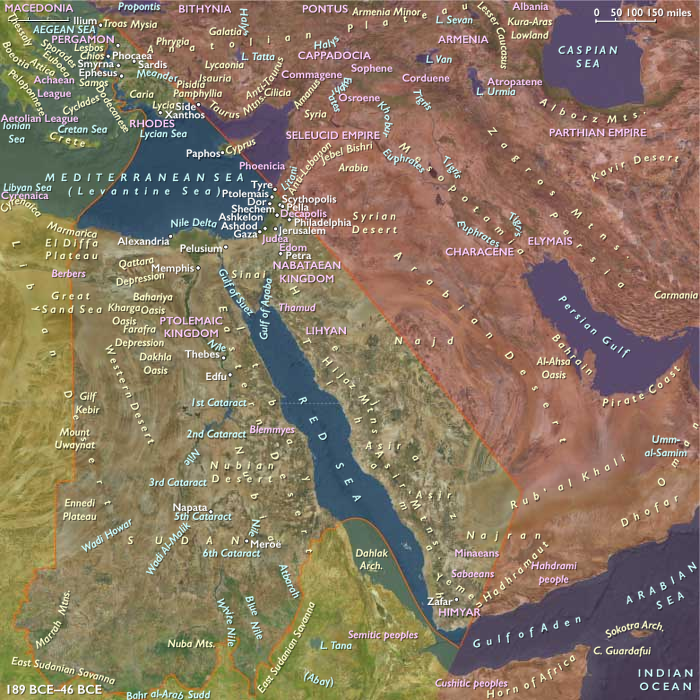
Years: 189BCE - 46BCE
The new Greek rulers from Syria institute an aggressive policy of Hellenization among their subject peoples.
Efforts to suppress Judaism spark a revolt in 166 BCE led by Judas (Judah) Maccabaeus, whose kinsmen in the next generation reestablish an independent Jewish kingdom under the rule of the Hasmonean Dynasty.
The East Bank remains a battleground in the continuing struggle between the Jews and the Seleucids.
Roman legions under Pompey methodically remove the last remnants of the Seleucids from Syria
by the first century BCE, converting the area into a full Roman province.
The new hegemony of Rome causes upheaval and eventual revolt among the Jews while it enables the Nabataeans to prosper.
Rival claimants to the Hasmonean throne appeal to Rome in 64 BCE for aid in settling the civil war that has divided the Jewish kingdom.
The next year Pompey, fresh from implanting Roman rule in Syria, seized Jerusalem and installs the contender most favorable to Rome as a client king.
On the same campaign, Pompey organizes the Decapolis, a league of ten self-governing Greek cities also dependent on Rome that includes Amman, Jarash, and Gadara (modern Umm Qays), on the East Bank.
Roman policy here is to protect Greek interests against the encroachment of the Jewish kingdom.
Locations
People
Groups
- Semites
- Edomites, Kingdom of the
- Arab people
- Nabataeans
- Roman Republic
- Jews
- Greeks, Hellenistic
- Nabataean Kingdom
- Egypt, Ptolemaic Kingdom of
- Seleucid Empire
- Hasmonean dynasty
- Hasmonean dynasty
- Judea, Roman client kingdom of
Subjects
Regions
Subregions
Years: 189BCE - 46BCE
Locations
People
Groups
- Semites
- Edomites, Kingdom of the
- Arab people
- Nabataeans
- Roman Republic
- Jews
- Greeks, Hellenistic
- Nabataean Kingdom
- Egypt, Ptolemaic Kingdom of
- Seleucid Empire
- Hasmonean dynasty
- Hasmonean dynasty
- Judea, Roman client kingdom of
Subjects
Regions
Subregions