The Hospitalers move from Cyprus to Rhodes …
Years: 1310 - 1310
The Hospitalers move from Cyprus to Rhodes in 1310, rebuilding the city of Rhodes and ruling the island as an independent state.
Locations
Groups
Subjects
Regions
Subregions
Related Events
Filter results
Showing 10 events out of 44882 total
Henry, Count of Tyrol and Duke of Carinthia and Carniola, having in 1306 wed Anna Přemyslovna, the daughter of Wenceslaus II, had become the new brother-in-law of King Wenceslaus III of Bohemia, and had been elected King of Bohemia following the latter's murder in this same year.
Anna’s fourteen-year-old sister Elisabeth, now the only single princess in the family, is of an age to marry and so becomes one of the key players in the seizure-of-power disputes over the Kingdom of Bohemia.
The quarrels of the Bohemian throne between Henry of Bohemia and Rudolph of Habsburg had resulted in Rudolph taking Bohemia and marrying Elisabeth Richeza of Poland (Elisabeth's stepmother).
Elisabeth had gone to live in Prague Castle with her brother's widow, Viola Elisabeth of Cieszyn.
However, Rudolph's death had caused the throne to return in 1307 to her brother-in-law and sister, who had wanted Elisabeth to marry the lord of Bergova (Otto of Löbdaburg) for political reasons.
Upon Elisabeth’s refusal, an opposition group is made against Henry and Anne, with Elisabeth as the figurehead.
John, Count of Luxembourg and the eldest son of German king Henry VII and his wife Margaret of Brabant, is in 1310 elected as King of Bohemia and so one of the seven prince-electors of the Holy Roman Empire.
The fourteen-year-old John, French by education but deeply involved in the politics of Germany, is forced to invade Bohemia with the backing of the Bohemian nobility and his father.
Henry and Anna retire to Carinthia; Elisabeth marries John at Speyer in September 1310.

Ladislaus Kán, under the threats of the Papal legate, finally hands over the Holy Crown and Charles is, for the third time, crowned with the Holy Crown on August 27, 1310 by the Archbishop of Esztergom.
Chaos and disorder had ensued in Hungary until 1308, when the diet at last chose Charles, crowned two years later as King Károly of Hungary.
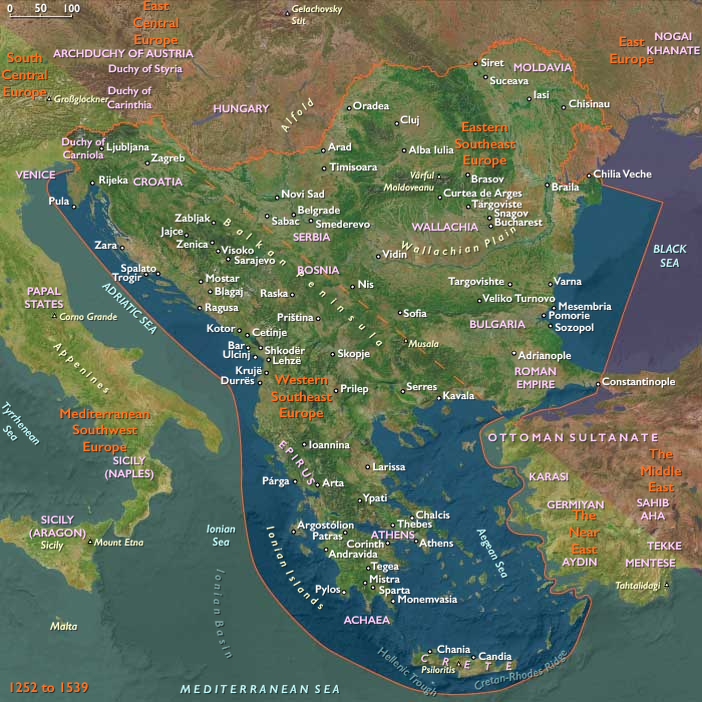
The kingdom of Károly, who establishes his new capital at Visegrád, includes not only the lands of the Danubian basin up to the peaks of the Carpathian Mountains as they enclose Slovakia, Transylvania, and Carpathian Rus', but also the principality of Wallachia (which includes Severin), northern Serbia, Bosnia, and the Dalmatian coast, recently regained from Venice.
Transylvania has become virtually autonomous in the first decade of the fourteenth century.
Under increasing economic pressure from unrestrained feudal lords and religious pressure from zealous Catholics, many Romanians have emigrated from Transylvania eastward and southward over the Carpathians.
Öljaitü’s magnificent mausoleum of at Soltaniyeh, constructed sometime before the Mongol ruler’s death in 1316, has an interior span of about eighty-five feet (twenty-six meters).
It remains the best known monument of Ilkhanid Persia.
The Catalan mercenaries, after years of raiding in Thrace and Macedonia, finally advance south into Greece in 1310, when Roger Deslaur offers the Company’s service to Gautier V of Brienne, Duke of Athens.
Narbonne had been home in the eleventh and twelfth centuries to an important Jewish exegetical school, which had played a pivotal role in the growth and development of the Zarphatic (Judæo-French) and Shuadit (Judæo-Provençal) languages.
Jews had settled in Narbonne from about the fifth century, with a community that had risen to approximately two thousand in the twelfth century.
At this time, Narbonne was frequently mentioned in Talmudic works in connection with its scholars.
One source, Abraham ibn Daud of Toledo, gives them an importance similar to the exilarchs of Babylon.
In the twelfth and thirteenth centuries, the community had gone through a series of ups and downs before settling into extended decline.
The thirty thousand deaths associated with Narbonne’s devastating plague of 1310, together with the late-thirteenth-century expulsion of the city’s Jews and the silting up of the harbor due to a change in the course of the Aude River, send the once prosperous industrial city and port into a serious decline.
Baldo d'Aguglione pardons most of the White Guelphs in exile and allows them to return to Florence; Dante, however, has gone too far in his violent letters to Arrigo (Henry VII), and he is not recalled.
Bajamonte Tiepolo conspires with the aristocratic Querini family, his in-laws, to take control of the Venetian government.
Word of the plot leaks out, compelling the conspirators to rebel prematurely and seize the piazza on June 15, 1310.
Pietro Gradenigo, the Doge of Venice, dispatches forces that suppress the rebels in street fighting, capturing and executing Marco Querini, the head of the family, but Tiepolo to start a new life in Istria.
The council of ten, a secret tribunal, is established on July 10, to “protect” the Venetian republic by rooting out conspiracies and hunting down rebels.
Intended as a temporary response to the revolt led by Tiepolo against the Doge, it is given emergency powers to deal with the resulting unrest.
The Council of Ten, or simply the Ten, is to be one of the major governing bodies of the Republic of Venice from 1310 to 1797.
Although originally established for a period of two months, its authority will be continuously renewed, until it becomes a permanent body in 1334.
Although its actions are often secretive, it will generally considered to be fair and effective by the citizens of the Republic.
Documentation of Giotto is scanty: he was trained, according to a late tradition, by his most famous Florentine predecessor, Cimabue, whose reputation, as Dante notes in his “Purgtoriao,” was soon eclipsed by Giotto’s.
More fundamental influences on Giotto’s style may have been the works of Cavallini in Rome and the sculptures of Nicola and Giovanni Pisano.
Working in 1310 in his home town, Giotto executes a large wooden panel painting known as the “Ognissanti Madonna.”