The iron industry in Song Dynasty China …
Years: 1078 - 1078
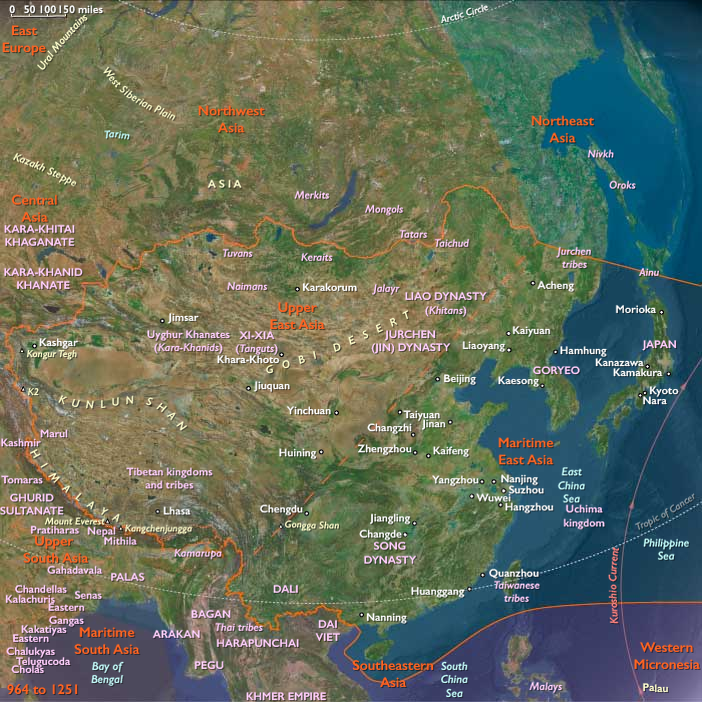
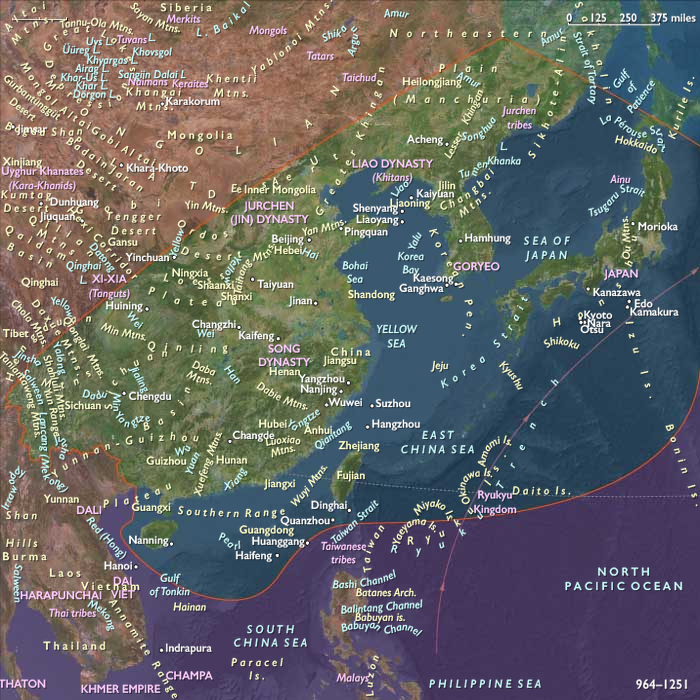
The iron industry in Song Dynasty China is by 1078 producing a total weight of one hundred and twenty-seven million kilograms (one hundred and twenty-five thousand tons) of iron product per year.
Locations
Groups
Commodoties
Subjects
Regions
Subregions
Related Events
Filter results
Showing 10 events out of 50595 total
Su Shi was born in Meishan, near Mount Emei in what is now Sichuan province.
His brother Su Zhe and his father Su Xun are both famous literati.
Su's early education had been conducted by a Taoist priest at a local village school.
Later in his childhood, he had studied under his mother, herself a highly educated woman.
Su married at age seventeen.
He and his younger brother had an extremely close relationship, and in 1057, when Su was nineteen, he and his brother had both passed the highest-level civil service examinations to attain the degree of jinshi, a prerequisite for high government office.
His accomplishments at such a young age had attracted the attention of Emperor Renzong, and also that of Ouyang Xiu, who had beome Su's patron thereafter.
Ouyang had already been known as an admirer of Su Xun, sanctioning his literary style at court and stating that no other pleased him more.
When the 1057 jinshi examinations were given, Ouyang Xiu had required—without prior notice—that candidates were to write in the ancient prose style when answering questions on the Confucian classics.
The Su brothers had gained high honors for what were deemed impeccable answers and achieved celebrity status, especially in the case of Su Shi's exceptional performance in the subsequent 1061 decree examinations.
Beginning in 1060 and throughout the following twenty years, Su will hold a variety of government positions throughout China; most notably in Hangzhou, where he is responsible for constructing a pedestrian causeway across the West Lake that still bears his name: suti (Su causeway).
He had served as a magistrate in Mizhou, which is located in modern day Zhucheng County of Shandong province.
Later, when he is governor of Xuzhou, he writes a memorial to the throne in 1078 complaining about the troubling economic conditions and potential for armed rebellion in Liguo Industrial Prefecture, where a large part of the Chinese iron industry is located.

In 1076, the same year Sviatoslav I died in Kiev and was succeeded there by his brother Vsevolod, Sviatoslav’s son Oleg, failing to get along with his uncle, had fled Kiev to a distant Chernihivian domain on the Black Sea shore, called Tmutarakan.
Here, in 1078, he makes an alliance with the Kipchaks, and with their support returns to his father's patrimony, Chernihiv.
It marks the first time that a Slavic prince brings a pagan horde to the walls of a Russian city in order to achieve his ends.
Oleg's forces clash with Vsevolod of Kiev on October 3, 1078, at the Nezhatinnaya Niva (or Nezhatina Niva, today's Nizhyn).
He is defeated and escapes to …
…Tmutarakan, where the Khazars have him imprisoned and sent in chains to Constantinople.
The emperor, who is a relative and ally of Vsevolod, will exile him to Rhodes, where he will marry a noble lady, Theophano Mouzalonissa, who will bear him several children.
Suleiman is the son of Qutalmish, who had struggled unsuccessfully against his cousin Alp Arslan for the throne of Great Seljuq Empire.
When Kutalmish died in 1064, Suleiman had fled with his three brothers into the Taurus Mountains and there sought refuge with Turkmen tribes living beyond the borders of the empire.
Alp Arslan had responded by launching a series of punitive expeditions against them.
Of the four brothers, Suleiman alone has survived the raids and has been able to consolidate his leadership of the Turkmen.
Suleiman has been appointed governor of the northwestern provinces and assigned to completing the invasion of Anatolia.
An explanation for this choice can only be conjectured from Ibn al-Athir’s account of the battle between Alp-Arslan and Qutalmish, in which he writes that Alp-Arslan wept for the latter's death and greatly mourned the loss of his kinsman.
The emperor Michael VII seeks the help of Suleiman in 1078 against Nikephoros Botaneiates, the commander of the Anatolic Theme, who has challenged the emperor for the throne.
Suleiman intercepts Botaneiates' small force between Cotyaeum and Nicaea, whereupon the usurper persuades Suleiman to join his rebellion by offering him incentives superior to those of the emperor.
Nikephoros' bid for power is successful, and in return for their support Suleiman's Turkmen are allowed to settle on the Asiatic side of the Bosporus, near Constantinople itself.
Saracen-held Taormina falls to Roger Guiscard’s Normans in 1078.
Guiscard, to guarantee Apulia against attack from the new rulers of the Empire, wants the territories on the Adriatic coast of the Balkan Peninsula, and he begins to build a large navy.
Michael's expulsion and Helen's confinement reawaken his unappeased spirit of adventure and hastens his long-considered expedition.
Now his goal is even more ambitious: to march to Constantinople and crown himself emperor in place of the deposed Michael.
The taifa of Murcia has passed successively under the rule of Almería, Toledo and Seville after the fall of the Caliphate of Cordoba in 1031.
Abbad II al-Mu'tadid brings the taifa kingdom under the forcible control of Seville from 1078.
Al-Mu'tamid ibn Abbad, who had inherited Seville after the death of his father Abbad II al-Mu'tadid in 1069, had attempted in 1071 to seize neighboring Córdoba and lost its in 1075; he regains it in 1078.
The Almoravid emir, Yusuf ibn Tashfin, besieges Ceuta.
Since the city can receive help from the sea, the siege will last until 1083.