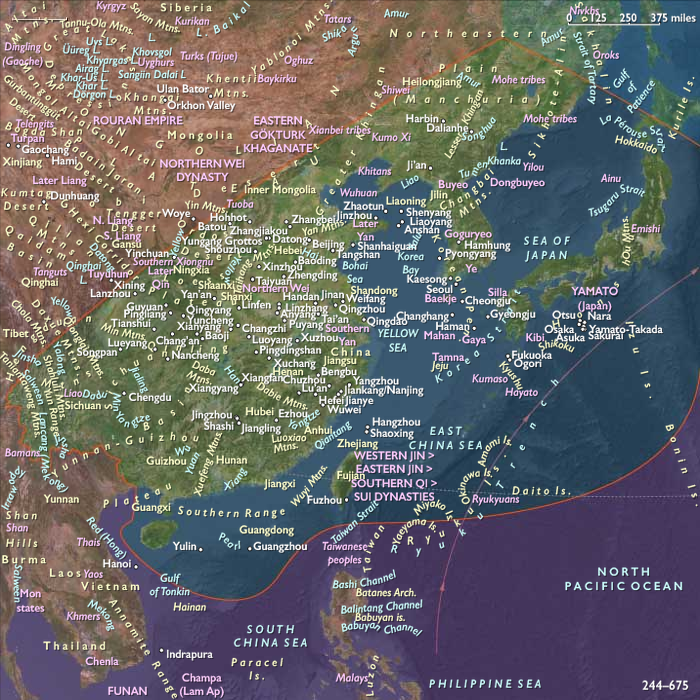
…the key city of Xuchang (in modern …
Years: 289 - 289
…the key city of Xuchang (in modern Xuchang, Henan).
Locations
People
Groups
Topics
Subjects
Regions
Subregions
Related Events
Filter results
Showing 10 events out of 60120 total
Emperor Wu’s generosity and kindness have undermined his rule, as he has become overly tolerant of the noble families' corruption and wastefulness, which has drained the state’s resources.
Further, when the emperor had established the Jìn Dynasty, he had been concerned about his regime's stability, and, believing that the predecessor state, Cao Wei, had been doomed by its failure to empower the princes of the imperial clan, he has greatly empowered his uncles, his cousins, and his sons with authority including high military ranking.
This, ironically, will lead to the destabilization of the Jìn Dynasty.
In 289, as Emperor Wu nears death, he considers whom to make the regent for Crown Prince Zhong, who is developmentally disabled.
He considered both Empress Yang's father Yang Jun and his uncle Sima Liang the Prince of Ru'nan, the most respected of the imperial princes.
As a result, Yang Jun becomes fearful of Sima Liang and has him posted to …
Maximian’s Failed Invasion of Britain (288/289 CE) and the Continued Rule of Carausius
By 288 or 289 CE, Emperor Maximian, co-ruler of the Western Roman Empire, prepared to invade Britain to reclaim the province from Carausius, the rogue naval commander who had declared himself Augustus of Britain and northern Gaul. However, the invasion failed, allowing Carausius to remain in power for several more years.
1. The Roman Invasion Attempt and Its Failure
- Maximian assembled a fleet, likely at Gesoriacum (modern Boulogne), intending to retake Britain by force.
- The invasion failed, but sources disagree on why:
- A panegyric to Constantius Chlorus blames bad weather, implying that storms or rough seas prevented the fleet from landing.
- Eutropius, a 4th-century historian, states that the failure was due to Carausius’ military skill, suggesting that his fleet successfully repelled the attack.
- Carausius himself claimed a military victory, further bolstering his legitimacy as ruler of Britain and parts of Gaul.
2. The Aftermath: Stalemate and a Peace Agreement
- Following the failed invasion, neither side could force a decisive outcome, leading to a stalemate.
- Eutropius records that hostilities were in vain, meaning that Rome was unable to dislodge Carausius, despite its military strength.
- As a result, peace was agreed, possibly recognizing de facto independence for Carausius' rule over Britain and northern Gaul.
- Carausius continued to issue coins, portraying himself as a legitimate emperor, emphasizing slogans such as "Restitutor Britanniae" (Restorer of Britain).
3. The Continued Threat of Carausius to Roman Authority
- Carausius’ control over the English Channel meant that Rome could not easily launch another invasionwithout a large naval force.
- His alliance with local Britons, Frankish and Saxon mercenaries, and Roman deserters strengthened his rule.
- However, his separatist state was not politically stable, leading to internal tensions.
4. The Road to Carausius’ Downfall (293 CE)
- In 293 CE, Emperor Diocletian’s Tetrarchy restructured the empire, and Constantius Chlorus was appointed Caesar of the West, tasked with recovering Britain.
- Constantius recaptured Boulogne, cutting Carausius off from his Gallic territories and weakening his position.
- Soon after, Carausius was assassinated by his finance minister, Allectus, who briefly ruled Britain before being defeated by Roman forces in 296 CE.
Conclusion: A Temporary British Empire
- Maximian’s failed invasion of 288/289 CE allowed Carausius to maintain his rule over Britain for several more years.
- His control of the sea and military skill prevented Rome from reclaiming the province until a more coordinated campaign under Constantius Chlorus in 296 CE.
- While Carausius' breakaway state eventually fell, his reign demonstrated the increasing instability of the Western Roman Empire and foreshadowed later provincial revolts that would contribute to Rome’s eventual decline.
Despite his defiance of Roman authority, Carausius' rule remains one of the most remarkable secessionist movements in Roman history, where a naval commander successfully held Britain against the might of the empire for nearly a decade.
Emperor Wu has resolved by 290 to let Yang Jun and Sima Liang both be regents, but after he writes his will, the will is seized by Yang Jun, who instead has another will promulgated in which Yang alone is named regent.
Emperor Wu dies soon hereafter, and Crown Prince Zhong ascends the throne as Emperor Hui.
Empress Yang is honored as empress dowager, Crown Princess Jia becomes empress, and Prince Yu becomes crown prince.
Although the Jin dynasty has provided a brief period of unity after conquering the Kingdom of Wu, the longest-lived of the Three Kingdoms competing for control of China after the fall of the Han Dynasty, in 280, a complex power struggle begins among the Sima clan following the death of Emperor Wu in 290.
The new emperor is developmentally disabled, and factions fight to control the imperial court.
Initially, the emperor's stepmother, Empress Dowager Yang, exerts the most power at the courts, and empowers her family, the Yang consort clan, with her father Yang Jun given the most power.
Yang Jun quickly shows himself to be autocratic and incompetent, drawing the ire of many other nobles and officials.
He tries to appease them by making many bestowments of titles and honors among them, but this only brings further contempt for his actions.
Knowing Empress Jia to be strong-willed and treacherous, he tries to place people loyal to him in charge of all the defense forces of the capital, Luoyang, and orders that all edicts not only be signed by the emperor but also by Empress Dowager Yang before they could be promulgated.
Empress Jia, however, wants to be involved in the government, and is angry that she is constantly rebuffed by Empress Dowager Yang and Yang Jun.
She therefore conspires with the eunuch Dong Meng and the generals Meng Guan and Li Zhao against the Yangs.
She tries to include Sima Liang into the conspiracy, but Sima Liang declines; instead, she persuades her brother-in-law, Sima Wei the Prince of Chu, to join her plan.
Sima Wei is the fifth son of Emperor Wu by his concubine Consort Shen.

Carausius had begun to entertain visions of legitimacy and official recognition by 289, minting his own coins and bringing their value in line with Roman issues as well as acknowledging and honoring Maximian and then Diocletian, who, having failed in several attempts to dislodge Carausius, acknowledge him as ruler of Britain in 290.
Diocletian and Maximian meet in Milan on the five-year anniversary of their rule, either in late December 290 or January 291, to discuss their successes and failures.
The meeting is undertaken with a sense of solemn pageantry; the Emperors spend most of their time in public appearances.
It has been surmised by David Potter that the ceremonies were arranged to demonstrate Diocletian's continuing support for his faltering colleague.
(Potter, David S. The Roman Empire at Bay: AD 180–395.
New York: Routledge, 2005) A deputation from the Roman Senate meets with the Emperors, renewing that body's infrequent contact with the Imperial office.
The choice of Milan over Rome further snubs the capital's pride, but it is already a long established practice that Rome itself is only a ceremonial capital, as the actual seat of the Imperial administration is determined by the needs of defense.
Long before Diocletian, Gallienus (r. 253–68) had already chosen Milan as the seat of his headquarters.
If the panegyric detailing the ceremony implies that the true center of the Empire is not Rome, but where the Emperor sits ("...the capital of the Empire appeared to be there, where the two emperors met"), (Panegyrici Latini 11(3)12, qtd.
in Williams, 57.)
it simply echoes what had already been stated by the historian Herodian in the early third century: "Rome is where the emperor is".
During the meeting, decisions on matters of politics and war are probably made, but they are made in secret.
The Augusti will not meet again until 303.
A coup begins after Sima Wei returns with his troops in 291 to Luoyang from his defense post in Jing Province—modern Hubei and Hunan.
Empress Jia, who has her husband easily under her control, has him issue an edict declaring that Yang Jun has committed crimes and should be removed from his posts.
It also orders Sima Wei and Sima Yao, the Duke of Dong'an, to attack Yang's forces and defend against counterattacks.
It quickly becomes clear that Yang is in trouble.
Empress Dowager Yang, trapped in the palace, writes an edict ordering assistance for Yang Jun and puts it on arrows, shooting them out of the palace.
Empress Jia now makes the bold declaration that Empress Dowager Yang is committing treason.
Yang Jun is quickly defeated, and his clan massacred.
Only his wife Lady Pang, the empress dowager's mother, is pardoned and allowed to live with the empress dowager.
However, Empress Jia continues to be resentful, and soon has Empress Dowager Yang deposed from her position and made a commoner, and then has Lady Pang executed, despite humble pleas from the empress dowager, who is put under house arrest inside the palace.
Initially, her closest servants are allowed to remain to serve her.
Sima Liang and Wei Guan have reservations about Sima Wei's ferocity in overthrowing Yang, and they therefore try to strip him of his military command, but Sima Wei persuades Empress Jia to let him keep his military command.
Sima Wei's assistants Qi Sheng and Gongsun Hong then falsely tell Empress Jia that Sima Liang and Wei plan to depose the emperor.
Empress Jia, who already resents Wei for having, during Emperor Wu's reign, suggested that he change his heir selection, also wants more direct control over the government, and therefore resolves to undergo a second coup.
In summer 291, Jia has Emperor Hui personally write an edict to Wei, ordering him to have Sima Liang and Wei removed from their offices.
His forces surround Liang and Wei's mansions, and while both men's subordinates recommend resistance, each declines and is captured.
Against what the edict says, both are killed: Liang with his heir Sima Ju and Wei with nine of his sons and grandsons.
Qi then suggests to Sima Wei to take the opportunity to kill Empress Jia's relatives and take over the government, but Sima Wei hesitates.
At the same time, Empress Jia comes to the realization that killing Sima Liang and Wei, were her intentions to be discovered, could bring a political firestorm and that Sima Wei will not be easily controlled.
She therefore publicly declares that Sima Wei had falsely issued the edict.
Sima Wei's troops abandon him, and he is captured.
At his execution, he tries to show the edict to the official in charge of the execution, Liu Song, and Liu, knowing that Sima Wei had actually carried out the coup on Empress Jia's orders, is saddened, but still carries out the execution.
Gongsun and Qi are executed also, along with their clans.
From this point on, Empress Jia becomes the undisputed power behind the throne.
Jiaozhi had been the first name given to the land based around Hanoi and the Red River, but by 300 it has been renamed Annam (Pacified South) by its overlord, imperial China.
Galindians, Galindae, or Goliad, one of the western Baltic tribes, migrates to the Eastern end of Baltic realm around the fourth century CE, and settles around the region of present Moscow, Russia, according to one of the theories that has gained considerable traction over the years.
The Balts, defeated by the Goths around 300, remain in their ancestral homeland.
Tacitus in 98 CE had described one of the tribes living near the Baltic Sea (Mare Svebicum) as Aestiorum gentes and amber gatherers.
It is believed that these peoples were inhabitants of Sambia, the peninsula northwest of present Kaliningrad, although no other contemporary sources exist.
This homeland includes all historical Balts, and every location where Balts are thought to have been at different periods in time.
The huge area of Baltic habitation will shrink over time, due to assimilation by other groups, and to invasions.