
...the Meadowcroft Rockshelter located near Avella in …
Years: 38925BCE - 37198BCE
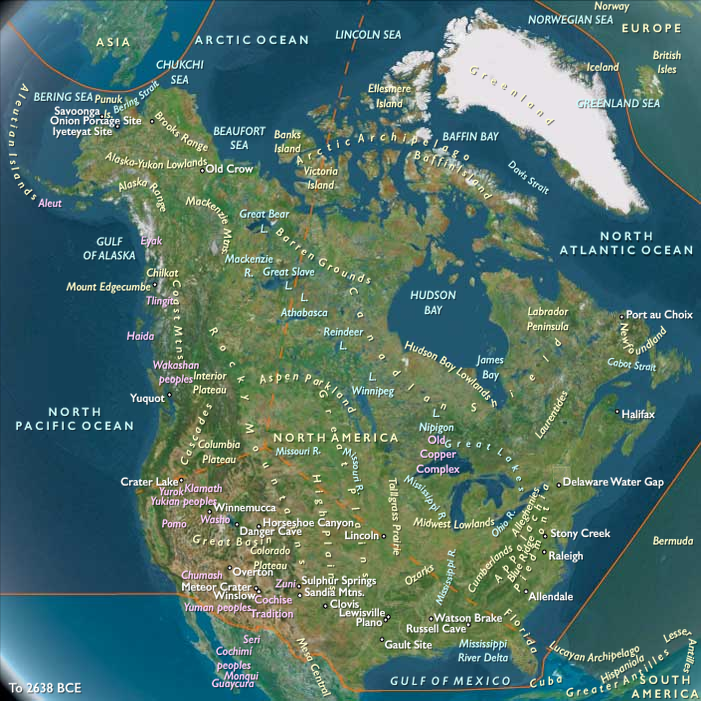
...the Meadowcroft Rockshelter located near Avella in Washington County, in southwestern Pennsylvania, United States, dated to sixteen thousand years BP.
These discoveries have raised doubts about the "Clovis First" theory, and have led to alternative proposals for the routes of colonization and the diffusion of culture through the continent, in a heated dispute that has not been solved.
Locations
Topics
Subjects
Regions
Subregions
Related Events
Filter results
Showing 8 events out of 8 total
Huang Ti, the legendary Yellow Emperor, is supposed by Daoists to have ruled China from 2697.
Both emperors lived in a time of warfare.
The Yan emperor was unable to control the disorder within his realm thus the Yellow emperor began taking up arms to establish his domination over various warring factions.
The Yellow emperor is also known as an inventor who improved the livelihood of the nomadic hunter lifestyle.
He taught people how to build shelters, tame wild animals and grow the five Chinese cereals.
He also invented carts, boats, and clothing.
At the Yellow Emperor's request, historian Cang Jié created the first Chinese character writing system; this would change the way history was recorded in the following dynasties through the use of Oracle bone script, which would later become the basis for the genealogy of many scripts.
The Yellow Emperor's principal wife Léizu taught people how to weave silk from Bombyx mori silkworms and dye clothes.
Most recognized today is the Yellow Emperor's Inner Canon on internal medicine, supposedly the oldest medical book that forms the basis of Traditional Chinese medicine.
Other inventions credited to the emperor include the Diadem, palace rooms, bow, sling, early Chinese astronomy, the Chinese calendar, calculations, sound laws, football.
He is also said to have played a part in the creation of the Guqin musical instrument, together with the Fu Xi and Yan emperors.
It is also recorded that at that time Ling Lun created music, while the Yan emperor created the requisite musical instruments.
East Asia (2637 – 910 BCE): Rivers, Metals, and the Rise of States
Regional Overview
During the Bronze and Early Iron Ages, East Asia emerged as one of the world’s great civilizational heartlands.
From the Yellow and Yangtze valleys of China to the Korean Peninsula, Japan, Taiwan, and the highlands and steppe corridors of western China and Mongolia, societies transformed irrigation, metallurgy, and writing into the instruments of state power.
This was an age of hydraulic empires, bronze workshops, and expanding frontiers, when settled farmers, mobile herders, and maritime voyagers together forged the cultural matrix that would define East Asia’s classical eras.
Geography and Environment
East Asia’s vast domain encompassed temperate plains, subtropical coasts, and alpine plateaus.
The Yellow River carved loess terraces ideal for millet and wheat, while the Yangtze Delta offered lush paddies for rice.
To the north and west lay the steppe and desert margins—Mongolia, Xinjiang, and Gansu—where grasslands merged into arid basins and mountain ranges.
Along the Pacific rim, the Korean and Japanese archipelagos formed the maritime frontier, linked to the mainland by currents and trade.
These diverse settings sustained a continuum from intensive wet-rice agriculture to high-pasture nomadism.
Climate and Environmental Shifts
Holocene stability continued, though alternating floods, droughts, and cool spells along the Yellow River spurred engineering and migration.
Monsoon rains sustained southern rice fields, while drier cycles reshaped steppe pastures.
Environmental mastery—levees, canals, and paddy works—became the defining measure of political capacity.
Societies and Political Developments
By the mid-third millennium BCE, the Longshan culture of northern China had introduced walled towns and social hierarchy, evolving into the Erlitou state (often equated with the semi-legendary Xia).
The Shang dynasty (c. 1600–1046 BCE) institutionalized bronze ritual, written records, and urban administration; its successor, the early Zhou, extended feudal rule across the plains.
In the south, Liangzhu and its heirs built water-managed jade-working centers.
Across the steppe rim, pastoral chiefdoms traded horses and metalwork with the settled zones, while in Korea, the Mumun culture advanced agriculture and monumental dolmen building.
The Jōmon peoples of Japan refined a maritime-forest economy, their cord-marked ceramics among the world’s oldest continuous traditions.
Economy and Technology
Agriculture anchored all development: millet and wheat in the north, rice in the south, supplemented by legumes, fruit trees, and silk production.
Bronze metallurgy reached unprecedented artistry under the Shang, producing ornate vessels, chariot fittings, and weapons.
Iron smelting appeared toward the close of this era, transforming farming and warfare.
Riverine and coastal transport expanded trade in jade, salt, ceramics, and textiles; the Yangtze Delta became a maritime hub connecting inland producers with Korea, Japan, and Taiwan.
In the west, the Hexi Corridor and Tarim oases formed early nodes of the Silk Road, moving jade eastward and horses west.
Belief, Writing, and Art
Shang oracle-bone inscriptions inaugurated Chinese writing, binding religion and administration.
Bronze vessels embodied a theology of ancestor worship and royal mediation between Heaven and Earth.
In the south, jade rituals expressed a cosmology of water and fertility; in the steppe, stone stelae and kurgan rings honored sky gods and heroic ancestors.
Across Korea and Japan, dolmens, shell mounds, and figurines encoded lineage and territorial identity.
Art and ritual thus formed a shared grammar of power from the Pacific to the Altai.
Movement and Interaction Corridors
East Asia’s civilizations grew through constant motion.
Caravan and river routes carried goods from the Tarim Basin to the Yellow Plain; maritime passages through the Bohai, East China, and Japan Seas linked coastal polities and disseminated crops, metals, and ideas.
These overlapping land and sea networks prefigured the trans-Eurasian and trans-Pacific exchange systems of later antiquity.
Environmental Adaptation and Resilience
Flood-control levees, paddy irrigation, and terrace farming stabilized yields in volatile climates.
Nomadic mobility balanced the steppe’s shifting pastures, while coastal fishers diversified protein sources and trade goods.
In every zone, societies developed adaptive mosaics of agriculture, herding, and craft that cushioned environmental stress and underpinned political endurance.
Regional Synthesis and Long-Term Significance
By 910 BCE, East Asia was a continent of interconnected yet distinctive worlds:
-
In China, bronze states and written administration redefined governance.
-
In Korea and Japan, agrarian and megalithic cultures matured along maritime arteries.
-
In the western highlands and steppe, mobile herders linked China to Central Asia’s metallurgical frontier.
Together these traditions laid the foundations of the classical Chinese, Korean, and Japanese civilizations, and established East Asia’s lasting role as a pivot between the land empires of Eurasia and the oceanic cultures of the Pacific.
Maritime East Asia (2637 – 910 BCE): River Valleys, Coastal Plains, and Early States
Geographic and Environmental Context
Martitime East Asia—including eastern China, Taiwan, the Korean Peninsula, and Japan—was anchored by fertile river basins such as the Yellow River and Yangtze River, alongside extensive coastal plains and sheltered inland seas. The Bohai Gulf, East China Sea, and Sea of Japan created maritime corridors, while inland mountain ranges like the Qinling and Taebaek defined cultural and ecological boundaries. The climate ranged from temperate in the north to subtropical in the south, fostering diverse agricultural systems.
Agriculture and Early Civilizations
By the mid–third millennium BCE, the north’s Yellow River basin supported millet and wheat farming, while the Yangtze basin cultivated rice in sophisticated paddy systems. These agricultural foundations sustained some of East Asia’s earliest complex societies.
-
In the Yellow River region, the late Longshan culture (c. 3000–1900 BCE) developed rammed-earth walled towns, elaborate pottery, and social stratification, laying the groundwork for the emergence of the Erlitou cultur e(c. 1900–1500 BCE), often identified with the semi-legendary Xia dynasty.
-
The Shang dynasty (c. 1600–1046 BCE) established one of the first fully documented states in East Asia, with urban centers, palatial compounds, and control over large territories through networks of allied and subordinate polities.
-
In the Yangtze basin, complex cultures such as Liangzhu (before c. 2300 BCE) and its successors specialized in jade production, hydrological engineering, and ceremonial centers.
Technological and Cultural Developments
Bronze metallurgy flourished under the Shang, producing ritual vessels, weapons, and chariot fittings of extraordinary skill. Oracle bone script emerged as the earliest known form of Chinese writing, used for divination and state record-keeping. Jade carving traditions—especially in Liangzhu-descended communities—produced bi disks and cong tubes, objects central to ritual and elite identity.
In Korea, the Mumun period (c. 1500–300 BCE) introduced intensive agriculture, large-scale dolmens, and bronze weaponry. In Japan, the Jōmon culture maintained a hunter-fisher-gatherer economy with some plant cultivation, producing highly distinctive cord-marked pottery and shell middens that attest to rich coastal subsistence.
Maritime Networks and Exchange
Coastal and riverine transport tied together communities across Lower East Asia. The Yangtze Deltaacted as a hub for trade in jade, ceramics, and textiles, while the Shandong Peninsula facilitated contact between northern China and the Korean Peninsula. Early seafaring along the East China Sea connected mainland cultures with Taiwan and the Ryukyu Islands, moving nephrite jade, shell ornaments, and possibly agricultural crops.
Cultural and Symbolic Expressions
In the north, Shang ritual life centered on ancestor worship, with elaborate bronze vessels used in feasts and sacrifices. In the south, water-focused cosmologies and earth–sky symbolism infused jade artistry and ceremonial landscapes. Across Korea and Japan, monumental burial sites—dolmens in Korea, shell mounds in Japan—served as both funerary monuments and markers of social memory.
Environmental Adaptation and Resilience
Communities engineered river levees, paddy fields, and irrigation channels to manage seasonal flooding and droughts. Coastal fishing villages diversified diets with shellfish, seaweed, and marine fish, buffering agricultural shortfalls. In Korea and Japan, seasonal resource scheduling allowed balanced exploitation of marine and terrestrial environments.
Transition to the Early First Millennium BCE
By 910 BCE, Martitime East Asia was a region of dynamic cultural interaction and technological sophistication. In China, the Shang state’s political, economic, and ritual systems set precedents for later dynasties, while in Korea and Japan, evolving agricultural and maritime traditions created the foundations for complex societies that would integrate more fully into continental networks in the centuries ahead.
Maritime East Asia (2637 – 910 BCE): River Valleys, Coastal Plains, and Early States
Geographic and Environmental Context
Martitime East Asia—including eastern China, Taiwan, the Korean Peninsula, and Japan—was anchored by fertile river basins such as the Yellow River and Yangtze River, alongside extensive coastal plains and sheltered inland seas. The Bohai Gulf, East China Sea, and Sea of Japan created maritime corridors, while inland mountain ranges like the Qinling and Taebaek defined cultural and ecological boundaries. The climate ranged from temperate in the north to subtropical in the south, fostering diverse agricultural systems.
Agriculture and Early Civilizations
By the mid–third millennium BCE, the north’s Yellow River basin supported millet and wheat farming, while the Yangtze basin cultivated rice in sophisticated paddy systems. These agricultural foundations sustained some of East Asia’s earliest complex societies.
-
In the Yellow River region, the late Longshan culture (c. 3000–1900 BCE) developed rammed-earth walled towns, elaborate pottery, and social stratification, laying the groundwork for the emergence of the Erlitou cultur e(c. 1900–1500 BCE), often identified with the semi-legendary Xia dynasty.
-
The Shang dynasty (c. 1600–1046 BCE) established one of the first fully documented states in East Asia, with urban centers, palatial compounds, and control over large territories through networks of allied and subordinate polities.
-
In the Yangtze basin, complex cultures such as Liangzhu (before c. 2300 BCE) and its successors specialized in jade production, hydrological engineering, and ceremonial centers.
Technological and Cultural Developments
Bronze metallurgy flourished under the Shang, producing ritual vessels, weapons, and chariot fittings of extraordinary skill. Oracle bone script emerged as the earliest known form of Chinese writing, used for divination and state record-keeping. Jade carving traditions—especially in Liangzhu-descended communities—produced bi disks and cong tubes, objects central to ritual and elite identity.
In Korea, the Mumun period (c. 1500–300 BCE) introduced intensive agriculture, large-scale dolmens, and bronze weaponry. In Japan, the Jōmon culture maintained a hunter-fisher-gatherer economy with some plant cultivation, producing highly distinctive cord-marked pottery and shell middens that attest to rich coastal subsistence.
Maritime Networks and Exchange
Coastal and riverine transport tied together communities across Lower East Asia. The Yangtze Deltaacted as a hub for trade in jade, ceramics, and textiles, while the Shandong Peninsula facilitated contact between northern China and the Korean Peninsula. Early seafaring along the East China Sea connected mainland cultures with Taiwan and the Ryukyu Islands, moving nephrite jade, shell ornaments, and possibly agricultural crops.
Cultural and Symbolic Expressions
In the north, Shang ritual life centered on ancestor worship, with elaborate bronze vessels used in feasts and sacrifices. In the south, water-focused cosmologies and earth–sky symbolism infused jade artistry and ceremonial landscapes. Across Korea and Japan, monumental burial sites—dolmens in Korea, shell mounds in Japan—served as both funerary monuments and markers of social memory.
Environmental Adaptation and Resilience
Communities engineered river levees, paddy fields, and irrigation channels to manage seasonal flooding and droughts. Coastal fishing villages diversified diets with shellfish, seaweed, and marine fish, buffering agricultural shortfalls. In Korea and Japan, seasonal resource scheduling allowed balanced exploitation of marine and terrestrial environments.
Transition to the Early First Millennium BCE
By 910 BCE, Martitime East Asia was a region of dynamic cultural interaction and technological sophistication. In China, the Shang state’s political, economic, and ritual systems set precedents for later dynasties, while in Korea and Japan, evolving agricultural and maritime traditions created the foundations for complex societies that would integrate more fully into continental networks in the centuries ahead.
Maritime East Asia (2637–2494 BCE): Legendary Foundations and Cultural Innovations
Between 2637 BCE and 2494 BCE, Maritime East Asia—comprising lower Primorsky Krai, the Korean Peninsula, the Japanese Archipelago below northern Hokkaido, Taiwan, and southern, central, and northeastern China—witnesses critical advancements, legendary foundations, and key cultural innovations that lay essential groundwork for later civilizations. This age is traditionally dominated by Chinese legendary figures, such as the celebrated Yellow Emperor (Huangdi), and marked by significant Neolithic cultural advances, notably the refined pottery of the Longshan Culture in China, the expansion of settled agriculture, early sericulture, developments in divination practices, and intricate Jōmon pottery traditions in Japan.
Legendary Reign of the Yellow Emperor (Huangdi)
The era is strongly influenced by the legendary reign of the Yellow Emperor (Huangdi), regarded by Chinese tradition as the first of the "Five Emperors." According to historian Sima Qian (writing much later in the Shiji), Huangdi rules from 2697 BCE until his death in 2598 BCE, initiating profound cultural and technological transformations. He is traditionally credited with essential inventions, including the principles of traditional Chinese medicine, significantly influencing subsequent Chinese medical practices and theories.
Under his legendary administration, Huangdi’s young wife, Xilingji, traditionally receives credit for the discovery and refinement of silk culture—or sericulture—around the third millennium BCE. Early silk production, involving domesticated silkworms (Bombyx mori), initially operates on a small, closely guarded scale, laying the foundations for what becomes one of China's most enduring and coveted secrets.
Additionally, legend attributes to Cangjie, a bureaucrat serving under Huangdi, the invention of the first Chinese characters (zì) around 2650 BCE. Inspired by observing the vein patterns on a tortoise at Mount Yangxu (modern Shanxi Province), Cangjie supposedly develops an intricate symbolic writing system based on nature’s patterns. Tradition dramatically states that this event was so transformative that demons mourned and grains fell like rain, symbolizing the dawn of civilization itself.
Longshan Culture: Pottery, Urbanization, and Agriculture
Simultaneously, during the late Chinese Neolithic, the prosperous Longshan Culture emerges along the central and lower Yellow River (Huang He), with origins traced back to around 3000 BCE and continuing prominently through this period. Named after the archaeological site at Longshan, Shandong Province, the culture is renowned for its highly polished, thin-walled black pottery (often termed "egg-shell pottery"), characterized by wheel-turned production methods that represent a significant technological advancement from earlier Yangshao ceramics.
Longshan pottery, used extensively for rituals and burials, signifies increasing sophistication in craft specialization and cultural expression. Remarkably, this pottery tradition expands widely across regions, reaching the Yangzi River valley and even the southeastern coastal areas, illustrating a broadening cultural exchange and migration within ancient China.
Longshan settlements evolve significantly during this period, demonstrating early urban characteristics, including fortified cities enclosed by substantial rammed-earth walls and moats. Notably, the site at Taosi, located in today's Shanxi Province, emerges as the largest walled Longshan settlement, exemplifying the nascent urbanization process.
Expansion of Agricultural Practices
Agricultural practices become increasingly sophisticated and widespread, with permanent farming settlements expanding extensively into the eastern plains of China, Manchuria, and southern regions. By this age, rice cultivation is securely established, particularly in the Yangzi River basin, ensuring long-term demographic growth, economic stability, and cultural continuity across Lower East Asia.
Early Chinese Divination Practices
In conjunction with cultural and agricultural innovations, archaeological evidence from this era suggests the practice of early forms of divination in China. These ritual practices involve interpreting crack patterns formed in heated cattle bones—methods that later evolve into sophisticated oracle bone inscriptions central to Chinese divination and early historical record-keeping.
Japan: Middle Jōmon Cultural Flourishing
Meanwhile, in southern Japan (south of an imaginary line from modern Hokkaido through northern Honshu), the Middle Jōmon period (approximately 3000 BCE onward) sees a remarkable demographic expansion, evidenced by numerous archaeological sites. Potters in central Japan produce elaborately decorated and sculptural pottery, distinctively differing from earlier, simpler conical and cylindrical ceramics of northern Japan.
This period is especially notable for the manufacture of intricate clay figurines (dogū), likely associated with fertility and funerary rituals, reflecting early spiritual and social practices. The distinct regional pottery styles underscore Japan's early cultural diversity and sophisticated artisanal traditions, laying foundations for subsequent Jōmon cultural developments.
Legacy of the Age: Cultural Foundations and Technological Innovations
Thus, the age 2637–2494 BCE profoundly shapes the foundational cultural landscape of Maritime East Asia. Legendary Chinese rulers and heroes symbolize essential cultural and technological advances, notably traditional medicine, silk production, and early writing systems. Simultaneously, significant pottery innovations and the early steps toward urbanization mark the Longshan period in China, while the Jōmon pottery tradition flourishes in Japan, indicating complex cultural and social dynamics.
These developments together establish enduring cultural, technological, and societal frameworks, fundamentally influencing subsequent historical trajectories across Lower East Asia into the ensuing ages.
Cangjie, a bureaucrat under the legendary sovereign and Han Chinese cultural hero Huangdi, will be said to have invented Chinese characters around 2650 BCE.
The legend tells that Cangjie was hunting on Mount Yangxu (today Shanxi) when he saw a tortoise whose veins caught his curiosity.Inspired by the possibility of a logical relation of those veins, he studied the animals of the world, the landscape of the earth, and the stars in the sky, and invented a symbolic system called zì: Chinese characters.
It was said that on the day the characters were born, Chinese heard the devil mourning, and saw crops falling like rain, as it marked the beginning of the world.
Silk culture may originate in China as early as the third millennium BCE; Chinese tradition ascribes its discovery, and the invention of the silk reel, to Xilingji, the fourteen-year-old wife of Huangdi.
Early sericulture consists of small-scale production by raising and domesticating the silkworm Bombyx mori.
The cultivation and weaving of silk begins to be a closely guarded secret in China.
The first of China's legendary Five Emperors, the Yellow Emperor, or Huangdi, supposedly reigned from 2697 BCE; among his many accomplishments, Huangdi has been credited with the invention of the principles of traditional Chinese medicine. (According to the writings in the Shiji by historian Sima Qian [145 BC-90 BCE], the reign of Huangdi, or the Yellow Emperor, lasts until his death in 2598 BCE.)
Years: 38925BCE - 37198BCE
Locations
Topics
Subjects
Regions
Subregions