
The Megalithic Tomb Tradition: A Pan-European Phenomenon …
Years: 4509BCE - 4366BCE
The Megalithic Tomb Tradition: A Pan-European Phenomenon
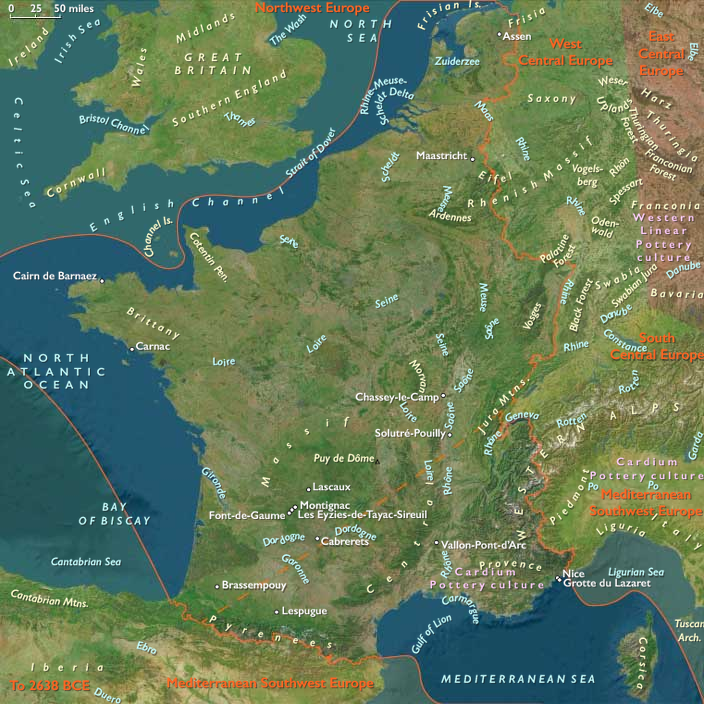
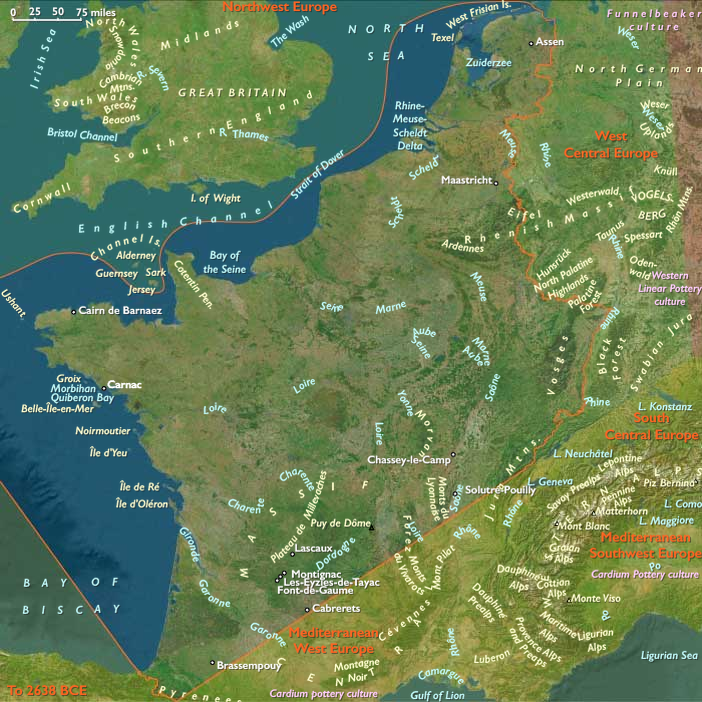
The megalithic tomb tradition, an evolution of collective burial practices seen in long barrows, extended across Western and Northern Europe, spanning from Évora in Portugal to northern Scotland, and eastward into Germany and Denmark. This architectural and ritualistic tradition reflects shared cultural influences among early Neolithic communities.
Regional Distribution and Variation
- The earliest known megalithic structures appear in Brittany (France), Iberia, and western France, before spreading northward and eastward into the British Isles, Scandinavia, and Central Europe.
- These stone-built tombs vary in external design and internal chamber structure, but all share a focus on communal burial and monumental stone construction.
The Cairn of Barnenez: One of Europe's Oldest Megalithic Monuments
- Located near Plouezoc'h on the Kernéléhen peninsula, in northern Finistère, Brittany, the Cairn of Barnenez dates to approximately 4500 BCE, placing it among the earliest megalithic structures in Europe.
- This massive burial cairn consists of two distinct phases of construction, ultimately reaching a length of about 72 meters (236 feet).
- Multiple burial chambers were built within the cairn, accessed through narrow passageways.
Megalithic Art and Symbolism
- Barnenez is notable for its engraved stones, featuring megalithic art that includes abstract geometric patterns, axes, and symbolic motifs.
- These engravings reflect ritual significance, suggesting that these sites were not merely tombs but also sacred ceremonial spaces.
Locations
Groups
Topics
Subjects
Regions
Subregions
Related Events
Filter results
Showing 10 events out of 77 total
Southeast Asia (909 BCE – 819 CE): Monsoon Networks, Bronze Drums, and the Birth of Maritime Kingdoms
Regional Overview
By the dawn of the first millennium BCE, Southeast Asia had already begun to crystallize as the great crossroads of the Old World tropics.
Inland, the rice kingdoms of the Mekong, Chao Phraya, and Red River valleys emerged from the metallurgy and village confederations of the Bronze–Iron Age.
Seaward, the Andaman–Malay–Sumatran and Philippine–Bornean worlds turned the monsoon into an empire of routes, connecting India, China, and Oceania.
The entire region was defined by rhythm — the breathing of wind and water — in which farming, trade, and belief all synchronized to the turning of the monsoon.
Geography and Environment
The geography of Southeast Asia forms two great environmental theaters.
On the mainland, broad alluvial plains—Mekong, Chao Phraya, Irrawaddy, Red River—fed dense populations, while surrounding hills and plateaus nurtured metals and forest goods.
The insular and peninsular zones, stretching from the Malay Peninsula to Java, Sumatra, Borneo, Sulawesi, and the Philippine arcs, fused equatorial rainforest with coral coasts and volcanic fertility.
Farther west, the Andaman–Nicobar–Aceh corridor linked Bay of Bengal and Indian Ocean worlds, its islands and capes functioning as the hinges between South and East Asia.
Climatically, a regular monsoon pattern dominated: rains from May to October, dry trade-wind seasons from November to April. This stability made intensive wet-rice cultivation possible and guaranteed predictable sailing cycles—the dual engines of Southeast Asia’s rise.
Societies and Political Development
Mainland Southeast Asia
In the first millennium BCE, Bronze Age chiefdoms such as the Dong Son culture of the Red River valley forged regional identities through warfare, metallurgy, and ceremony. Their massive bronze drums, decorated with solar and aquatic motifs, became symbols of power from Vietnam to Borneo.
By the early centuries CE, irrigated rice systems underpinned early proto-states:
-
Funan in the Mekong delta—an entrepôt absorbing Indian trade and ideas;
-
Dvaravati in the Chao Phraya basin—Mon-speaking city-states blending Buddhism and local animism;
-
early Cham centers along the central Vietnamese coast, the maritime ancestors of later Hindu–Shaiva kingdoms;
-
and upland polities in Myanmar and Laos that balanced trade, salt, and forest exchange.
These societies fused Indigenous agrarian traditions with Indic and Sinic influences carried by merchants, monks, and artisans, producing hybrid languages of kingship and ritual that would define the classical kingdoms of later centuries.
Insular and Maritime Southeast Asia
Across the seas, communities in Java, Sumatra, Borneo, Sulawesi, and the Philippines evolved from Lapita-descended or Austronesian roots into settled horticultural and trading societies.
By the early first millennium CE, Iron-Age ports and coastal chiefdoms had appeared, their rulers mediating between inland farmers and overseas merchants.
On the Malay Peninsula, small harbors such as Kedah and Tambralinga became staging points for India–China traffic.
In Sumatra, fertile volcanic valleys and river deltas supported rice and pepper cultivation, while estuarine towns gathered forest resins, camphor, and gold.
In the Philippines, barangay polities combined boat-based clans with agricultural villages, forming fluid, maritime societies.
Andamanasia
At the western margin, Andamanasia—the Andamans, Nicobars, and northern Sumatran islands—was a liminal zone where Austronesian voyagers, Bay-of-Bengal traders, and forest foragers met.
Aceh and Nias sustained canoe chiefdoms trading resin, shells, and turtle shell for iron and beads from India; the Nicobars became vital relay stations between Sri Lanka and the Malay world.
The Andamans, by contrast, preserved independent hunter-gatherer cultures, holding their forests and reefs against encroachment.
Economy and Exchange
Everywhere, rice was the foundational crop, but economic vitality lay in diversity: rice in the floodplains, millet and tubers in uplands, sago and coconut in the islands, and marine protein along every coast.
Metals—bronze and later iron—spread from mining centers in northern Vietnam and central Thailand through trade networks that reached Sumatra and Java.
The monsoon trade carried spices, resins, camphor, tin, gold, and forest products westward toward India and the Mediterranean, and brought textiles, beads, and ceramics eastward in return.
Between these circuits, the maritime Austronesian seafarers of Borneo, the Philippines, and the Nicobars acted as indispensable intermediaries.
Technology and Material Culture
Iron tools and weapons revolutionized cultivation and warfare, enabling larger fields and more durable architecture.
Pottery traditions diversified; weaving and dyeing reached new complexity.
In navigation, plank-built outrigger canoes evolved into ocean-worthy ships using stitched or doweled planking and early lateen-type sails.
Bronze drums, metal jewelry, and stone statuary embodied both artistry and cosmology—objects that spoke of rain, fertility, and solar power.
Belief and Symbolism
Spiritual life blended animism, ancestor worship, and cosmic dualism with imported Hindu-Buddhist and Chinesecosmologies.
Mountain peaks and rivers were divine; kingship was a sacred covenant between the fertility of land and the order of heaven.
In the islands, sea gods and canoe ancestors received offerings before voyages; in the deltas, spirits of rice and water guarded every harvest.
Temples, bronze drums, and standing stones were not only monuments but acoustic instruments of faith—their sound bridging human and divine worlds.
Adaptation and Resilience
Southeast Asian societies mastered monsoon risk through diversification and redundancy. Double cropping, tank irrigation, and arboriculture mitigated drought.
Trade dualities—coast and interior, wet and dry season—created flexible economies.
When flood or famine struck one zone, maritime mobility rerouted supply and ritual obligation ensured redistribution.
This environmental intelligence, codified in both custom and cosmology, sustained the region’s balance between land and sea.
Regional Synthesis and Long-Term Significance
By 819 CE, Southeast Asia stood as a mature interface between the agrarian civilizations of the Asian continent and the maritime worlds of the Indian Ocean and Pacific.
Its mainland river states were consolidating bureaucratic power through irrigation and writing, while its island chiefdoms managed global trade routes that would soon nurture the empires of Srivijaya and Angkor.
To the west, Andamanasia remained the connective hinge—a patchwork of forager enclaves and canoe polities linking two oceans.
The region’s unity lay not in empire but in pattern: monsoon cycles, rice terraces, and sea lanes repeated across thousands of kilometers.
Its natural divisions—continental floodplains, equatorial archipelagos, and coral-fringed channels—explain why Southeast Asia divides so clearly into its Southeastern and Andamanasian subregions, each a reflection of the other: one grounded in the earth, the other in the sea.
Southeastern Asia (909 BCE – 819 CE): Iron Age Chiefdoms and Proto-States
Geographic and Environmental Context
Southeastern Asia includes southern and eastern Myanmar, Thailand, Cambodia, Laos, Vietnam, the Malay Peninsula, Sumatra (excluding Aceh and its western islands), Java, Borneo, Sulawesi, the Philippines, and surrounding archipelagos (Banda, Molucca, Ceram, Halmahera, Sulu seas).
-
Anchors: Mekong (Funan precursor states), Chao Phraya (Dvaravati), Red River (Dong Son chiefdoms), Java–Sumatra, Borneo–Philippines, Sulawesi–Moluccas.
Climate & Environmental Shifts
-
First-millennium monsoons variable but overall stable for agriculture.
Subsistence & Settlement
-
Large-scale rice irrigation; surplus agriculture supported towns.
-
Coastal polities emerged with complex harbors.
-
Trade and tribute economies expanded.
Technology & Material Culture
-
Iron tools; bronze ritual drums and ornaments.
-
Canoes evolved into seagoing vessels.
-
Pottery refined; weaving expanded.
Movement & Interaction Corridors
-
Maritime exchange tied Vietnam–Malay Peninsula–Java–Philippines.
-
Overland links to China and India intensified.
Cultural & Symbolic Expressions
-
Early Hindu-Buddhist influences from India; animist traditions persisted.
-
Bronze drums used in rituals and diplomacy.
Environmental Adaptation & Resilience
-
Irrigated agriculture and diversified economies buffered climate shocks.
Transition
By 819 CE, Southeastern Asia was a landscape of Iron Age chiefdoms and proto-states, soon to evolve into the classical states we describe in 820–963 CE (Khmer, Srivijaya, Dvaravati, early Vietnam).
Hindus from southern India settle Palembang, in southern Sumatra, before 600.
Srivijaya, centered in today’s Palembang, South Sumatra, launches a military expedition against Java, according to the seventh century Kota Kapur inscription; the period coincides with the decline of Tarumanagara.
It is very likely that the Taruma Kingdom is attacked and defeated by Srivijaya around 650 CE.
Tarumanegara's influence over its neighbors begins to decline after this.
Tarumanagara, an early Sundanese Indianized kingdom in Java, is divided in 669 into two kingdoms: Sunda Kingdom and Galuh Kingdom, with the Citarum river as the boundary.
The Galuh Kingdom comprises many vassal kingdoms that cover areas of present-day West and present-day Central Java Provinces.
King Tarusbawa then establishes a new capital of his kingdom near the Cipakancilan river upstream which centuries later will become the city of Pakuan Pajajaran (or shortly called Pakuan or Pajajaran).
King Tarusbawa becomes the predecessor of the Sunda kings.
Zhang Wen Ming, who had become a monk at age fourteen, is an admirer of Faxian and Xuanzang, both famed monks of his childhood.
Renamed Yijing and provided with funding by an otherwise unknown benefactor named Fong, he had decided to visit the renowned Buddhist university of Nālandā, in Bihar, India, to further study Buddhism.
Traveling by a Persian boat out of Guangzhou, he arrives in the capital of the partly Buddhist kingdom of Srivijaya (today's Palembang of Sumatra) after twenty-two days, where he spends the next six months learning Sanskrit grammar and Malay language.
He reports over a thousand Buddhist monks in residence.
He goes on to record visits to the nations of Melayu and Kiteh (Kedah), and in 673 after ten days additional travel reaches the "naked kingdom" (south west of Shu).
Yijing records his impression of the "Kunlun peoples", using an ancient Chinese word for Malay peoples.
"Kunlun people have curly hair, dark bodies, bare feet and wear sarongs."
Two great Indonesian hegemonies dominate the period from about the mid-sixth to eleventh centuries.
The first is known as Srivijaya, a Buddhist trading kingship centered on the region of today's city of Palembang, on the Musi River in present-day Sumatera Selatan Province.
At its zenith in the ninth and tenth centuries, Srivijaya will extend its commercial sway from approximately the southern half of Sumatra and the Strait of Malacca to western Java and southern Kalimantan, and its influence as far away as locations on the Malay Peninsula, present-day southern Thailand, eastern Kalimantan, and southern Sulawesi.
It probably arose out of policies of war and alliance applied, perhaps rather suddenly, by one local entity to a number of trading partners and competitors.
The process is thought to have coincided with newly important direct sea trade with China in the sixth century, and by the second half of the seventh century Srivijaya has become a wealthy and culturally important Asian power.
The Chinese pilgrim Yijing (635-713), who briefly visits Srivijaya in 671 and 687, then lives there from 687 to 695, recommends it as a world-class center of Buddhist studies.
Inscriptions from the 680s, written in Pallava script and the indigenous Old Malay language (forerunner of contemporary Bahasa Indonesia), identify the realm and its ruler by name and demand the loyalty of allies by pronouncing elaborate threats and curses.
Srivijaya's preeminence depends in part on exercising a degree of control over the burgeoning commerce moving through the Strait of Malacca.
This it accomplishes by mobilizing the policing capabilities of small communities of seafaring orang laut (Malay for sea people), providing facilities and protection in exchange for reasonable tax rates on maritime traders, and maintaining favorable relations with inland peoples who are the source of food and many of the trade goods on which commerce of the day is built, but Srivijaya also promotes itself as a commanding cultural center in which ideas from all over Buddhist Asia circulate and are redistributed as far as away Vietnam, Tibet, and Japan.
Southeast Asia (820 – 963 CE): Khmer Beginnings, Pyu Decline, Cham Expansion, and Srivijaya’s Maritime Power
Geographic and Environmental Context
Southeast Asia in this age stretched from the Irrawaddy, Chao Phraya, Mekong, and Red River basins to the Malay Peninsula and the great insular corridors of the Malacca Strait, Java Sea, Makassar Strait, Sulu Sea, and the Moluccas—the hinge between the Indian Ocean and South China Sea.
Two complementary realms defined the region:
-
Mainland agrarian heartlands (southern & eastern Myanmar, Thailand, Cambodia, Laos, Vietnam) built on irrigated rice basins.
-
Insular thalassocracies (Sumatra—excl. Aceh & West offshore islands, Java, Borneo, Sulawesi, Bali–Timor, Banda–Moluccas–Ceram–Halmahera, Philippines) that mediated the Indian–China sea-lanes.
The adjacent Andamanasia arc—Andaman & Nicobar Islands, Aceh and its offshore chains (Simeulue, Nias, Batu, Mentawai), the Cocos (Keeling), and the Preparis–Coco islets—formed the Bay of Bengal’s island threshold into the Strait of Malacca.
Climate and Environmental Shifts
A warm, humid tropical regime prevailed with monsoon regularity.
-
Mainland basins enjoyed reliable flood–recession cycles for wet-rice expansion.
-
Insular corridors experienced stable sailing seasons; volcanic soils in Java and Sumatra yielded high rice outputs.
-
ENSO variability intermittently brought droughts and typhoons—hardest on atolls and windward coasts—yet diversified subsistence and maritime redistribution buffered shocks.
-
Toward the century’s end, conditions segued toward the Medieval Warm Period without major disruption.
Societies and Political Developments
Mainland Southeast Asia
-
Myanmar (southern & eastern): The Pyu city-states (Śrī Kṣetra, Beikthano, Halin) waned after Nanzhao incursions in the 9th century. Burman-speaking groups moved into the central Irrawaddy, laying foundations for the Pagan/Bagan polity of the next age; Pyu Buddhism persisted in hybrid forms.
-
Thailand & Laos: Dvaravati (Mon) states flourished in the Chao Phraya basin with moated towns and Buddhist stupas; Theravāda and Mahāyāna coexisted. Upland Lao chiefdoms maneuvered between Mon and Khmer influence.
-
Cambodia (Khmer beginnings): From post-Chenla fragmentation, Jayavarman II (c. 802–835) proclaimed the Devarāja and inaugurated Angkor’s line; early capitals around Kulen–Angkor show expanding irrigation and temple programs.
-
Vietnam: In 939, Ngô Quyền’s victory at Bạch Đằng ended nearly a millennium of Chinese rule, inaugurating an independent Vietnamese kingdom. South of the Red River, Champa consolidated as a Hindu-Shaiva seafaring kingdom, projecting force northward at intervals from temple-cities like Mỹ Sơn.
Insular Southeast Asia
-
Sumatra (excl. Aceh & W offshore islands): Srivijaya (Palembang) reached consolidation—commanding Malacca and Sunda Straits, taxing and protecting China–India traffic, and influencing western Borneo and parts of Java. Its monasteries drew international pilgrims and linked Nalanda to Tang ports.
-
Java: Sanjaya (Hindu Shaiva) and Sailendra (Buddhist) legacies framed competing courts across central/eastern Java; monumental idioms of Borobudur and Prambanan still shaped the cultural landscape; intensive rice economies underwrote dense populations and court power.
-
Borneo: Coastal polities aligned with Srivijaya’s tribute circuits, exporting camphor, resins, forest products; interiors housed Dayak clan communities, loosely tied to maritime trade.
-
Sulawesi: Coastal nodes in Makassar, Buton, and bays of the north acted as brokers between Java, the Philippines, and the Moluccas, honing navigational linkages that stitched the archipelago together.
-
Eastern Archipelagos (Bali–Timor, Banda–Moluccas–Ceram–Halmahera, Philippines):
-
Spice Islands (Banda, Moluccas) supplied the world’s cloves and nutmeg, routed via Sulawesi and Borneo.
-
Philippines: Barangay polities (20–50 boat-household clusters) along Luzon and Visayas bays mined gold, wove textiles, and exported pearls and forest goods.
-
Bali–Timor arc balanced wet-rice, taro, and dryland farming, funneling produce into spice circuits.
-
Andamanasia (Srivijayan supremacy, local autonomies)
-
Srivijaya at its height dominated Malacca, projecting authority into Aceh and offshore chains.
-
Barus—already famed for camphor—operated under Srivijaya’s influence; Lambri remained a small coastal settlement not yet in foreign records.
-
Andamanese (Onge, Jarwa, Sentinelese) maintained autonomous hunter-gatherer lifeways; Nicobar Islanders practiced Austronesian horticulture and canoe voyaging; Nias, Simeulue, Mentawai sustained fortified villages, megalithic traditions, and ritual feasting economies.
-
Cocos (Keeling) and Preparis–Coco islets served as uninhabited waypoints.
Economy and Trade
-
Mainland agrarian cores: expansion of wet-rice in Mekong, Chao Phraya, Red River valleys supported temple endowments and administrative elites.
-
Insular thalassocracy: Srivijaya controlled strait chokepoints, taxing multi-regional traffic between India and China; Java’s rice surplus and shipyards supplied regional fleets.
-
Exports: spices (clove, nutmeg), camphor and resins, gold (Philippines), tin (Malay Peninsula), rice (Java), forest and marine products.
-
Redistribution hubs: Palembang, Kedah/Tambralinga, Javanese ports, Sulawesi harbors, and Philippine bays integrated inland producers with long-distance merchants.
Subsistence and Technology
-
Hydraulics: Khmer and Vietnamese waterworks managed floods and extended paddy cultivation; dike–canal systems underwrote urban-temple growth.
-
Naval/shipbuilding: plank-built vessels with lash-lug construction, quarter-rudders, and multi-sail rigs; harbor pilotage in straits; navigational astronomy and monsoon timing.
-
Craft industries: brick temple and stone carving (Angkor, Prambanan); ceramic traditions from mainland kilns to insular polities; metalwork from Java to Champa.
-
Insular subsistence: arboriculture (coconut, sago) alongside rice; reef fisheries and lagoon management sustained coastal towns.
Movement and Interaction Corridors
-
Malacca Strait: Srivijaya’s toll and convoy system linked India–Arabia–East Africa with China.
-
Java Sea—Makassar—Moluccas: rice and timber outbound; spices inbound; Sulawesi the cross-beam.
-
Sulu–Philippine seas: gold, pearls, forest goods into Chinese and insular markets.
-
Mainland river routes: Irrawaddy, Chao Phraya, Mekong, Red River channeled grain, ceramics, and ritual bronzes between interior and coast.
-
Bay of Bengal stepping-stones: Nicobars, Aceh islets, and Andaman lanes as waypoints into Malacca under Srivijayan shadow.
Belief and Symbolism
-
Khmer: Devarāja (divine kingship) fused Hindu sovereignty with monumental temples and linga cults.
-
Mon & Pyu: Theravāda/Mahāyāna Buddhist traditions embedded in stupas and monasteries.
-
Vietnam: emergence of Confucian bureaucracy alongside vital Buddhism.
-
Srivijaya: Buddhist scholastic hub with Nalanda connections and Tang embassies.
-
Champa: Shaiva Hindu cults in brick sanctuaries (Mỹ Sơn), merged with Austronesian ritual.
-
Eastern archipelagos: robust animism and ancestor/sea-spirit cults, with Indic icons appearing in littoral shrines; Philippine ritual and barangay leadership consecrated authority through feast and exchange.
-
Andamanasia: Andamanese animism of forest/sea spirits; Nias–Mentawai megalithic feasting as embodiments of mana.
Adaptation and Resilience
-
Hydraulic states (Angkor, Vietnam) managed flood regimes and drought through canal–reservoir systems.
-
Maritime redistribution (Srivijaya, Java, Sulawesi brokers) moved staples and luxuries to cushion local shortfalls.
-
Diverse subsistence portfolios—rice, sago, root crops, arboriculture, reef fisheries—buffered climatic swings.
-
Ritual–political economies (feasts, temple endowments, tribute) transformed surplus into social cohesion and diplomatic reach.
Long-Term Significance
By 963 CE, Southeast Asia crystallized as a dual structure:
-
Mainland agrarian kingdoms: Khmer divine kingship taking root at Angkor; Pyu decline and Burman migrations; Mon Buddhist centers; independent Vietnam; rising Champa.
-
Insular thalassocracies: Srivijaya dominating straits commerce; Java sustaining Hindu–Buddhist courts and rice armies; Borneo and Sulawesi interlaced with the spice trade; Philippine barangays ascending in gold and sea trade.
-
Andamanasia: firmly within Srivijaya’s orbit at sea, yet sustaining local autonomies from the Andamans to Nias–Mentawai.
This age established Southeast Asia as the pivotal hinge of Afro-Eurasian exchange—rice empires inland, maritime federations at sea—setting the stage for Angkor’s hydraulic apogee, Pagan’s rise, Vietnamese consolidation, Cham–Khmer rivalries, and the long radiance of Srivijaya in the centuries to follow.
Southeastern Asia (820 – 963 CE): Khmer Beginnings, Pyu Decline, Cham Expansion, and Srivijaya’s Maritime Power
Geographic and Environmental Context
Southeastern Asia includes southern and eastern Myanmar, Thailand, Cambodia, Laos, Vietnam, the Malay Peninsula, Sumatra (excluding Aceh and the western offshore islands), Java, Borneo, Sulawesi, and the surrounding archipelagos (Bali–Timor, Banda, Moluccas, Ceram, Halmahera, and the Philippines).
-
The Irrawaddy, Chao Phraya, Mekong, and Red River basins supported intensive wet-rice farming.
-
Insular corridors — the Malacca Strait, Java Sea, Makassar Strait, Sulu Sea, and the Moluccas — connected Indian Ocean and South China Sea trade, making maritime Southeast Asia pivotal for long-distance commerce.
-
Volcanic soils in Java and Sumatra produced high agricultural yields, while the Spice Islands (Moluccas, Banda) remained the world’s sole source of cloves and nutmeg.
Mainland Southeast Asia
Myanmar (southern & eastern)
-
The Pyu city-states — Śrī Kṣetra, Beikthano, and Halin — were in decline after devastating raids from Nanzhao (Yunnan) in the 9th century.
-
Burman-speaking groups were moving into the central Irrawaddy basin, laying groundwork for the Pagan (Bagan) polity that would rise in the next age.
-
Pyu Buddhist traditions persisted, blending with new influences from India and China.
Thailand and Laos
-
Dvaravati (Mon) city-states in the Chao Phraya basin flourished, building moated towns, Buddhist stupas, and shrines.
-
Theravāda and Mahāyāna Buddhist traditions coexisted.
-
In the uplands of Laos, smaller chiefdoms maintained shifting alliances, often under Mon and Khmer influence.
Cambodia (Khmer beginnings)
-
The old polity of Chenla fragmented, giving way to ambitious rulers in the Mekong basin.
-
Jayavarman II (r. c. 802–835) established the Devarāja cult, legitimizing divine kingship and founding the Angkorian line.
-
Early capitals near the Kulen hills and Angkor bore evidence of expanding irrigation and temple construction.
Vietnam
-
The Red River delta threw off Chinese rule when Ngô Quyền defeated Southern Han forces at the Battle of Bạch Đằng (939).
-
This victory inaugurated an independent Vietnamese kingdom, ending nearly a millennium of Chinese administration.
-
Central Vietnam (Champa): the Cham, Austronesian seafarers, consolidated into a Hindu-Shaiva kingdom, raising brick temples like Mỹ Sơn and expanding northward at times.
Insular Southeast Asia
Malay Peninsula
-
Ports like Kedah and Tambralinga flourished as waystations for Srivijayan control of straits commerce.
-
These entrepôts exchanged Indian textiles, Chinese ceramics, and Arabian goods for local resins, tin, and forest products.
Sumatra (excluding Aceh & western islands)
-
Srivijaya (centered at Palembang) reached consolidation by this age, exercising naval hegemony over the Malacca and Sunda Straits.
-
It drew tribute from Malay Peninsula ports and exerted influence over western Borneo and parts of Java.
-
Buddhist monasteries at Palembang became international centers of learning, hosting Chinese pilgrims en route to India.
Java
-
Central and eastern Java supported competing dynasties — the Sanjaya (Hindu Shaiva) and Sailendra (Buddhist).
-
Monumental traditions (Borobudur, Prambanan) still influenced the cultural landscape, though major temple construction had peaked earlier.
-
Java’s fertile rice fields supported dense populations and powerful courts.
Borneo
-
Coastal settlements aligned with Srivijayan tribute networks, exporting camphor, resins, and forest products.
-
The Dayak interior remained under shifting clan-based communities, less integrated into maritime trade.
Sulawesi
-
The island developed as a maritime hub, with communities on the coasts of Makassar and Buton linking to trade routes between Java, the Philippines, and the Moluccas.
-
Navigation skills here were particularly influential in connecting the archipelago.
Eastern Archipelagos (Bali–Timor, Banda, Moluccas, Ceram, Halmahera, Philippines)
-
Spice Islands (Banda, Moluccas): cloves and nutmeg were harvested by local chiefdoms, traded via Sulawesi and Borneo intermediaries.
-
Philippines: barangay polities (20–50 boat-based clans) clustered along bays and rivers in Luzon and Visayas. They engaged in gold mining, weaving, and sea trade, exporting gold, pearls, and forest products.
-
Bali–Timor arc: mixed rice, taro, and dryland farming; local rulers tied into wider spice trade circuits.
Economy and Trade
-
Mainland: wet-rice agriculture expanded in Mekong, Chao Phraya, Red River valleys.
-
Insular: Srivijaya controlled straits shipping, taxing and protecting merchants between India and China.
-
Spices, camphor, and resins from Moluccas, Sumatra, and Borneo moved outward.
-
Gold from the Philippines, tin from the Malay Peninsula, and rice from Java entered Indian Ocean and South China Sea exchange.
Belief and Symbolism
-
Khmer: Devarāja cult fused Hindu divine kingship with monumental temple building.
-
Mon and Pyu: Buddhist traditions (Theravāda and Mahāyāna) persisted, expressed in stupas and monasteries.
-
Vietnam: Confucian bureaucracy replaced Chinese rule, but Buddhism remained vital.
-
Srivijaya: international Buddhist hub, sending embassies to Tang China and maintaining Nalanda connections.
-
Champa: Shaiva Hindu cults merged with Austronesian ritual; temples served as both sanctuaries and political symbols.
-
Philippines–Sulawesi–Moluccas: animist traditions of ancestor and sea spirits dominated, with imported Indic icons appearing in coastal shrines.
Adaptation and Resilience
-
Hydraulic works in Angkor and Vietnam managed flood regimes and expanded farming.
-
Maritime orientation in Srivijaya and the islands allowed resilience through redistribution of goods.
-
Diversified economies combining rice, root crops, foraging, and trade buffered against climate shocks.
Long-Term Significance
By 963 CE, Southeastern Asia was firmly divided into:
-
Mainland agrarian kingdoms: Khmer beginnings at Angkor, Pyu decline and Burman migrations, Mon Buddhist centers, independent Vietnam, rising Champa.
-
Insular thalassocracies: Srivijaya commanding the straits, Java sustaining Hindu-Buddhist courts, Borneo and Sulawesi tied to spice trade.
-
Eastern archipelagos: Spice Islands and Philippine chiefdoms expanding their role in long-distance commerce.
This age crystallized Southeastern Asia’s dual structure: land-based rice empires inland, and maritime federations at sea, both feeding into the great Indian Ocean–China exchange system.
Years: 4509BCE - 4366BCE
Locations
Groups
Topics
Subjects
Regions
Subregions