
The Middle East: 16–27 CE Parthian …
Years: 16 - 27
The Middle East: 16–27 CE
Parthian Instability and Roman Intervention
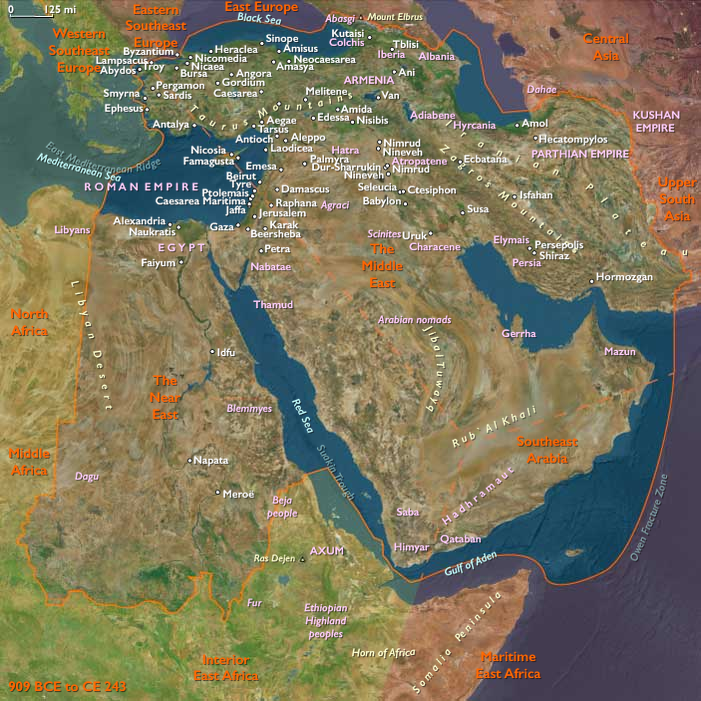
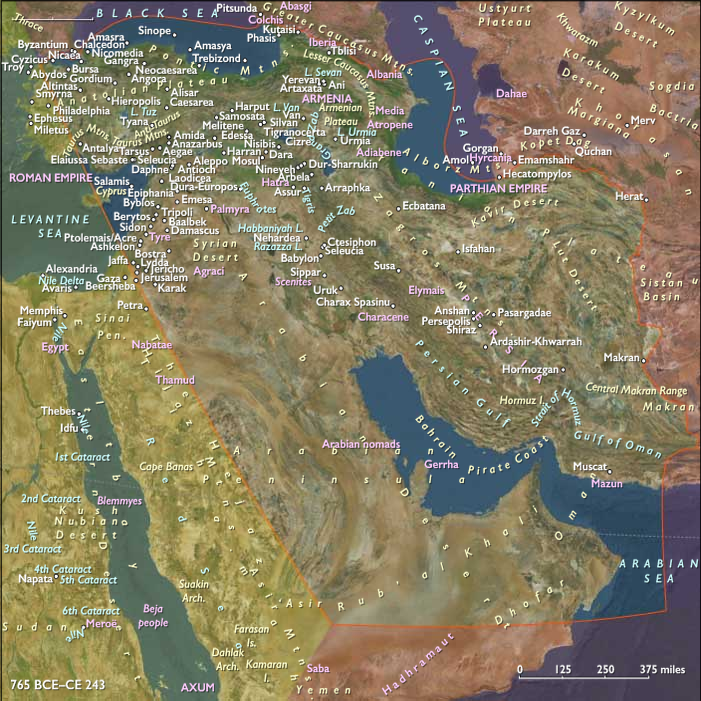
The uneasy stability achieved by Rome's cautious diplomacy in the preceding era rapidly deteriorates, leading to further upheaval in Parthia. Vonones I, installed with Roman support, struggles to maintain his legitimacy amidst escalating resentment among the Parthian nobility due to his overtly Romanized manner and affiliations. By 16 CE, internal opposition compels Vonones to flee, first to Armenia and subsequently to Roman protection in Syria, where he lives under Roman custody.
Seizing upon this power vacuum, the Parthian aristocracy invites Artabanus II, ruler of Media Atropatene, to assume the Parthian throne. Artabanus II swiftly consolidates his position around 18 CE, adopting a distinctly anti-Roman stance. His assertiveness marks a new phase of Parthian resurgence, significantly shifting regional dynamics and prompting renewed Roman diplomatic and military attention.
Roman interests, deeply invested in the status of Armenia as a critical buffer state, become increasingly concerned by Artabanus's assertiveness, which threatens to destabilize the carefully maintained balance of power. Artabanus openly challenges Roman hegemony, maneuvering to install a pro-Parthian king in Armenia. Rome responds swiftly, deploying diplomatic envoys backed by the implicit threat of military intervention.
In 20 CE, the Roman general and future emperor Germanicus Caesar travels eastward to assert Roman interests, but his sudden death in Antioch in 19 CE delays decisive action, fueling suspicion and tension on both sides. Meanwhile, Artabanus's domestic policy of centralization provokes discontent among the powerful Parthian noble houses, fostering continued instability within the Parthian state.
The era concludes with Artabanus II temporarily consolidating power but presiding over an increasingly fragmented realm. Rome, for its part, continues to carefully monitor Parthian internal politics, ready to exploit weaknesses and preserve its strategic influence in Armenia and the broader Middle East. The ongoing rivalry between Rome and Parthia thus persists, characterized by diplomatic maneuvering, shifting alliances, and intermittent threats of war.
People
Groups
- Roman Republic
- Atropatene, (Media) Kingdom of
- Parthian Empire
- Armenia, Kingdom of Greater
- Syria (Roman Province)
Topics
Subjects
Regions
Subregions
Years: 16 - 27
People
Groups
- Roman Republic
- Atropatene, (Media) Kingdom of
- Parthian Empire
- Armenia, Kingdom of Greater
- Syria (Roman Province)
Topics
Subjects
Regions
Subregions