
The Middle East: 621–478 BCE Rise …
Years: 621BCE - 478BCE
The Middle East: 621–478 BCE
Rise and Expansion of the Achaemenid Empire
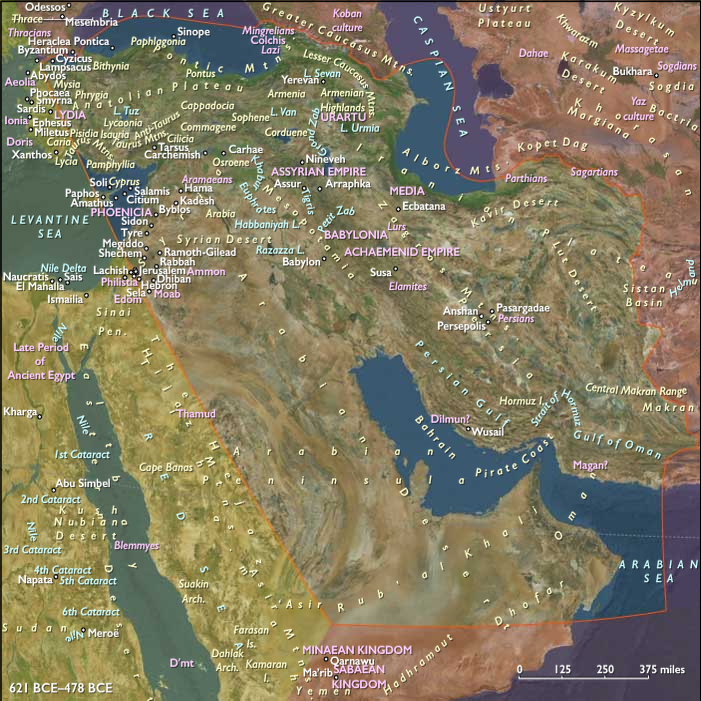
From the late seventh to the early fifth centuries BCE, the Middle East witnesses the rise and consolidation of the Achaemenid Persian Empire, transforming regional geopolitics. Under Cyrus the Great, the empire rapidly expands, uniting Medes and Persians into a formidable power. By 546 BCE, Cyrus has conquered Lydia, integrating Asia Minor and the Levant. His empire stretches from the Hindu Kush to the Mediterranean, exemplified by his humane conquest of Babylon in 539 BCE, where he famously releases the Judahites from captivity, earning him an enduring legacy in biblical texts.
Administrative Innovations and Cultural Integration
Following a brief period of instability after Cyrus’s death, Darius I ascends the throne in 522 BCE, imposing order through significant administrative and economic reforms. He introduces a structured system of satrapies, standardized legal codes (Universal Law), and creates a sophisticated postal system supported by the extensive Royal Road. His issuance of gold coinage (darics) fosters robust economic activity throughout the vast empire.
Under Darius, cultural and religious practices, notably Zoroastrianism, are actively promoted as tools for unifying diverse peoples. Monumental architecture at Persepolis symbolizes imperial unity, blending artistic traditions from across conquered territories.
Military Ambitions and Western Limitations
Despite substantial successes in consolidating internal control, Darius's military ambitions in Greece are significantly challenged. The Persian defeat at the Battle of Marathon in 490 BCE marks a notable limitation of Persian expansion westward, laying groundwork for future Greek-Persian conflicts.
Transition and Challenges Under Xerxes
Following Darius's death in 486 BCE, his son Xerxes I inherits an expansive but increasingly strained empire. Xerxes swiftly quells rebellions in Egypt and Babylonia before embarking on ambitious campaigns against Greece. Initial successes, notably at Thermopylae, are overshadowed by decisive defeats at Salamis and Plataea, forcing Persian withdrawal and marking a pivotal shift in Mediterranean geopolitics.
Mesopotamian Shifts: From Babylonian Splendor to Persian Rule
Under the earlier Neo-Babylonian Empire, particularly during Nebuchadnezzar II's reign (605–562 BCE), Babylon achieves significant cultural and architectural prominence, exemplified by structures like the legendary Hanging Gardens. However, internal religious conflicts weaken Babylon, paving the way for Persian conquest under Cyrus in 539 BCE.
Persian administration initially revitalizes Mesopotamia economically, but by 500 BCE, signs of cultural and economic decline become apparent, reflecting shifting regional importance.
Phoenicia, Cyprus, and the Persian Sphere
Phoenician cities and Cyprus become integral maritime and commercial hubs within the Persian sphere. While Phoenician naval resources are vital during Persian campaigns, especially against Greece, burdensome tribute obligations lead to periodic rebellions. Cyprus, though officially a Persian satrapy, retains considerable autonomy, culturally aligning closely with Greece and occasionally resisting Persian domination.
Technological Advances and Economic Integration
The Achaemenids introduce notable innovations such as early forms of mercury amalgamation around 500 BCE. Economic and trade advancements under Persian rule significantly enhance interregional commerce, embedding Persian cultural and linguistic influences into broader Mediterranean and Middle Eastern contexts.
Thus, the era from 621 to 478 BCE sees the Middle East dramatically reshaped by the rapid expansion and sophisticated governance of the Achaemenid Persian Empire, laying enduring foundations for subsequent regional dynamics.
People
Groups
- Athens, City-State of
- Medes
- Greece, classical
- Persian people
- Sparta, Kingdom of
- Greeks, Classical
- Egypt (Ancient), Late Period of
- Zoroastrians
- Neo-Babylonian, or Chaldean, Empire
- Achaemenid Empire
- Babylonia, Classical
Topics
- Persian Conquests of 559-509 BCE
- Greco-Persian Wars, Early
- Persian Invasion of Greece, First
- Marathon, Battle of
- Thermopylae, Battle of
- Persian Invasion of Greece, Second
- Salamis, Battle of
- Plataea, Battle of
Commodoties
Subjects
Regions
Subregions
Years: 621BCE - 478BCE
People
Groups
- Athens, City-State of
- Medes
- Greece, classical
- Persian people
- Sparta, Kingdom of
- Greeks, Classical
- Egypt (Ancient), Late Period of
- Zoroastrians
- Neo-Babylonian, or Chaldean, Empire
- Achaemenid Empire
- Babylonia, Classical
Topics
- Persian Conquests of 559-509 BCE
- Greco-Persian Wars, Early
- Persian Invasion of Greece, First
- Marathon, Battle of
- Thermopylae, Battle of
- Persian Invasion of Greece, Second
- Salamis, Battle of
- Plataea, Battle of
Commodoties
Subjects
Regions
Subregions