
The Middle East: 549–538 BCE Cyrus …
Years: 549BCE - 538BCE
The Middle East: 549–538 BCE
Cyrus the Great and the Persian Ascendancy
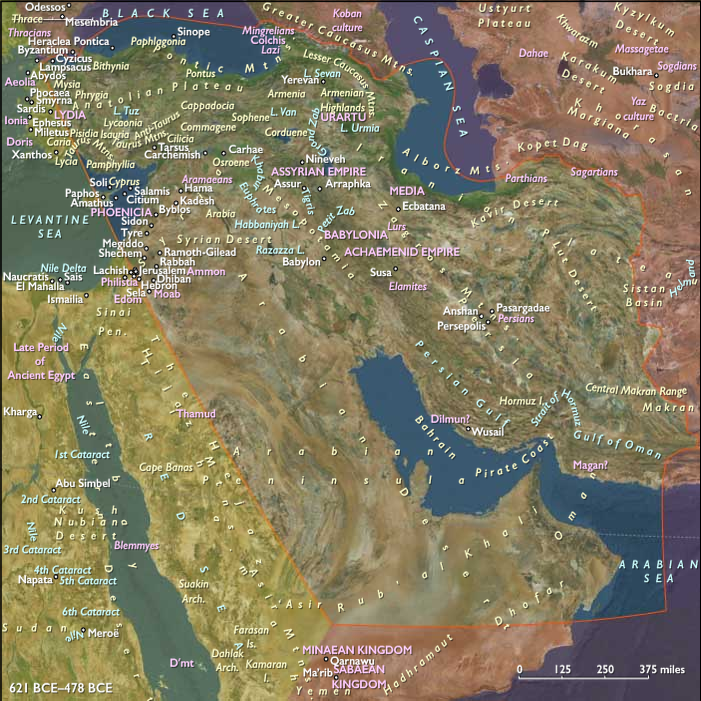
By 549 BCE, Cyrus the Great has firmly established his rule, officially assuming the title "King of Persia." Having previously dismantled the Median Empire and consolidated power by capturing the Median capital of Ecbatana, Cyrus continues to expand the burgeoning Achaemenid Persian Empire. He incorporates Media seamlessly into his empire, forming a lasting union of the Persians and Medes, and unites the twin kingdoms of Parsa and Anshan into the heartland of Persia proper.
Conquest of Lydia and Anatolian Expansion
Cyrus’s ambitious westward expansion places him in conflict with the wealthy kingdom of Lydia, ruled by Croesus. Initially engaging in an indecisive battle at Pteria in Cappadocia, Cyrus decisively defeats Croesus at the subsequent Battle of Thymbra. The Lydian capital, Sardis, soon falls after a brief siege around 546 BCE, leading to Persian dominance over Lydia and its Greek colonies, including cities like Ephesos and Cyzicus. This marks the beginning of Persia's profound influence over Anatolia and its Greek-speaking communities.
Persian Consolidation and the Fall of Babylon
After securing Lydia and the Ionian Greek cities along the Aegean coast, Cyrus turns his attention to Babylonia, exploiting internal unrest and dissatisfaction under King Nabonidus and his co-regent son, Belshazzar. In 539 BCE, Persian forces engage Babylonian armies at the strategic location of Opis along the Tigris River. Cyrus swiftly secures victory, leading to the rapid surrender of major Babylonian centers including Babylon, Sippar, and Ur.
Babylon's conquest is notably recorded on the famous Cyrus Cylinder, an inscription where Cyrus proclaims himself "king of Babylon, king of Sumer and Akkad, king of the four corners of the world," emphasizing his policy of restoring religious sanctuaries and repatriating displaced peoples. This conquest signals a definitive shift, positioning Persia as the dominant power across Mesopotamia and the wider Near East.
Thus, between 549 and 538 BCE, the Middle East undergoes dramatic geopolitical transformations, spearheaded by Cyrus's Persian Empire. His rapid and effective consolidation of power from Anatolia through Mesopotamia sets the stage for a new era of Persian ascendancy, profoundly reshaping the political and cultural landscape of the ancient world.
People
Groups
- Medes
- Persian people
- Megara, City-State of
- Mariandyni
- Greeks, Classical
- Anshan, Kingdom of
- Neo-Babylonian, or Chaldean, Empire
- Medes, Kingdom of the
- Judahites
- Achaemenid Empire
Topics
Subjects
Regions
Subregions
Years: 549BCE - 538BCE
People
Groups
- Medes
- Persian people
- Megara, City-State of
- Mariandyni
- Greeks, Classical
- Anshan, Kingdom of
- Neo-Babylonian, or Chaldean, Empire
- Medes, Kingdom of the
- Judahites
- Achaemenid Empire
Topics
Subjects
Regions
Subregions