
The Middle East: 765–754 BCE Assyrian …
Years: 765BCE - 754BCE
The Middle East: 765–754 BCE
Assyrian Decline and Instability
Beginning around 765 BCE, the Assyrian Empire enters a prolonged period of internal instability and external vulnerability. Under the rule of Ashur-dan III (773–755 BCE), Assyria endures significant setbacks, including a devastating plague in 765 BCE, which halts customary annual military campaigns. This plague, combined with the ominous total eclipse of the sun recorded on June 15, 763 BCE (the "Bur-Sagale eclipse"), profoundly shakes Assyrian confidence and authority.
The eclipse is interpreted as a dire omen, further exacerbating the country's already fragile state, characterized by widespread discontent and the lingering effects of plague. This period witnesses intense internal turmoil, including a major revolt in 763 BCE, which persists until another plague strikes four years later. During this tumultuous period, Assyrian rulership is considerably weakened by the influence of powerful court dignitaries, particularly the commander-in-chief (turtanu), Shamshi-ilu.
Rise and Dominance of Urartu
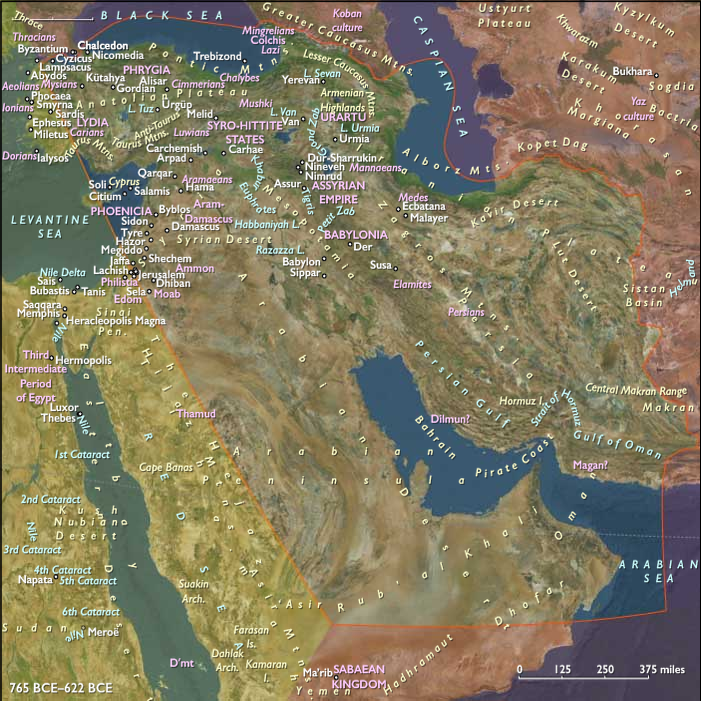
In stark contrast to Assyria's difficulties, the northern kingdom of Urartu reaches the pinnacle of its power under King Argishti I (785–763 BCE). Argishti significantly expands Urartian influence, successfully establishing the citadel of Erebouni (modern Yerevan, Armenia) in 782 BCE and constructing the strategically important fortress-city of Argishtikhinili in 776 BCE.
Under Argishti’s leadership, Urartu secures victories over Assyria, captures the northern Syrian territories, and extends control northward into regions around Lake Sevan, the Ararat Valley, and areas close to the Black Sea. Argishti even manages to frustrate Assyrian King Shalmaneser IV’s military campaigns, at one point extending Urartian military reach to the gates of Babylon itself.
Following Argishti, Sarduri II assumes the Urartian throne, continuing to uphold Urartu’s territorial expansion and regional influence. The kingdom at its zenith encompasses present-day Armenia, significant parts of southern Georgia, eastern Anatolia, and stretches eastward into areas around Tabriz and Lake Urmia. This era solidifies Urartu as a dominant northern rival of the Neo-Assyrian Empire, marking the rise of the first recognized Armenian empire.
Thus, the era from 765 to 754 BCE highlights the striking contrast between Assyria's internal crisis and Urartu's ascendancy, reshaping the geopolitical dynamics in the ancient Middle East.
People
Groups
Topics
Subjects
Regions
Subregions
Years: 765BCE - 754BCE
People
Groups
Topics
Subjects
Regions
Subregions