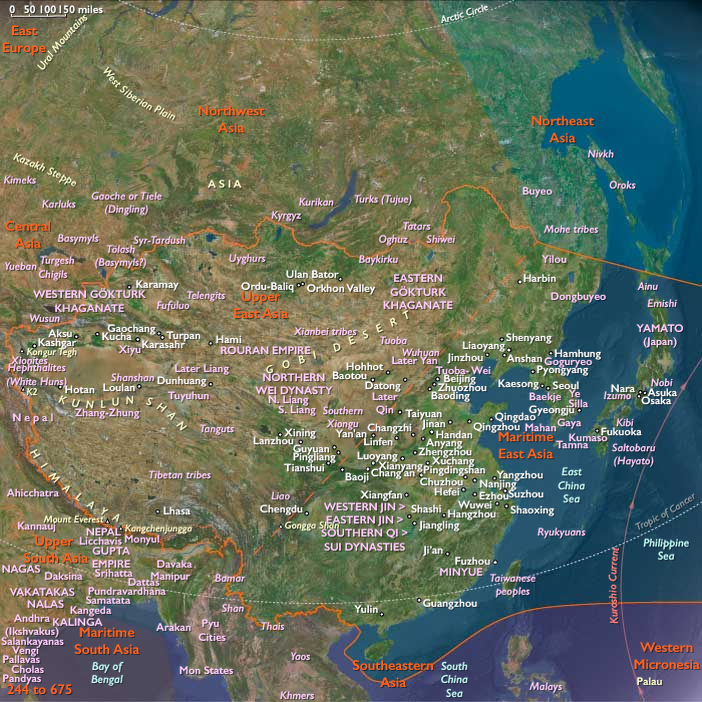
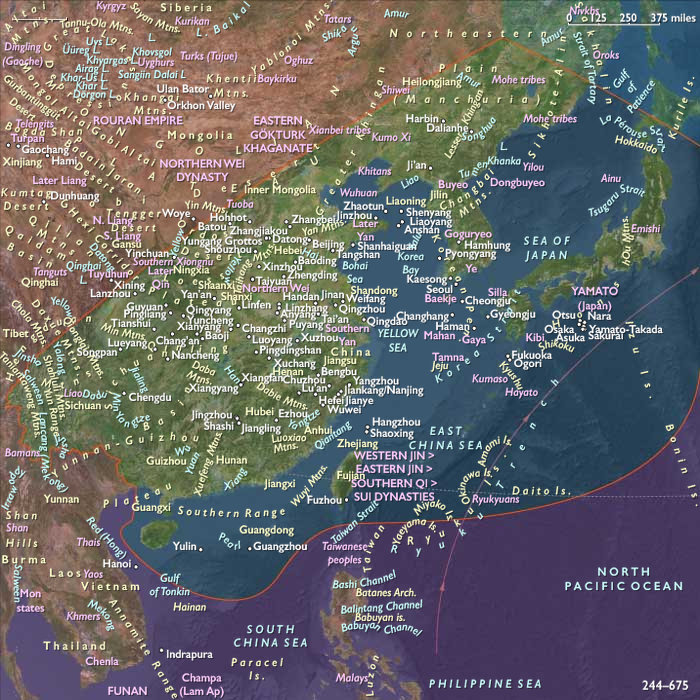
The Murong Xianbei invade once again in …
Years: 406 - 406
June
The Murong Xianbei invade once again in 406, but yet again the king of Goguryeo is able to repel them.
Locations
People
Groups
- Korean people
- Xianbei
- Silla, Kingdom of
- Goguryeo (Koguryo), Kingdom of
- Baekje (or Paekche), Kingdom of
- Later Yan, Xianbei kingdom of
Topics
Commodoties
Subjects
Regions
Subregions
Related Events
Filter results
Showing 10 events out of 59211 total
Gongsun, in order to grab even more power, falsely accuses Murong Zhong of treason in 406.
Murong Zhong, Murong Fa, and Duan Hong therefore enter into a conspiracy in which Feng Song and Empress Dowager Duan are also involved, but Empress Dowager Duan, in fear, eventually reveals the plot to Murong Chao.
Feng is executed, and Murong Chao sends generals Murong Zhen, the Prince of Guilin, and Han Fan to attack Murong Zhong, Murong Fa, and Duan Hong.
Duan Hong flees to Northern Wei, while Murong Zhong and Murong Fa flee to Later Qin.
A triumphal arch is erected at Rome in celebration of the imperial victory over Radagaisus.
Stilicho, hearing of new invaders and rebels who had appeared in the northern provinces, insists in 406 on making peace with Alaric, probably on the assumption that Alaric would prepare to move either against the Eastern court or against the rebels in Gaul.
Stained glass is used for the first time in churches in Rome.
In early Christian churches of the fourth and fifth centuries, there are many remaining windows which are filled with ornate patterns of thinly sliced alabaster set into wooden frames, giving a stained-glass like effect.
The Invasion of Gaul: A New Wave of Destruction
The Vandals, Suebi, and Alani, having crossed the Rhine in 406 CE, are quickly followed by a second wave of invaders—the Burgundians and non-federated Alemanni. Unlike the earlier groups, these new arrivals have no prior agreements with Rome and come as unchecked raiders and conquerors, adding to the chaos engulfing Gaul.
As they sweep across Roman territory, these Germanic groups easily overrun the federated Franks and Alemanni, who had been tasked with defending the empire’s northern frontiers. The Roman border defenses—already strained and reliant on these federate forces—crumble in the face of relentless assaults.
With the imperial legions unable to mount an effective response, Gaul descends into anarchy, its cities and countryside devastated by raiders and settlers alike. This breakdown of Roman authority further accelerates the decline of the Western Roman Empire, leaving vast territories beyond effective imperial control.
Chinese traveler Faxian arrives in India, and visits the major seats of Buddhist learning (Oddiyana, Peshawar, and …
…Taxila).
One Atticus, an ordained presbyter who had soon became known as a rising man, had proved himself one of John Chrysostom's most bitter adversaries.
If not, as Palladius of Galatia asserts, the architect of the whole cabal, he certainly took a very leading part in carrying it into execution.
The organization of the Synod of the Oak owed much to his practical skill.
Pope Innocent I at Rome had ordered a synod to reinstate Chrysostom as bishop, but his envoys had been imprisoned.
Chrysostom’s successor, the aged Arsacius, had died on November 5, 405.
Four months of intrigue ended in the selection of Atticus as the new bishop of Constantinople.
Roman legions in Britain mutiny against Honorius and select Marcus as new emperor.
He may have risen to power as a reaction to the increasing raids from abroad at a time when the Empire is withdrawing troops from its distant provinces like Britain to protect its heartland.
There are too few troops capable of defending Britain at this time, as raiders such as Irish records of raiders like Niall of the Nine Hostages show.
Local troops, with ties to their home garrisons, are likely to have resisted being redeployed to Italy at a time of such instability in Britain; Marcus' elevation may have been a result of this or some other, unrecorded crisis.
Liu Bobo was born in 381, when his father Liu Weichen was an important Xiongnu chief and a vassal of Former Qin.
It is not known whether his mother Lady Fu was Liu Weichen's wife or concubine.
He was one of Liu Weichen's younger sons.
After Former Qin collapsed in light of various rebellions after its emperor Fu Jiān's defeat at the Battle of Fei River in 383, Liu Weichen took control of what is now part of Inner Mongolia south of the Yellow River and extreme northern Shaanxi, and while he nominally submitted to both Later Qin and Western Yan as a vassal, he was actually a powerful independent ruler.
However, in 391, he sent his son Liu Zhilidi to attack Northern Wei's prince Tuoba Gui, and Tuoba Gui not only defeated Liu Zhilidi, but crossed the Yellow River to attack Liu Weichen's capital Yueba (in modern Ordos, Inner Mongolia), capturing it and forcing Liu Weichen and Liu Zhilidi to flee.
The next day, Liu Weichen was killed by his subordinates, and Liu Zhilidi was captured.
Tuoba Gui seized Liu Weichen's territory and people and slaughtered his clan.
However, Liu Bobo escaped and fled to the Xuegan tribe, whose chief Tai Xifu refused to turn him over despite Northern Wei demands.
Instead, Tai delivered Liu Bobo to the Xianbei tribal chief Mo Yigan, the Duke of Gaoping, a Later Qin vassal, and Mo Yigan not only gave Liu Bobo refuge but also married one of his daughters to Liu Bobo.
Liu Bobo, from that point on, became highly dependent on his father-in-law.
(Meanwhile, in 393, Tuoba Gui, because of Tai Xifu's refusal to deliver Liu Bobo to him, attacked Tai and slaughtered his people, although Tai himself escaped and fled to Later Qin.)
Little is known about Liu Bobo's life during the following years.
In 402, Tuoba Gui's brother Tuoba Zun, the Prince of Changshan, attacked Mo's home base of Gaoping (in modern Guyuan, Ningxia), and Mo was forced to flee to Later Qin, abandoning his own people, who were scattered about, although later Later Qin recaptured Gaoping and gave that city back to Mo.
Sometime before 407, Liu Bobo, who has become known for being handsome, ability to speak well, alertness, and intelligence, had come to the attention of Later Qin's emperor Yao Xing.
Yao Xing had been so impressed by Liu Bobo's abilities when he met Liu Bobo that he wanted to make him a major general to defend against Northern Wei.
Yao Xing's brother Yao Yong, however, spoke against it, believing Liu Bobo to be untrustworthy.
Yao Xing initially, at Yao Yong's counsel, did not give Liu Bobo a commission, but eventually was so seduced by his talent that he made him a general and the Duke of Wuyuan, giving him the responsibility of defending Shuofang (in modern Ordos as well).
In 407, after suffering a number of losses against Northern Wei, Yao Xing decides to make peace with Northern Wei.
Upon hearing this, Liu Bobo becomes angry, because his father had been killed by Northern Wei, and he plans rebellion.
He therefore forcibly seizes the horses that Yujiulü Shelun), the khan of Rouran, had recently offered to Yao Xing as a tribute, and then makes a surprise attack on his father-in-law Mo Yigan, capturing Gaoping and killing Mo, seizing his troops.
He then declares himself a descendant of Yu the Great, the founder of Xia Dynasty, and names his state Xia.
He claims the title "Heavenly Prince" (Tian Wang).
Despite Liu Bobo's stated hatred for Northern Wei, he concentrates his efforts on undermining Later Qin, continually harassing Later Qin's northern territories and draining Later Qin's resources.
He therefore does not settle in a capital city; rather, he roved about with his mobile cavalry, constantly looking for Later Qin cities to pillage.
Also in 407, Liu Bobo seeks marriage with a daughter of the Southern Liang prince Tufa Rutan, but Tufa Rutan refuses.
In anger, Liu Bobo launches a punitive raid against Southern Liang, then retreats.
Tufa Rutan gives chase and, believing that he greatly outpowers Liu Bobo, is careless in his military actions.
Liu Bobo leads him into a canyon and locks the exit with ice and wagons, then ambushes him.
The defeat is such that it was said that sixty to seventy percent of Southern Liang's famed officials and generals died in the battle.
Tufa Rutan barely escapes capture.

Murong Chao sends his official Feng Kai to Later Qin in 407 to negotiate to have Yao Xing turn his mother and wife over to him.
Yao Xing demands that he submit as a vassal and further gives Later Qin either the court musicians of Former Qin (who had, after much travels, settled down in Southern Yan by this point) or one thousand captives from Jin.
Murong Chao readily agrees to be a vassal, but hesitates at both alternative demands.
Eventually, in fear of retaliation from Jin, he chooses to turn over one hundred and twenty musicians.
Yao Xing then delivers his mother Lady Duan and wife Lady Huyan to him.
John Chrysostom, exiled to Pisunda, dies near the shore in 407.
Modern excavations in Pitsunda have unearthed remains of three fourth-century churches and a bath with superb mosaic floors.
The former "Great Pityus" harbor is now a mere lake within the town.
Years: 406 - 406
June
Locations
People
Groups
- Korean people
- Xianbei
- Silla, Kingdom of
- Goguryeo (Koguryo), Kingdom of
- Baekje (or Paekche), Kingdom of
- Later Yan, Xianbei kingdom of