
The Natchez Rebellion expands into a larger …
Years: 1730 - 1730
July
The Natchez Rebellion expands into a larger regional conflict with many repercussions.
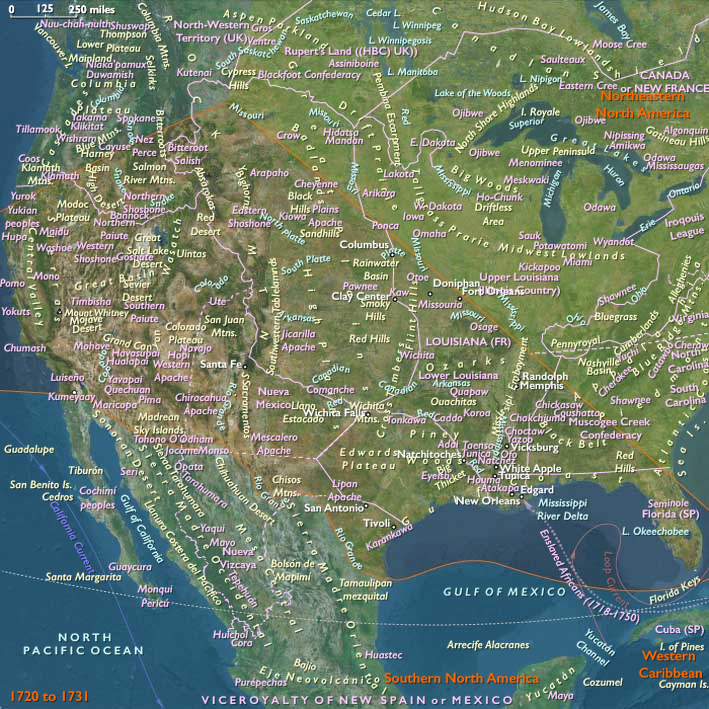
The Tunica are initially reluctant to fight on either side.
The Head Chief of the Tunica, Cahura-Joligo, agrees in June 1730, tto let a small party of Natchez refugees settle near his village, with the provision that they should do so unarmed.
He receives thirty Natchez warriors into his village, after disarming them.
A few days later, the last chief of the Natchez arrives at the Tunica village with a hundred men, and an unknown number of women and children.
They also conceal Chickasaw and Koroa in the canebrake around the village.
Cahura-Joligo informs them that he cannot receive them unless they give up their arms.
They reply that this is their intention, but ask if they can keep them awhile longer so their women do not get the impression that their unarmed men are prisoners.
He consents to their request and proceeds to distribute food to his new guests.
A celebratory dance is held till after midnight, when the Tunica retire to their cabins, thinking that the Natchez will do the same.
The Natchez, Chickasaw and Koroa attack their hosts in their cabins, and kill all they manage to surprise while asleep.
Cahura-Joligo kill four Natchez during the fighting, but is eventually killed along with twelve of his warriors.
His war-chief Brides les Boeufs (Buffalo Tamer), with a dozen of his warriors, repulses the attack and retakes the Head Chief's cabin.
He rallies his remaining warriors, and after fighting for five days and nights without interruption, regains control of the village.
Twenty Tunica are killed and as many wounded in the fighting.
They have also managed to kill thirty-three of the Natchez warriors and take three prisoners, who are later burned in punishment for the attack.
The Tunica, in retaliation, will throughout the 1730s and into the 1740s attack Natchez refugees.
Locations
People
Groups
- Natchez (Amerind tribe)
- Koroa (Amerind tribe)
- Choctaw (Amerind tribe)
- Chickasaw (Amerind tribe)
- Quapaw, or Arkansas (Amerind tribe)
- Tunica people
- Yazoo (Amerind tribe)
- New France (French Colony)
- France, (Bourbon) Kingdom of
- Carolina, Province of (English Colony)
- Louisiana (New France)
- Britain, Kingdom of Great
Topics
Commodoties
Subjects
Regions
Subregions
Years: 1730 - 1730
July
Locations
People
Groups
- Natchez (Amerind tribe)
- Koroa (Amerind tribe)
- Choctaw (Amerind tribe)
- Chickasaw (Amerind tribe)
- Quapaw, or Arkansas (Amerind tribe)
- Tunica people
- Yazoo (Amerind tribe)
- New France (French Colony)
- France, (Bourbon) Kingdom of
- Carolina, Province of (English Colony)
- Louisiana (New France)
- Britain, Kingdom of Great
Topics
Commodoties
Subjects
Regions
Subregions