
The native Taíno people before the arrival …
Years: 1496 - 1496
May
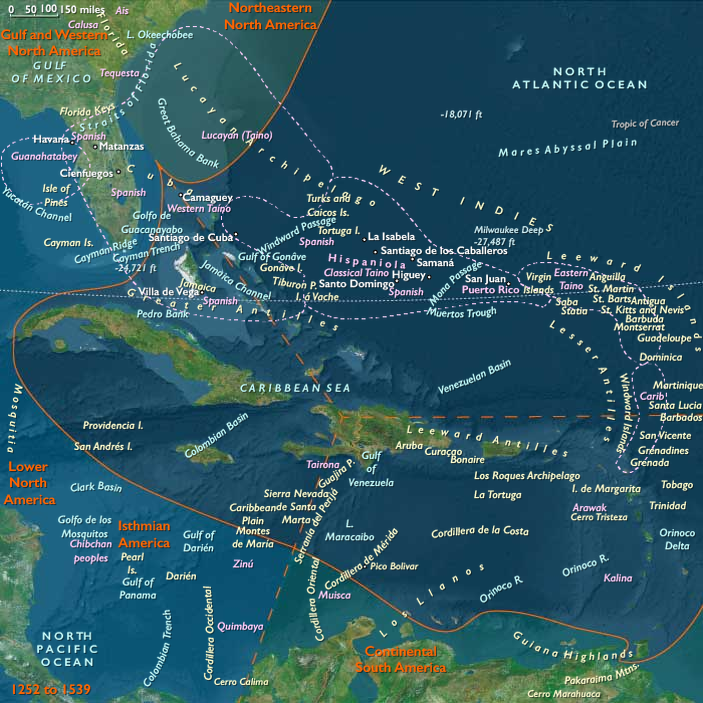
The native Taíno people before the arrival of Christopher Columbus in 1492 had populated the island that they call Quisqueya (mother of all lands) and Ayiti (land of high mountains), and which Columbus later names Hispaniola, including the territory of today's Republic of Haiti.
At this time, the island's territory consists of five chiefdoms: Marién, Maguá, Maguana, Jaragua, and Higüey These are ruled respectively by caciques (chiefs) Guacanagarix, Guarionex, Caonabo, Bohechío, and Cayacoa.
Bartholomew Columbus had founded a settlement on the site of today’s Santo Domingo and named it La Nueva Isabela, after the earlier settlement in the north named after the Queen of Spain, Isabella I.
It had been renamed "Santo Domingo" in 1495, in honor of Saint Dominic.
Santo Domingo will come to be known as the "Gateway to the Caribbean" and the chief town in Hispaniola from this point forward.
Expeditions that lead to Ponce de León's colonization of Puerto Rico, Diego Velázquez de Cuéllar's colonization of Cuba, Hernando Cortes' conquest of Mexico, and Vasco Núñez de Balboa's sighting of the Pacific Ocean will all be all launched from Santo Domingo.
Locations
People
- Bartholomew Columbus
- Christopher Columbus
- Diego Velázquez de Cuéllar
- Hernán Cortés
- Isabella I of Castile
- Juan Ponce de León y Figueroa
- Juan de la Cosa
- Martín Alonso Pinzón
- Vasco Núñez de Balboa
Groups
- Arawak peoples (Amerind tribe)
- Kalinago (Amerind tribe)
- Lucayans
- Taíno
- Aragón, Kingdom of
- Aragon, Crown of
- Castile, Crown of
- Canary Islands (Castilian colony)
- Santo Domingo, Captaincy General of
Topics
- Age of Discovery
- Canary Islands, conquest of the
- Colonization of the Americas, Spanish
- Spanish Golden Age
Subjects
Regions
Subregions

Years: 1496 - 1496
May
Locations
People
- Bartholomew Columbus
- Christopher Columbus
- Diego Velázquez de Cuéllar
- Hernán Cortés
- Isabella I of Castile
- Juan Ponce de León y Figueroa
- Juan de la Cosa
- Martín Alonso Pinzón
- Vasco Núñez de Balboa
Groups
- Arawak peoples (Amerind tribe)
- Kalinago (Amerind tribe)
- Lucayans
- Taíno
- Aragón, Kingdom of
- Aragon, Crown of
- Castile, Crown of
- Canary Islands (Castilian colony)
- Santo Domingo, Captaincy General of
Topics
- Age of Discovery
- Canary Islands, conquest of the
- Colonization of the Americas, Spanish
- Spanish Golden Age
Subjects
Regions
Subregions