
The Near East, 1876 to 1887 CE: …
Years: 1876 - 1887
The Near East, 1876 to 1887 CE: European Intervention and the British Occupation of Egypt
Escalating Financial Control and European Domination
When Ismail suspends interest payments on Egypt's foreign debts in 1875, Britain and France swiftly respond by sending representatives through the Goschen-Joubert Mission. This mission consolidates Egypt’s debt and establishes strict European oversight through the Caisse de la Dette Publique, diverting over sixty percent of Egypt's revenue directly to European creditors by 1877.
European interference increases further with the formation of an international commission to investigate Egypt's finances, leading to the appointment of numerous European officials in key government positions. These interventions undermine Egyptian sovereignty, exacerbating tensions among the local population.
Nationalist Movements and the Urabi Revolt
Opposition to European interference unites Egyptian notables, intellectuals, and military officers. The nationalist sentiment crystallizes around army officer Colonel Ahmad Urabi, who emerges as the leader of the nationalist Al Hizb al Watani al Ahli (National Popular Party). Urabi’s movement aims not only to eliminate European influence but also to challenge the authority of Khedive Tewfiq, who had replaced Ismail under European pressure.
Tensions escalate dramatically when Urabi and his followers seize political influence, resulting in anti-European riots in Alexandria and prompting military interventions by Britain and France. Britain ultimately decides to act alone, bombarding Alexandria in July 1882 and launching a full-scale invasion.
British Military Occupation and Defeat of the Urabi Revolt
Under Sir Garnet Wolseley, a British force of twenty thousand lands in Egypt and defeats Urabi’s army decisively at Tall al Kabir on September 13, 1882. The British rapidly occupy Cairo, reinstate Khedive Tewfiq, and effectively establish Egypt as an unofficial British protectorate.
Urabi is captured, sentenced to death, and subsequently exiled to Ceylon after British intervention. Although the British initially announce intentions of a temporary occupation, their prolonged military and administrative presence becomes a lasting reality, shaping Egypt’s governance for decades.
Mahdist Movement and Revolt in Sudan
Concurrently, in Sudan, Muhammad Ahmad ibn al-Sayyid Abdallah emerges as the Mahdi, leading a widespread revolt against Egyptian-Ottoman rule. The Mahdi’s movement, known as the Mahdiyyah, calls for a return to early Islamic purity, rejection of Ottoman authority, and expulsion of foreign influence. By 1882, the Mahdi’s forces, the Ansar, achieve significant victories, capturing Al-Obeid and defeating Egyptian armies sent against them.
The Mahdist regime imposes strict religious laws, rejects foreign influence, and garners widespread local support. British attempts to relieve besieged Egyptian garrisons culminate tragically in 1885 when General Charles Gordon is killed and Khartoum falls to Mahdist forces, solidifying Mahdist control over much of Sudan.
Societal Impact and Resistance to European Domination
This era marks significant upheaval within Egyptian society. Continued financial crises and European economic policies exacerbate rural poverty, deepening indebtedness and land loss among peasants. European control, symbolized by the Caisse de la Dette Publique, significantly restricts Egyptian economic sovereignty and autonomy.
The nationalist backlash against European interference, embodied by Urabi's revolt, underscores rising Egyptian resistance and the desire for political independence. Though suppressed militarily, these nationalist sentiments persist, fueling continued opposition to British rule in subsequent decades.
Legacy of the Era: Occupation, Resistance, and Colonial Domination
The period from 1876 to 1887 solidifies foreign domination over Egypt through British military occupation and European financial control, profoundly shaping Egypt’s political and economic trajectory. Concurrently, the rise and success of the Mahdist revolt in Sudan reveal significant local resistance to foreign intervention, setting the stage for future struggles for independence and national identity across the Near East.
People
- Ahmed Urabi
- Charles George Gordon
- Garnet Wolseley, 1st Viscount Wolseley
- Isma'il Pasha
- Muhammad Ahmad
- Tewfik Pasha
Groups
- Arab people
- Islam
- Britain (United Kingdom of Great Britain and Ireland)
- Egypt, (Ottoman) Viceroyalty of
- Sudan, Turco-Egyptian
- France (French republic); the Third Republic
- Ansar (Sudan)
Topics
Subjects
Regions
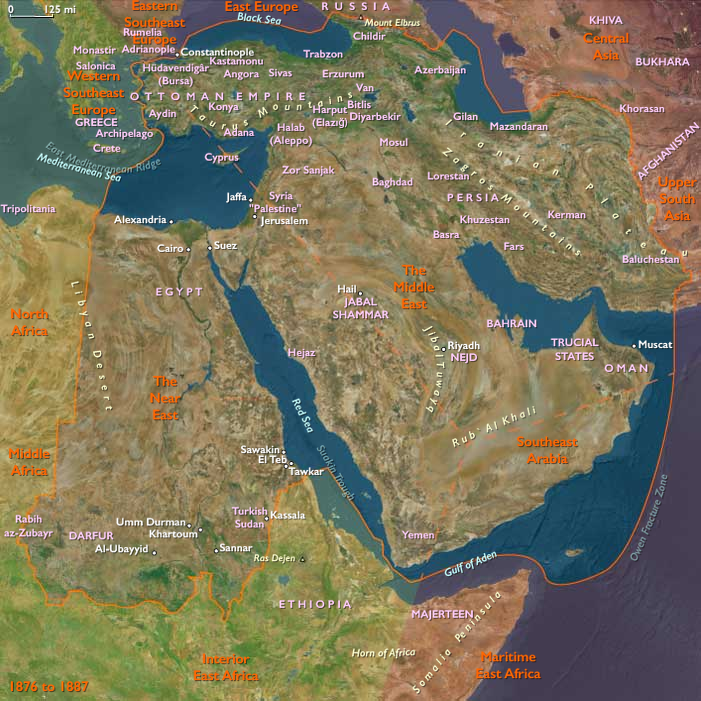
Subregions
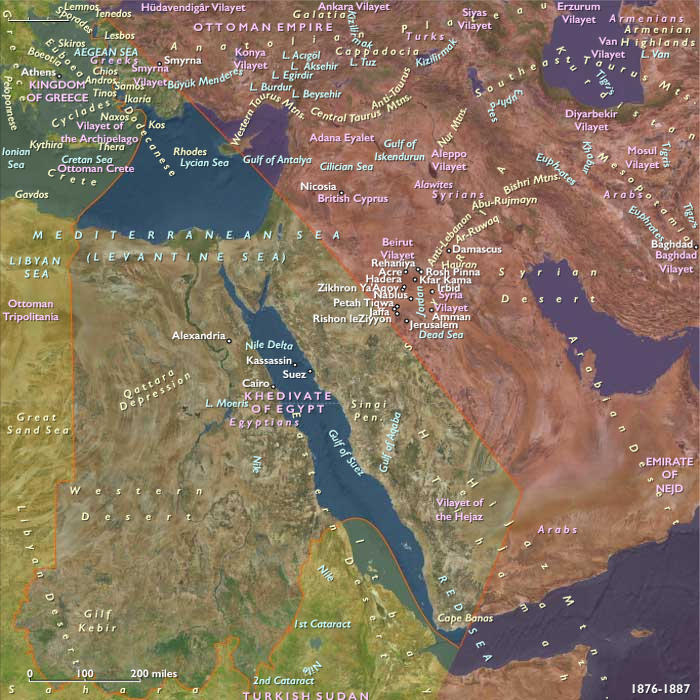
Years: 1876 - 1887
People
- Ahmed Urabi
- Charles George Gordon
- Garnet Wolseley, 1st Viscount Wolseley
- Isma'il Pasha
- Muhammad Ahmad
- Tewfik Pasha
Groups
- Arab people
- Islam
- Britain (United Kingdom of Great Britain and Ireland)
- Egypt, (Ottoman) Viceroyalty of
- Sudan, Turco-Egyptian
- France (French republic); the Third Republic
- Ansar (Sudan)
Topics
Subjects
Regions
Subregions