The oldest evidence of humans in the …
Years: 4509BCE - 4366BCE
The oldest evidence of humans in the Caribbean is the Casirimoid culture in Cuba and Hispaniola, which dates back to 4500 BCE, and is associated with edge grinders similar to those used in Archaic Age Central America.
Related Events
Filter results
Showing 10 events out of 68960 total
The Akahoya eruption, one of the largest eruptions during the Holocene, ocurring around 4350 BCE, ejects about one hundred and fifty cubic kilometers (thirty-six cubic miles) of tephra, giving it a 7 on the Volcanic Explosivity Index.
One of only six known eruptions reaching that magnitude during the Holocene, or the last twelve thousand years, it forms the massive, mostly submerged Kikai Caldera, up to nineteen kilometers (twelve miles) in diameter in the Osumi Islands of Kagoshima prefecture, Japan.
Pyroclastic flows from that eruption reach the coast of southern Kyushu up to one hundred kilometers (sixty-two miles) away, and ash falls as far as Hokkaido.
It dramatically changes vegetation in Southern Kyūshū.
Archaeologically it has been dated around 7,300 cal. BP during the Earliest Jōmon period, but it has also been radiocarbon dated to 6,500 BP.
The very earliest plow was the simple scratch-plow, or ard, which consists of a frame holding a vertical wooden stick that was dragged through the topsoil (still used in many parts of the world).
It breaks up a strip of land directly along the plowed path, which can then be planted.
Because this form of plow leaves a strip of undisturbed earth between the rows, fields are often cross-plowed at ninety degree angles, and this tends to lead to squarish fields.
In the archaeology of northern Europe, such squarish fields are referred to as "Celtic fields.’
Farmers in the lower Danube region begin using cattle as plow animals by about 4500, at which time central and eastern European cultures begin to practice rich burial patterns.
The Middle East (4509–4366 BCE): Chalcolithic Expansion and Animal Domestication
Occupation of Tepe Yahya
Between 4509 and 4366 BCE, the archaeological site of Tepe Yahya, located approximately 225 kilometers (140 miles) south of Kerman in present-day Iran, began its initial occupation around 4500 BCE. This site became an important center of early human settlement and technological advancement in the region.
Chalcolithic Technological Spread
By 4500 BCE, the Chalcolithic era—characterized by the concurrent use of copper and stone tools—had spread widely throughout the Fertile Crescent. This marked significant technological advancement, fostering improved tools and greater efficiency in daily activities, agriculture, and trade.
Domestication and Agricultural Development
The domestication of oxen, which possibly began as early as the sixth millennium BCE in Mesopotamia, profoundly impacted agricultural practices by providing farmers with the necessary power for developing plowing techniques. The introduction of the plow significantly enhanced agricultural productivity and facilitated expansion into previously difficult-to-cultivate areas.
Regional Animal Domestication
Animal domestication continued extensively across the region, reaching as far north as present-day Turkey and as far south as the Zagros Mountains. These practices supported increasingly stable and productive agricultural systems, contributing to the prosperity and expansion of communities across a broad geographic area.
This period highlights significant advancements in technology, agriculture, and domestication, underpinning further social and economic developments across the ancient Middle East.

Tepe Yahya, an archaeological site in present Iran, one hundred and forty miles (two hundred and twenty-five kilometers) south of Kerman is occupied from 4500.
The Chalcolithic, or copper- and stone-working technology, encompasses the Fertile Crescent by 4500 BCE.
There are also tribes that practice domesticating animals as far north as Turkey, and as far south as the Zagros Mountains.
The domestication of oxen in Mesopotamia, perhaps as early as the sixth millennium BCE, provided farmers with the pulling power necessary to develop the plow.
The Egyptian, Hamitic and Cushitic cultures of Africa in 4500 BCE remainl at the Neolithic level, as are most of the Semitic tribes of the Arabian Peninsula.
The Megalithic Tomb Tradition: A Pan-European Phenomenon
The megalithic tomb tradition, an evolution of collective burial practices seen in long barrows, extended across Western and Northern Europe, spanning from Évora in Portugal to northern Scotland, and eastward into Germany and Denmark. This architectural and ritualistic tradition reflects shared cultural influences among early Neolithic communities.
Regional Distribution and Variation
- The earliest known megalithic structures appear in Brittany (France), Iberia, and western France, before spreading northward and eastward into the British Isles, Scandinavia, and Central Europe.
- These stone-built tombs vary in external design and internal chamber structure, but all share a focus on communal burial and monumental stone construction.
The Cairn of Barnenez: One of Europe's Oldest Megalithic Monuments
- Located near Plouezoc'h on the Kernéléhen peninsula, in northern Finistère, Brittany, the Cairn of Barnenez dates to approximately 4500 BCE, placing it among the earliest megalithic structures in Europe.
- This massive burial cairn consists of two distinct phases of construction, ultimately reaching a length of about 72 meters (236 feet).
- Multiple burial chambers were built within the cairn, accessed through narrow passageways.
Megalithic Art and Symbolism
- Barnenez is notable for its engraved stones, featuring megalithic art that includes abstract geometric patterns, axes, and symbolic motifs.
- These engravings reflect ritual significance, suggesting that these sites were not merely tombs but also sacred ceremonial spaces.
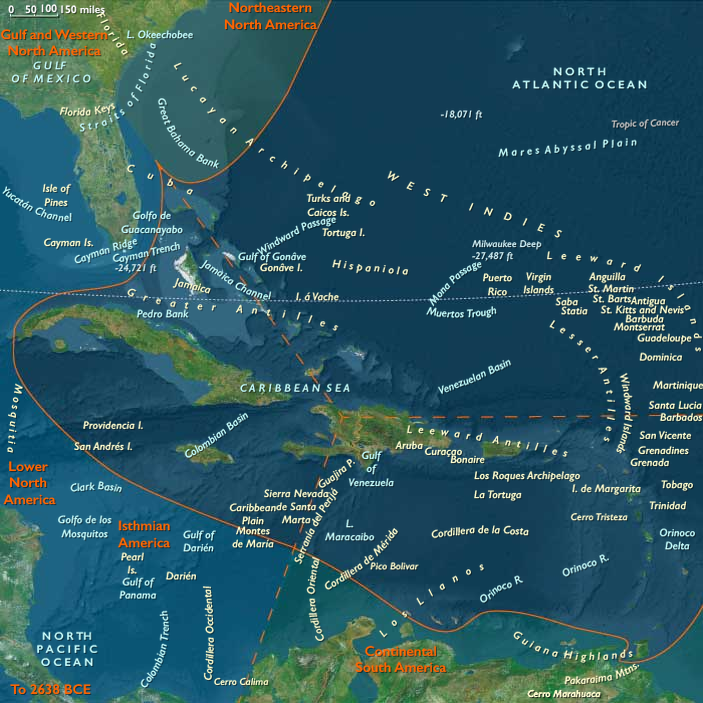
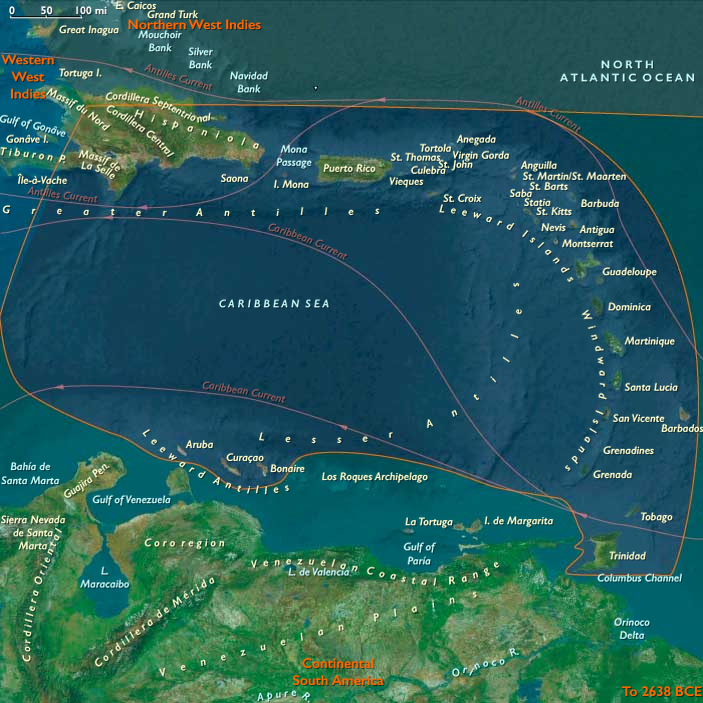
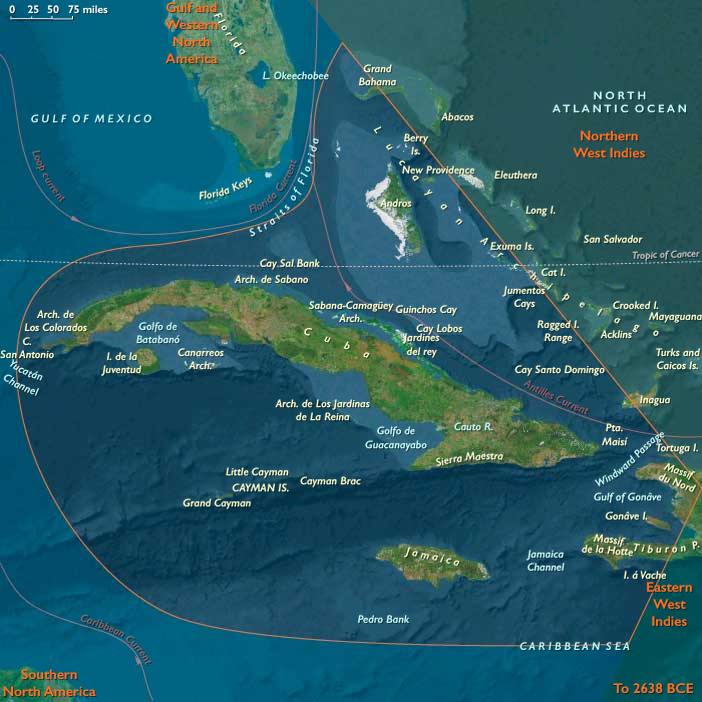
Western West Indies (4,365–2,638 BCE) Late Holocene — Ceramic Frontiers
Geographic and Environmental Context
Western West Indies includes Cuba and its surrounding isles, Jamaica, the Cayman Islands, and western Haiti — Tortuga Island, Port-de-Paix, western Massif du Nord, Gonâve Gulf & Île de la Gonâve, western Tiburon Peninsula (including Île à Vache).
Anchors: Windward Passage, Jamaica Channel, Tortuga–Port-de-Paix corridor, Gonâve Gulf, Cayman Ridge, northern Cuba shelves.
-
Saladoid ceramics and cassava gardening entered Cuba and Hispaniola (west); Jamaica later in sequence; plaza hamlets grew on leeward coasts.