
The original settlement on the Nekhen site …
Years: 3501BCE - 3358BCE
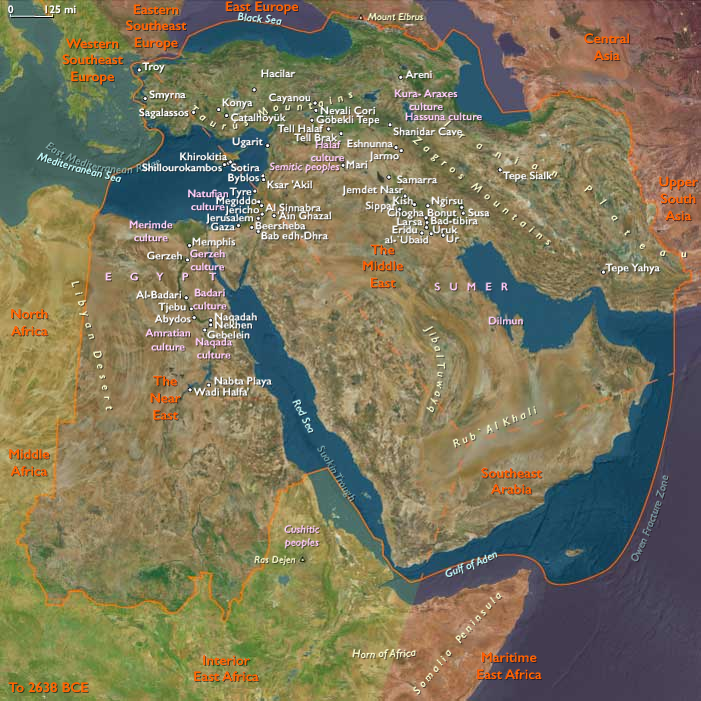
The original settlement on the Nekhen site dates from the culture known as Naqada I of 4400 BCE or the late Badarian culture, which may date from 5000 BCE.
Nekhen, later transliterated as Hierakonpolis, Hieraconpolis, or Hieracompolis, is at its height from about 3400 BCE, with at least five thousand and possibly as many as ten thousand inhabitants.
The oldest known zoological collection was revealed during excavations at Hierakonpolis in 2009 of a menagerie that dates to around 3500 BCE.
The exotic animals included hippos, hartebeest, elephants, baboons, and wildcats.
A jar with boat designs, from Hierakonpolis (today in the Brooklyn Museum), is created between about 3500 and 3400 BCE.
The first walled towns appear in Egypt around 3400.
Totemism, a complex of varied ideas and ways of behavior based on a worldview drawn from nature, is the basis for the belief system of Pre-Dynastic Egypt.
Positing a relation between kinship groups and specific animals and plants, Totemism is frequently mixed with different kinds of other beliefs, such as ancestor worship, ideas of the soul, or animism.
Each independent principality has its own totem.
Horus the falcon, one of the oldest and most significant deities in the Ancient Egyptian religion, is worshipped from at least the late Predynastic period.
The protector of Naqada in the south, Horus is also sometimes known as Nekheny, meaning "falcon.” Some have proposed that Nekheny may have been another falcon-god, worshiped at Nekhen (city of the hawk), but then Horus was identified with him early on.
Different forms of Horus are recorded in history and Egyptologists treat these as distinct gods.
These various forms may possibly be different perceptions of the same multi-layered deity in which certain attributes or syncretic relationships are emphasized, not necessarily in opposition but complementary to one another, consistent with how the Ancient Egyptians viewed the multiple facets of reality.
Horus is to serve many functions in the Egyptian pantheon, most notably being the god of the Sky, god of War and god of Protection.
Locations
Groups
Topics
Subjects
- Symbols
- Watercraft
- Engineering
- Painting and Drawing
- Environment
- Faith
- Anthropology
- Archaeology
- Zoology
Regions
Subregions

Years: 3501BCE - 3358BCE
Locations
Groups
Topics
Subjects
- Symbols
- Watercraft
- Engineering
- Painting and Drawing
- Environment
- Faith
- Anthropology
- Archaeology
- Zoology
Regions
Subregions