
The Orsini family, a Sicilian branch of …
Years: 1357 - 1357
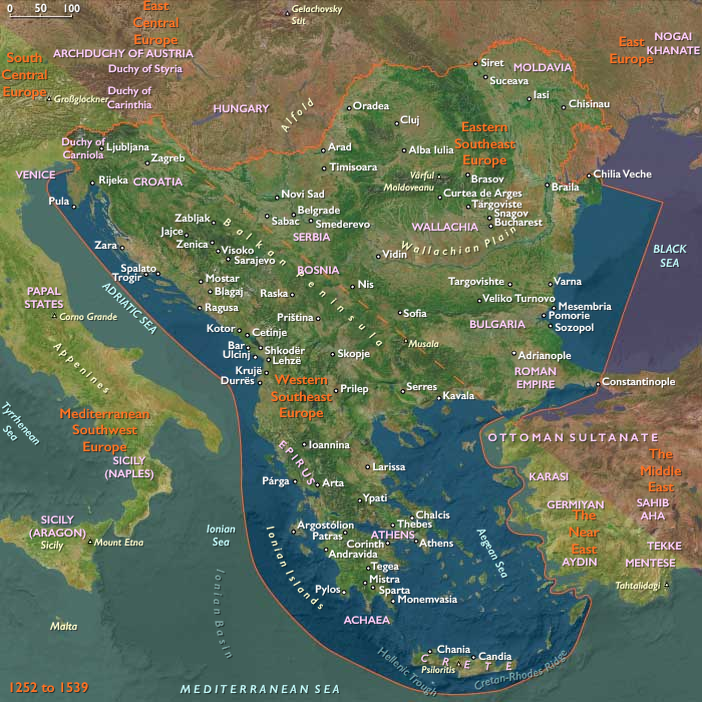
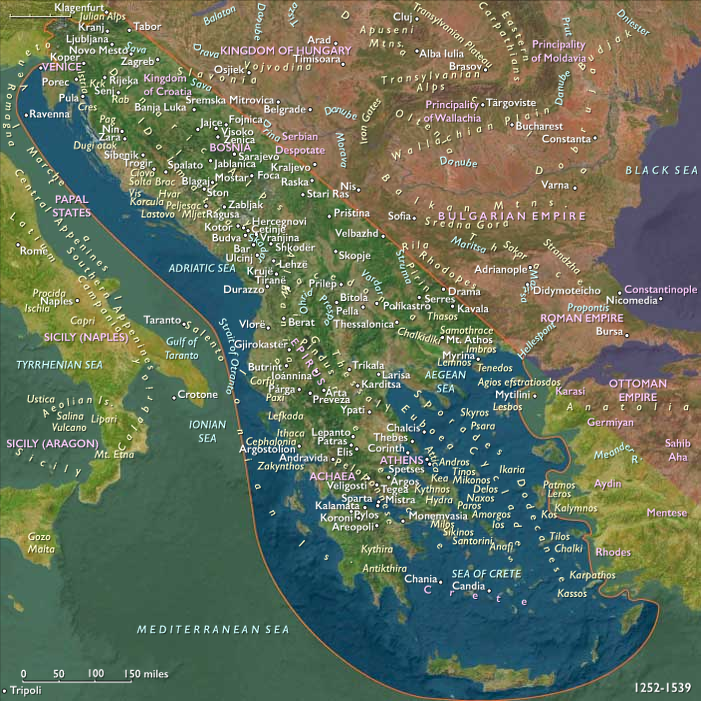
The Orsini family, a Sicilian branch of the family of the counts palatines of Rome, had not only ruled the Ionian Islands, but also conquered Epirus in early fourteenth century, thus acquiring the title of the despot as well.
Certain members of the family had embraced the Orthodox dogma and married Greek women.
After the death of John II Orsini in 1335, the islands had been occupied by the Angevins, who as rulers of Achaea had the islands under their suzerainty until then.
The Angevin occupation lasts until 1357, when the said Greek territory is ceded to the Italian family of the Tocchi, who will remain in power for over a century and secure unity in the governance of the islands of Cephalonia, Zakynthos and Leukas.
Locations
People
Groups
Subjects
Regions
Subregions
Related Events
Filter results
Showing 10 events out of 44085 total
The Golden Bull of 1356 regulates the whole election process in great detail, listing explicitly where, when, and under which circumstances what should be done by whom, not only for the prince-electors but also (for example) for the population of Frankfurt, where the elections are to be held, and also for the counts of the regions the prince-electors have to travel through to get here.
The decision to hold the elections in Frankfurt reflects a traditional feeling dating from East Frankish days that both election and coronation ought to take place on Frankish soil.
However, the election location is not the only specified location; the bull specifies that the coronation will take place in Aachen, and Nuremberg will be the place where the first diet of a reign shall be held.
The elections are to be concluded within thirty days; failing that, the bull prescriber that the prince-electors rre to receive only bread and water until they have decided.
Construction on the Charles Bridge, which crosses the Vltava river in Prague, starts in 1357 under the auspices of King Charles IV, and will finish in the beginning of the fifteenth century.
The bridge replaces the old Judith Bridge built 1158–1172 that had been badly damaged by a flood in 1342.
This new bridge is originally called the Stone Bridge (Kamenný most) or the Prague Bridge (Pražský most) but will be called the "Charles Bridge" beginning in 1870.
As the only means of crossing the river Vltava (Moldau) until 1841, the Charles Bridge is the most important connection between Prague Castle and the city's Old Town and adjacent areas.
This "solid-land" connection makes Prague important as a trade route between Eastern and Western Europe.
Throughout its history, the Charles Bridge will suffer several disasters and witness many historic events.
Czech legend has it that construction began on Charles Bridge at 5:31 am on July 9, 1357, with the first stone being laid by Charles IV himself.
This exact time is very important to the Holy Roman Emperor because he is a strong believer of numerology and this specific time, which forms a numerical bridge (1357 9, 7 5:31), will imbue the Charles Bridge with additional strength.
Given the bridge's long life perhaps the Emperor's belief holds some weight, though the bridge will see its fair share of tragedy.
Kantakouzenos' son Matthew has fought on for a few years following his father's abdication, but the dynasty of Kantakouzenos will not be perpetuated.
From his Thracian domain, centered on Gratzianous, a well-fortified town named for the Roman emperor Gratian, has led several wars against the Serbs.
An attack, which he had prepared in 1350, had been frustrated by the defection of his Turkish auxiliaries.
However with five thousand Turks he had tried to reestablish his former appanage along the Serbian-Byzantine border by attacking this region but had failed to take Serres and soon is defeated in battle in late 1356 or early 1357 by a Serb army under Vojvoda Vojihna, the holder of Drama, a major fortress in the vicinity.
The Serbs capture Matthew with the intention of releasing him when he has raised the large ransom they demand.
However John V Palaiologos, who has rapidly moved in to occupy Matthew's lands, offers Vojihna an even larger sum to turn Matthew over to him.
In exchange for the Despotate of the Morea, Matthew surrenders Gratzianous and all his Thracian domains to John V.
King Louis I of Hungary launches a successful military campaign in Venetian-controlled Dalmatia in 1357 and gains possession of many towns.
The Tragic Love Affair of Peter I and Inês de Castro (1339–1355)
The passionate and politically fraught love affair between Prince Peter (Pedro I) of Portugal and Inês de Castro—a noblewoman of Galician descent—became one of the most enduring and tragic romances in Iberian history.
Maria of Portugal and the Castilian Royal Scandal (1328–1335)
- King Afonso IV of Portugal had arranged for his eldest daughter, Maria, to marry Alfonso XI of Castile in 1328.
- The marriage produced a son in 1334, who would later become Peter of Castile.
- However, Alfonso XI soon abandoned Maria for the widowed Leonor de Guzmán, refusing to end the affair.
- Maria, humiliated and neglected, fled back to Portugal in 1335, sparking outrage in her father, Afonso IV.
Political Alliances: The Marriage of Peter and Constanza (1339)
- Seeking revenge on Castile, Afonso IV allied with Juan Manuel, Prince of Villena, a powerful Castilian noble who had been humiliated by Alfonso XI when his daughter's child marriage to the king was annulled in 1327.
- In a new alliance, Afonso IV arranged for his son, Peter, to marry Constanza Manuel, the daughter of Juan Manuel, in 1339.
- When Constanza arrived in Portugal, she was accompanied by her lady-in-waiting, Inês de Castro, a beautiful aristocrat of Galician origin, whose family had illegitimate links to both the Portuguese and Castilian royal families.
Peter and Inês: A Love That Defied the Throne
- Peter soon fell in love with Inês, and they conducted a secret affair that continued for years.
- Constanza died in 1345, shortly after giving birth to Fernando, who would later become King Fernando I of Portugal.
- After Constanza's death, Peter refused to marry anyone else and insisted on marrying Inês, but his father, Afonso IV, forbade it.
- Afonso IV banished Inês from court, but Peter and Inês continued their relationship in secret, living together.
Afonso IV’s Growing Fear and Inês’s Murder (1355)
- Inês’s brothers, exiled from Castile, had gained influence at Peter’s court, and Peter appointed them to key positions.
- This alarmed Afonso IV, who feared:
- That Portugal would be drawn into a civil war after his death.
- That the Portuguese throne would fall under Castilian control through Inês’s family ties.
- In 1355, Afonso IV made the fateful decision to eliminate Inês.
- He sent three men to the Monastery of Santa Clara-a-Velha in Coimbra, where she was detained, and they executed her by decapitation in front of one of her young children.
Peter’s Revenge and Coronation (1355–1357)
- Enraged by Inês’s murder, Peter revolted against his father, leading to a brief civil war.
- Afonso IV defeated his son, but died soon after in 1357.
- Peter succeeded to the throne as Peter I of Portugal, immediately seeking vengeance for Inês.
- According to legend, Peter later exhumed Inês’s body, crowned her posthumously as queen, and forced the court to kiss her decayed hand as a symbol of respect.
A Love Story Immortalized in Literature and Opera
The tragic romance of Peter and Inês has inspired over 20 operas and countless literary works, including:
- Portugal's national epic, Os Lusíadas (1572) by Luís de Camões.
- Spanish plays, including Nise Lastimosa and Nise Laureada (1577) by Jerónimo Bermúdez and Reinar Después de Morir by Luis Vélez de Guevara.
- French drama La Reine Morte by Henry de Montherlant.
- English tragedy Inez de Castro by Mary Russell Mitford.
Legacy of Peter and Inês
- Their ill-fated romance became one of the most famous love stories in Portuguese history, often compared to Romeo and Juliet.
- Inês’s tomb in Alcobaça Monastery, alongside Peter’s, remains a symbol of eternal love and loss.
- The legend of Inês de Castro continues to be retold and reinterpreted, keeping alive one of the most tragic royal love stories in medieval Europe.
The Golden Bull of 1356: Defining the Structure of the Holy Roman Empire
In 1356, Emperor Charles IV issued the Golden Bull, a landmark constitutional decree that formalized the electoral process of the Holy Roman Empire. The decree, issued at the Imperial Diets of Nuremberg and Metz, fixed the rules for electing the King of the Romans, the title held by the Emperor-elect before papal coronation. The Golden Bull remained the foundation of the empire’s political structure for more than four centuries.
Motivation for Reform: Stability and Preventing Conflict
- Charles IV sought to end the instability caused by contested imperial elections, which had led to civil wars and rival claims, most notably between:
- Louis IV (Ludwig of Bavaria) and his rival Frederick the Fair (Habsburg anti-king).
- Charles saw the Golden Bull as a way to eliminate political intrigue, stating that without it, the world would never be rid of "envious and ambitious politicians."
Key Provisions of the Golden Bull
1. Formalizing the Seven Electors
The Golden Bull explicitly named the seven Prince-electors (Kurfürsten) who were to choose the King of the Romans, who would then usually be crowned Emperor by the Pope:
-
Three Ecclesiastical Electors (Archbishops):
- Archbishop of Mainz (Archchancellor of Germany)
- Archbishop of Trier (Archchancellor of Gaul and Burgundy)
- Archbishop of Cologne (Archchancellor of Italy)
-
Four Secular Electors (Dukes and Counts):
- King of Bohemia (Cupbearer)
- Count Palatine of the Rhine (Pfalzgraf or Palsgrave) (Seneschal)
- Duke of Saxony (Marshal)
- Margrave of Brandenburg (Chamberlain)
- These seven electors were confirmed as the sole group responsible for choosing the emperor, preventing external interference from the Pope or other European powers.
- The Golden Bull ensured that no new electors could be added, maintaining a stable and predictable electoral process.
2. Indivisibility of Electoral Titles
- The Golden Bull decreed that the electors’ lands were indivisible and must be passed down undivided to ensure that votes could not be split among multiple heirs.
- This rule prevented internal family disputes from disrupting imperial elections.
3. Majority Voting System Introduced
- The decree codified the principle of majority voting, ensuring that:
- A simple majority of four votes was sufficient to elect a new king.
- Three electors could no longer block the process, reducing the risk of electoral deadlock.
- This provision formalized the electoral process, creating a clear and effective method for imperial succession.
4. Privileges of the Electors
- The Golden Bull granted the electors significant privileges, strengthening their political autonomy:
- Judicial authority over their territories.
- Exemption from imperial taxation.
- The right to mint their own coins.
- The ability to maintain their own armies.
- These privileges greatly increased the power of the electors, contributing to the gradual decentralization of the Holy Roman Empire.
Impact and Legacy
- The Golden Bull remained the empire’s fundamental constitutional law until 1806, when the Holy Roman Empire was dissolved.
- It cemented the power of the Prince-electors, leading to the emergence of semi-independent states within the empire.
- The requirement for papal approval weakened, as the emperor-elect was referred to as "rex in imperatorem promovendus" (king to be promoted emperor).
- This distinction became irrelevant after Maximilian I in 1508, when he adopted the title Emperor without papal coronation.
- The Golden Bull laid the foundation for the political fragmentation of the empire, a process that would only be fully realized with the Peace of Westphalia in 1648.
The Golden Bull of 1356 was a landmark decree that shaped the Holy Roman Empire for over 400 years, stabilizing the electoral process, strengthening the autonomy of the electors, and establishing the framework for the empire’s political structure until its dissolution in the 19th century.
The Founding and Rise of Edam: From Trade Town to City (1230–1357)
The town of Edam, located 12 miles (19 km) northeast of Amsterdam, was established around a dam on the river E or IJ, near the Zuiderzee (now known as the IJsselmeer). Its strategic location and control over trade routes allowed it to develop into a prosperous trade hub, with industries such as shipbuilding and fishing contributing to its economic growth.
Early Development of Edam (c. 1230–1350s)
- Around 1230, the channel was dammed, requiring goods to be unloaded and reloaded, which enabled the inhabitants of Edam to levy tolls on passing merchants.
- This trade-driven economy allowed Edam to grow as a regional commercial center.
- The town’s proximity to the Zuiderzee made fishing and shipbuilding key industries, further increasing its wealth and influence.
Granting of City Rights by Count William V (1357)
- In 1357, Count William V of Holland granted Edam official city rights, marking its formal recognition as an independent city.
- One of the primary reasons for this decision was the ongoing Hook and Cod Wars (1350–1490), a series of internal conflicts over the title of Count of Holland.
- By granting Edam city rights, William V:
- Strengthened his own political position by securing loyalty from key towns.
- Encouraged economic expansion, ensuring a steady flow of revenue from trade and industry.
- Solidified Holland’s control over important trade routes in the region.
Impact and Legacy
- The recognition of Edam as a city allowed it to further develop its shipbuilding industry, which became a major contributor to Dutch maritime power.
- Its fishing industry thrived, particularly in herring and other North Sea catches, making it a key supplier of seafood to Holland and beyond.
- Over time, Edam became famous for its cheese, with Edam cheese becoming a globally recognized product.
The granting of city rights to Edam in 1357 was a strategic move by William V of Holland, ensuring that the town remained loyal during the Hook and Cod Wars, while also cementing Edam’s role as a key economic and maritime center in the Low Countries.
David II of Scotland, held captive for eleven years at the English court, is thoroughly Anglicized at thirty-three.
From Windsor Castle in Berkshire, David and his household had later moved to Odiham Castle in Hampshire.
His imprisonment is not reputed to be a rigorous one.
After several protracted negotiations with the Scots' regency council, a treaty is signed on October 3, 1357, at Berwick-upon-Tweed under which Scotland's nobility agree to pay one hundred thousand marks (to be paid at the rate of ten thousand marks per year) as a ransom for their king.
This is ratified on November 6, 1357, by the Scottish Parliament at Scone.
David returns at once to Scotland.
Louis, seeking to restore his kingdom to great power status in the Balkans, had next turned his attention to Venetian-held Dalmatia, where his second war against Venice (1357-58) is more successful than his first venture.
Schwerin becomes a part of the Duchy of Mecklenburg in 1358, making it the seat of the dukedom from now on.
