
The Oseberg burial mound will be found …
Years: 834 - 834
The Oseberg burial mound will be found to contain numerous grave goods and two female human skeletons.
The ship's interment into its burial mound dates from 834, but parts of the ship date from around 800, and the ship itself is thought to be older.
It was excavated by Norwegian archaeologist Haakon Shetelig and Swedish archaeologist Gabriel Gustafson in 1904-1905.
This ship is widely celebrated and has been called one of the finest finds to have survived the Viking Age.
The ship and some of its contents are displayed at the Viking Ship Museum, in Bygdøy.
The ship is a clinker built 'karv' ship built almost entirely of oak.
It is 21.58 meters long and 5.10 meters broad, with a mast of approximately nine to ten meters.
With a sail of about ninety square meters, the ship could achieve a speed up to ten knots.
The ship has fifteen pairs of oar holes, which means that thirty people could row the ship.
Other fittings include a broad steering oar, iron anchor, gangplank, and a bailer.
The bow and stern of the ship are elaborately decorated with complex woodcarvings in the characteristic "gripping beast" style, also known as the Oseberg style.
Although seaworthy, the ship is relatively frail, and it is thought to have been used only for coastal voyages.
The skeletons of two women were found in the grave with the ship.
One, probably aged sixty to seventy, suffered badly from arthritis and other maladies.
The second was initially believed to be aged twenty-five to thirty, but analysis of tooth-root translucency suggests she was older (aged fifty to fifty-five).
It is not clear which one was the more important in life or whether one was sacrificed to accompany the other in death.
The younger woman had a broken collarbone, initially thought to be evidence that she was a human sacrifice, but closer examination showed that the bone had been healing for several weeks.
The opulence of the burial rite and the grave-goods suggests that this was a burial of very high status.
One woman wore a very fine red wool dress with a lozenge twill pattern (a luxury commodity) and a fine white linen veil in a gauze weave, while the other wore a plainer blue wool dress with a wool veil, possibly showing some stratification in their social status.
Neither woman wore anything entirely made of silk, although small silk strips were appliquéed onto a tunic worn under the red dress.
Dendrochronological analysis of timbers in the grave chamber dates the burial to the autumn of 834.
Although the high-ranking woman's identity is unknown, it has been suggested that she is Queen Åsa of the Yngling clan, mother of Halfdan the Black and grandmother of Harald Fairhair.
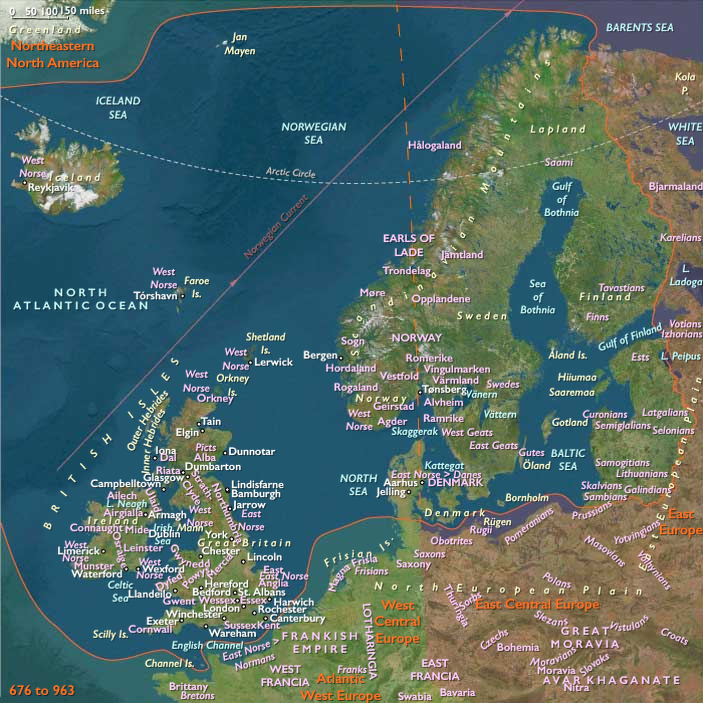
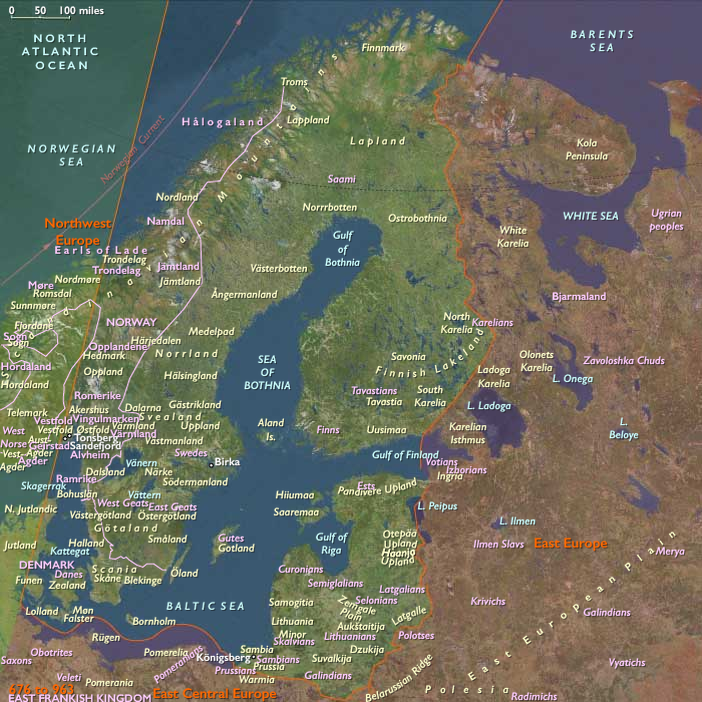
Recent tests of the women's remains suggest that they lived in Agder in Norway, as had Queen Åsa.
This theory has been challenged, however, and some think that she may have been a völva.
There were also the skeletal remains of 14 horses, an ox, and three dogs found on the ship.
Locations
Groups
Commodoties
Subjects
Regions
Subregions
Years: 834 - 834
Locations
Groups
Commodoties
Subjects
Regions
Subregions