
The Ottoman Empire had begun its ordering …
Years: 1732 - 1743
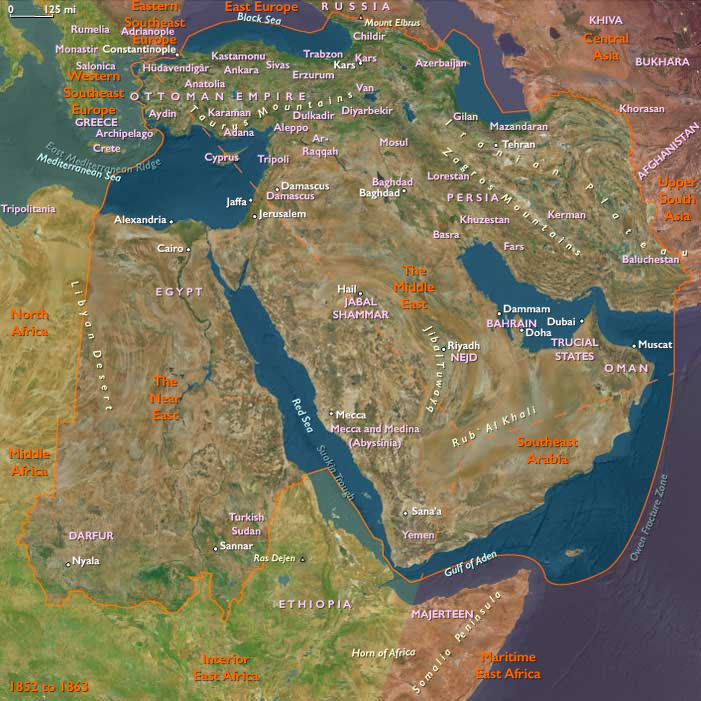
The Ottoman Empire had begun its ordering of the Arab Middle East in the sixteenth century, linking the fertile central Arabian oases of Nejd commercially and intellectually with western Arabia and the Fertile Crescent.
The area's remoteness and relative poverty have caused it to be often isolated, however, from general political and military trends.
As the population of such oasis towns as 'Uyaynah slowly rose from the sixteenth to the early eighteenth centuries, the 'ulama' (the learned of Islam), residing here has increased in number and sophistication.
Muhammad ibn 'Abd al-Wahhab, born in 'Uyaynah in 1703 to a family of religious judges and scholars, had traveled widely in other regions of the Middle East as a young man.
Influenced by the early fourteenth century teaching of the Hanbali scholar Ibn Taymiyah, he began, upon his return to 'Uyaynah, to preach his revolutionary ideas of religious reformation on fundamentalist lines.
He begins to abuse the Islamic schools of thought—i.e., those of Hanafi, Maliki, Shafi'ie and Hanbali—and labels those who disagreed with him as Murtadd (apostate), or Mushrik (polytheist).
'Uthman ibn Mu'ammar, 'Uyaynah's ruler, welcomes 'Abd al-Wahhab and subscribes to his doctrines, but many oppose him.
Locations
People
Groups
Subjects
Regions
Subregions
Years: 1732 - 1743
Locations
People
Groups
Subjects
Regions
Subregions