
The Ottoman issue has again become acute, …
Years: 1456 - 1456
The Ottoman issue has again become acute, and, after the fall of Constantinople in 1453, it seems natural that Sultan Mehmed II is rallying his resources in order to subjugate Hungary.
The sultan has initiated new pressure on the Hungarians and other European Christians, abducting some fifty thousand Serbs.
John Hunyadi, whose influence has waned in Hungary, had not been able to launch a counterattack against the Turks, nor could he go to the aid of Constantinople during the Turkish onslaught in 1453.
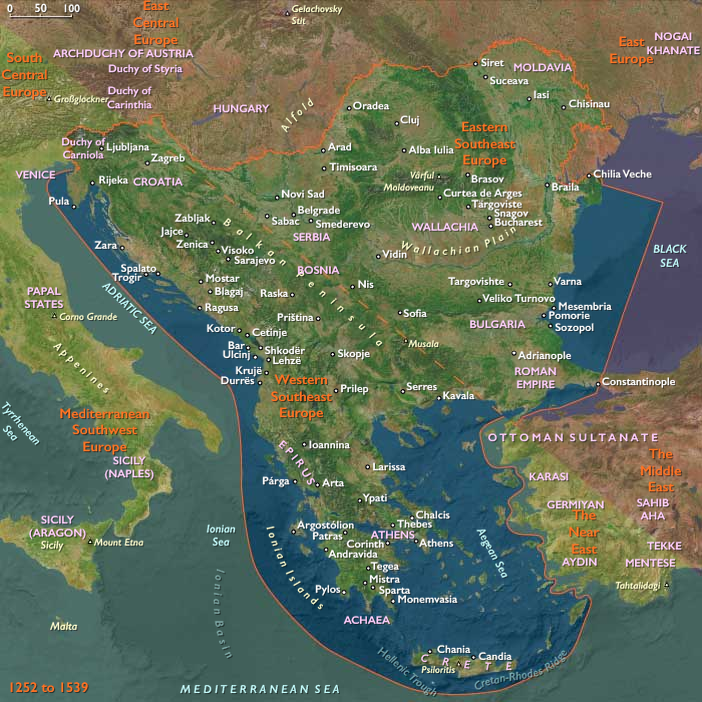
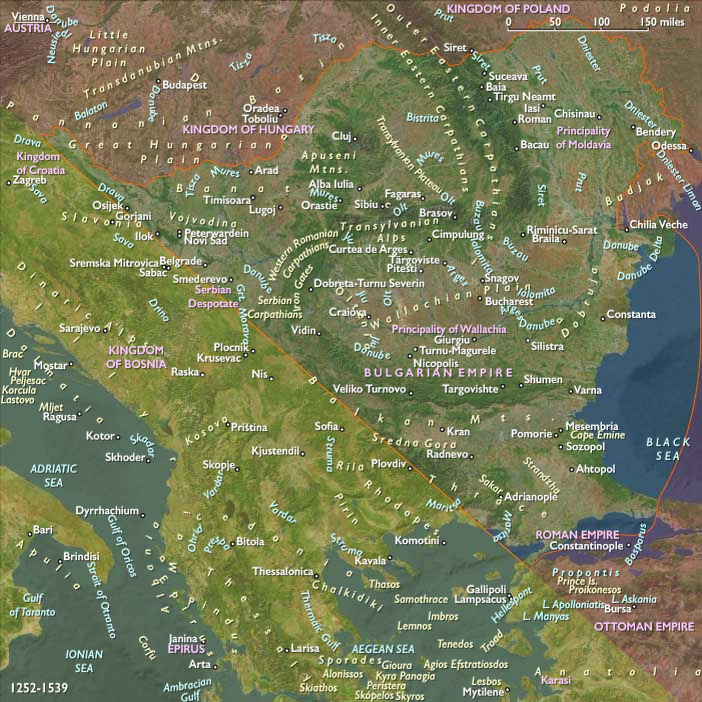
Mehmed’s immediate objective is Nándorfehérvár (today Belgrade), a major castle-fortress, and a gate keeper of south Hungary.
The fall of this stronghold would open a clear way to the heart of Central Europe.
Hunyadi had arrives at the siege of Nándorfehérvár at the end of 1455, after settling differences with his domestic enemies.
At his own expense, he restocks the supplies and arms of the fortress, leaving in it a strong garrison under the command of his brother-in-law Mihály Szilágyi and his own eldest son László Hunyadi.
He proceeds to form a relief army, and assembles a fleet of two hundred ships.
His main ally is the Franciscan friar Giovanni da Capistrano (known today as St. John of Capistrano), whose fiery oratory has drawn a large crusade made up mostly of peasants.
Although relatively ill-armed (mostly with farm equipment, such as scythes and pitchforks) they flock to Hunyadi and his small corps of seasoned mercenaries and cavalry.
The flotilla assembled by Hunyadi destroys the Ottoman fleet on July 14, 1456.
On July 21, Szilágyi's forces in the fortress repulse a fierce assault by the Rumelian army, and Hunyadi pursues the retreating Ottoman forces into their camp, taking advantage of the Turkish army's confused flight from the city.
After fierce but brief fighting, the camp is captured, and Mehmed lifts the siege and returns to Istanbul.
A seventy-year period of relative peace on Hungary's southeastern border begins with his flight.
However, plague breaks out in Hunyadi's camp three weeks after the lifting of the siege, and he dies on August 11.
On his deathbed, Hunyadi says, “Defend, my friends, Christendom and Hungary from all enemies... Do not quarrel among yourselves. If you should waste your energies in altercations, you will seal your own fate as well as dig the grave of our country.”
He is buried in the Roman Catholic Cathedral of Gyulafehérvár (now: Alba Iulia) next to his younger brother, John the Younger.
Sultan Mehmet II pays him tribute: "Although he was my enemy I feel grief over his death, because the world has never seen such a man."
Locations
People
Groups
- Islam
- Serbs (South Slavs)
- Christians, Eastern Orthodox
- Hungary, Kingdom of
- Serbian Despotate
- Ottoman Empire
- Rumelia Eyalet
Topics
Subjects
Regions
Subregions
Years: 1456 - 1456
Locations
People
Groups
- Islam
- Serbs (South Slavs)
- Christians, Eastern Orthodox
- Hungary, Kingdom of
- Serbian Despotate
- Ottoman Empire
- Rumelia Eyalet
Topics
Subjects
Regions
Subregions