
The position of Archbishop Bruno in Cologne …
Years: 964 - 964
The position of Archbishop Bruno in Cologne is little short of royal.
Indeed, Otto I has delegated to Bruno and his successors as archbishop a number of normally royal privileges—the right to build fortifications and set up markets, to strike coins and collect (and keep) such taxes as the special ones on Jews in return for royal protection, those on market trading and tolls from traffic along the Rhine.
Bruno's successors as archbishops will not be dukes as well, but they will nevertheless be the secular as well as the ecclesiastical rulers of Cologne until the battle of Worringen three centuries later.
Bruno's court in Cologne is the main intellectual and artistic center of its period in Germany—far more so than that of his brother Otto, which is far more peripatetic and militarily oriented.
Ratherius and Liutprand of Cremona, among others, spend time at the court.
Many of the next generation of German ecclesiastical leaders are educated at Bruno's court, like Everaclus of Liège, Gerard bishop of Toul, Wikfrid, bishop of Verdun, and Theoderic, bishop of Metz.
Bruno's effect on medieval Cologne is immense.
Apart from building a palace, he has extended the cathedral to the point where it is regarded as rivaling St. Peter's in Rome (this cathedral will burn down in 1248 and be replaced by the current one).
He has brought the area between the old Roman walls and the Rhine within the city fortifications; and built new churches to Saint Martin of Tours within this area and to Saint Andrew just outside the northern city wall and a Benedictine monastery dedicated to St. Pantaleon to the southwest of the city.
Locations
People
Groups
- Jews
- Christianity, Chalcedonian
- Benedictines, or Order of St. Benedict
- Cologne, Electorate of
- German, or Ottonian (Roman) Empire
Commodoties
Subjects
Regions
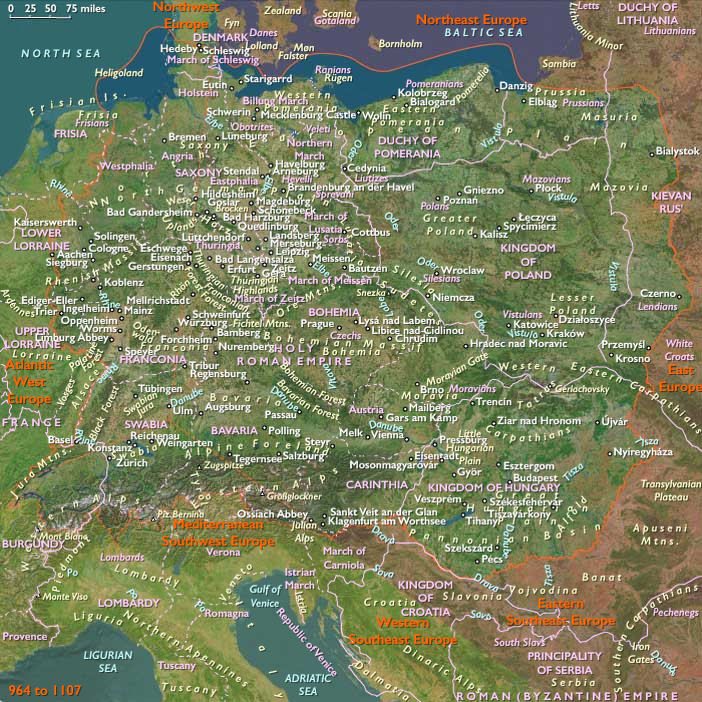
Subregions
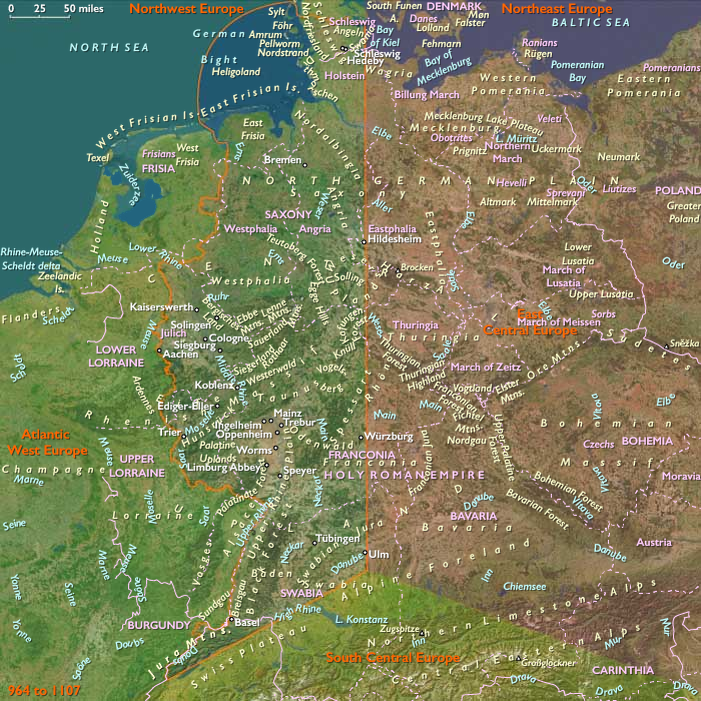
Related Events
Showing 1 events out of 1 total
Years: 964 - 964
Locations
People
Groups
- Jews
- Christianity, Chalcedonian
- Benedictines, or Order of St. Benedict
- Cologne, Electorate of
- German, or Ottonian (Roman) Empire
Commodoties
Subjects
Regions
Subregions