Relations between France and Great Britain have improved following the death of Louis XIV and Queen Anne.
George I and the new French Regent, Philippe II, Duke of Orléans, are cousins and each faced threats to their regime.
Orléans is concerned that his domestic enemies, in particular the Duke of Maine, will combine with Spain to overthrow him, while George I wishes to persuade the French to withhold support for any further Jacobite risings.
According to the Duc de Saint-Simon, who opposes the Alliance, the British Ambassador to Paris, the Earl of Stair, had argued that the short-term advantage to both regimes of an alliance outweighed their traditional differences.
Orléans agrees, as does his secretary Guillaume Dubois, the future Cardinal, who (together with James Stanhope, 1st Earl Stanhope, the English Secretary of State), is generally regarded as the principal author of the Triple Alliance.
Saint-Simon, who loathes Dubois, argues that the Bourbon Kingdoms of France and Spain should be perpetual allies, but this takes no account of present realities.
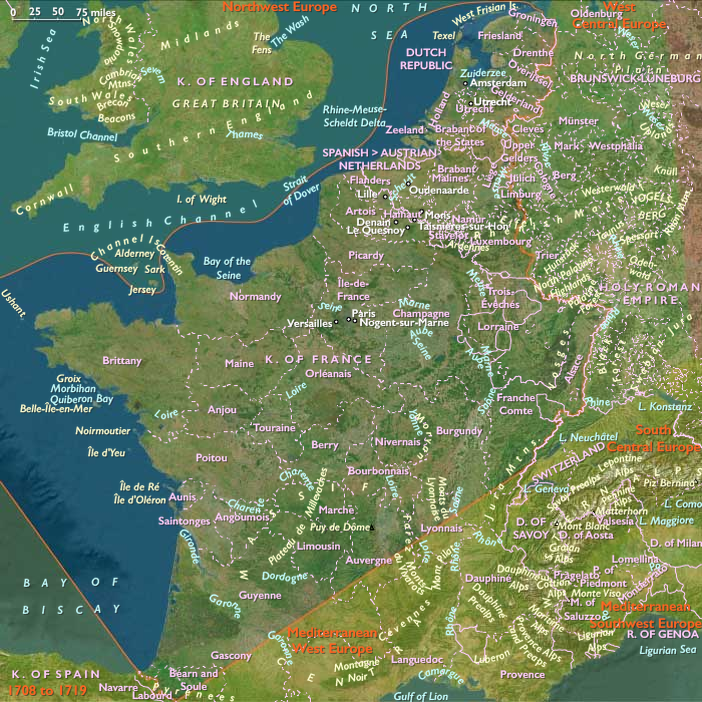
In an attempt to maintain the agreement of the 1713 Treaty of Utrecht, the Netherlands, Britain and France, concerned about Spain becoming a superpower in Europe, form the Triple Alilance on January 4, 1717 against Spain to secure the succession of Hanover to the British Throne and the House of Orleans to the French Throne, should Louis XV die.
As a result, militarization takes place, causing great havoc to civilians.
This enrages Spain and other states, leading to brinkmanship.
Britain, in particular, has become very concerned by Spanish ambitions in the Mediterranean Sea and Russian expansion in the Baltic and dispatches fleets to both as a preventative measure.
The French navy, badly weakened from the recent war, cannot offer much support.
Later in the year, to strengthen the Treaty of Utrecht, Britain, France and Austria contemplate ceding Sicily to the Holy Roman Emperor Charles VI.
This arrangement displeases Spain, who wants to recover the island.