
The prophet Zephaniah attacks imitations of foreign …
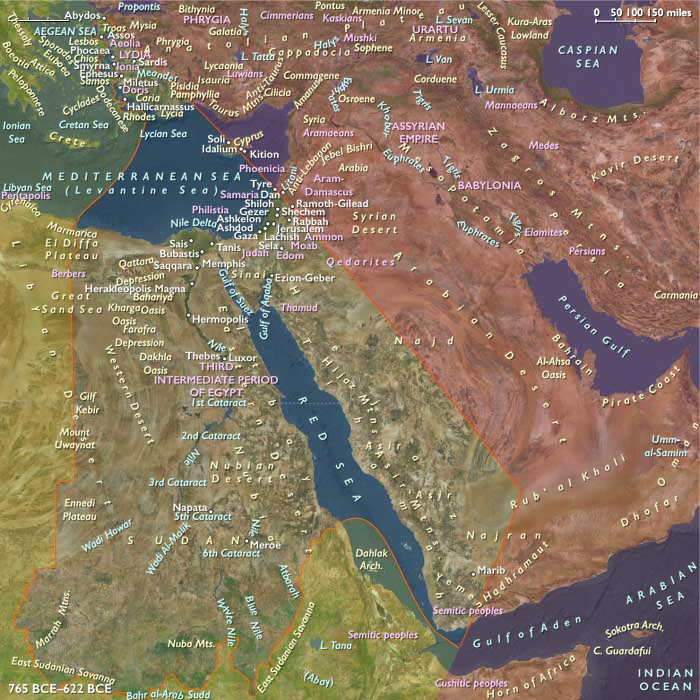
Years: 633BCE - 622BCE
The prophet Zephaniah attacks imitations of foreign religious practices, idolatry, and those who doubt the threat of the Lord's wrath, around 630 BCE
After the death of King Ashurbanipal in 627 BCE, the Assyrian empire falls into chaos; it is no longer assert its authority in Jerusalem.
Under the auspices of the priestly regency council, Josiah, now nineteen, has already set in motion a vigorous movement of independence and restoration, a cardinal aspect of which is religious.
Egypt also is weak, and Judah thus obtains an unusual degree of independence from foreign powers.
Josiah’s reign is noted for the religious reforms he institutes from 626 BCE.
In the eighteenth year of his rule (623/622 BCE), Josiah orders the High Priest Hilkiah to use the tax money which had been collected over the years to renovate the temple.
A scroll of Moses' Torah is allegedly found In the course of renovating the Temple.
By scholarly consensus this is an edition of Deuteronomy—its name, meaning "repeated law," is based on the book's stylistic form: a series of speeches in which the law originally given on Mount Sinai is repeated by Moses to the next generation.
Ascribed by tradition to Moses, the Book of Deuteronomy could not have been written much earlier than the time of Josiah.
Deuteronomy consists of a double introduction, a legal section (dating to the reign of King Hezekiah) with concluding ritual elaboration, two old poems, and an account of Moses' death.
The books’ principal themes include the election of Israel by God, trust in God's power, rejection of foreign gods, and the importance of the Mosaic law.
Traditionally accepted as the genuine words of Moses delivered on the eve of the occupation of Canaan, a broad consensus of modern scholars see its origins in traditions from Israel (the northern kingdom) brought south to the Kingdom of Judah in the wake of the Assyrian destruction of Samaria in the late eighth century BCE.
Refugees fleeing to Judah had brought with them a number of new traditions (new to Judah, at least).
One of these was that the god Yahweh, already known and worshiped in Judah, was not merely the most important of the gods, but the only god who should be served.
Deuteronomy 12-26, the Deuteronomic Code, the oldest part of the book and the core around which the rest will develop, is a series of mitzvot (commands) to the Israelites regarding how they ought to conduct themselves in Canaan, the land promised by Yahweh, the God of Israel.
This outlook influences the Judahite landowning elite, who have become extremely powerful in court circles after they placed the eight year old Josiah on the throne following the murder of his father.
This book, containing provisions supposedly relating to covenantal traditions of pre-monarchic times, deeply impresses Josiah and gives a decisive turn to his reforms.
Anxious to abide by its injunctions, Josiah has the local YHWH altars polluted to render them unusable and collects their priests in Jerusalem.
All local sanctuaries are abolished, sacrifice being concentrated at Jerusalem.
The celebration of the Passover this year is concentrated in the Temple, as it had not been since the days of the judges who judged Israel (according to II Kings 23:22), or since the days of Samuel (according to II Chron. 35:18). (Both references reflect the unhistorical theory of the Josianic, or Deuteronomic, reformers that the Shiloh sanctuary had been the precursor of the Jerusalem Temple as the sole legitimate site of worship in Israel (as demanded by Deuteronomy, chapter 12).
Alongside the male cult of Yahweh, there has been, up to now, a women's cult of Asherah in the Jerusalem Temple, under qedeshim auspices consecrated for fertility practices, according to 2 Kings 23:7.
Asherah's devotees consider her the chief wife of Yahweh, even as she is the wife of El, head of the Canaanite pantheon, for in the Bible El is identified with Yahweh.
King Josiah’s administration, which in about 621 launches a program of national renewal, centered on the Temple in Jerusalem, eliminates her cult.
The official religion of the Hebrews from this time forward will leave no place for other gods, which means the elimination of every goddess.
Under the aegis of Hilkiah, this puritan reform, the most intense in Judah's history, purges the Temple of all foreign cultic objects of Baal, Ashterah (or Asherah), "and all the hosts of the heavens" and dedicates it wholly to the worship of Yahweh.
The living pagan priests are killed and the bones of priests exhumed from their graves and burned on their altars—which is viewed as an extreme act of desecration against these pagan deities by their adherents. (2 Kings 23:4, et seq.)
The authors of Kings and Chronicles add to these acts in Jerusalem Josiah's similar destruction of altars and images belonging to pagan deities in the cities of the tribes of Manasseh, Ephraim, "and Simeon, as far as Naphtali" (2 Kings 23:8f);(2 Chr. 34:6f).
He also has Hilkiah take the tax monies that had been collected over the years and use them to repair the neglect and damage the Temple had suffered during the reigns of Amon and Manasseh.
To seal the reform, the King convokes a representative assembly and has them enter into a covenant with God over the newfound Torah.
For the first time, the power of the state is enlisted on behalf of the ancient covenant and in obedience to a covenant document.
It is a major step toward the fixation of a sacred canon.
Locations
People
Groups
- Polytheism (“paganism”)
- Hebrews
- Judah, Kingdom of
- Assyrian people
- Assyria, (New) Kingdom of (Neo-Assyrian Empire)
Topics
Commodoties
Subjects
Regions
Subregions
Years: 633BCE - 622BCE
Locations
People
Groups
- Polytheism (“paganism”)
- Hebrews
- Judah, Kingdom of
- Assyrian people
- Assyria, (New) Kingdom of (Neo-Assyrian Empire)
Topics
Commodoties
Subjects
Regions
Subregions