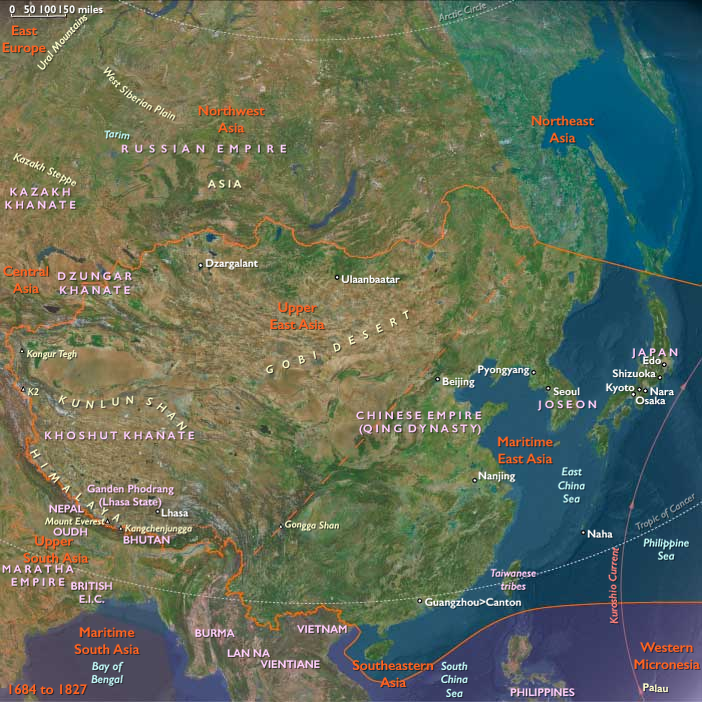
The Qing regime is determined to protect …
Years: 1684 - 1827
The Qing regime is determined to protect itself not only from internal rebellion but also from foreign invasion.
After China Proper had been subdued, the Manchus had conquered Outer Mongolia (now the Mongolian People's Republic) in the late seventeenth century.
In the eighteenth century, they gain control of Central Asia as far as the Pamir Mountains and establish a protectorate over the area commonly known in the West as Tibet, but which the Chinese call Xizang.
The Qing thus become the first dynasty to eliminate successfully all danger to China Proper from across its land borders.
Under Manchu rule the empire grows to include a larger area than before or since; Taiwan, the last outpost of anti-Manchu resistance, is also incorporated into China for the first time.
In addition, Qing emperors receive tribute from the various border states.
Locations
Groups
- Chinese (Han) people
- Tibetan people
- Neo-Confucianism
- Mongols
- Tibet, Lamacracy of
- Manchus
- Chinese Empire, Qing (Manchu) Dynasty
- Taiwan, or Formosa (Qing protectorate)
Topics
Subjects
Regions
Subregions
Related Events
Filter results
Showing 10 events out of 17 total
Northeastern North America (1684–1827 CE): Empires, Nations, and Atlantic Gateways
Geography & Environmental Context
Northeastern North America includes all territory east of 110°W, except the lands belonging to Gulf and Western North America. This encompasses the Great Lakes basin, the St. Lawrence River corridor, Hudson Bay and Labrador, Newfoundland, Greenland, the Arctic, the Maritime provinces, and the Atlantic seaboard from New England through Virginia, the Carolinas, and most of Georgia. It also contains the Mississippi Valley north of Illinois’ Little Egypt and the Upper Missouri above the Iowa–Nebraska crossing, as well as northeast Alabama, central and eastern Tennessee, and nearly all of Kentucky.
Anchors included the Great Lakes–St. Lawrence system, Hudson Bay, the Mississippi headwaters, the Appalachian piedmont and coastal plain, and the Greenland ice sheet. This was a land of forests and prairies, river valleys and tundra, increasingly tied to transatlantic markets.
Climate & Environmental Shifts
This age unfolded under the continuing Little Ice Age. Winters were harsh: ice closed the St. Lawrence, snow lingered across New England and the Maritimes, and Greenland’s fjords froze for longer periods, forcing Inuit hunters to adapt routes and tools. In the Great Lakes and Midwest, shorter growing seasons sometimes strained maize harvests. Atlantic storms battered coastlines, while the cod-rich Grand Banks remained among the world’s most productive fisheries.
Subsistence & Settlement
-
Indigenous nations:
-
Iroquois (Haudenosaunee), Huron-Wendat, and Algonquian peoples relied on maize horticulture, deer, moose, caribou, and fisheries.
-
Inuit in Greenland and Labrador centered subsistence on seals, whales, and caribou, adapting to changing sea ice.
-
Southeastern groups (Cherokee, Creek) combined horticulture with hunting.
-
-
Colonial settlements:
-
New France spread from Quebec to the Great Lakes and Mississippi through forts and missions.
-
New England, New York, and the Chesapeake grew rapidly, displacing Native peoples.
-
Hudson’s Bay Company (chartered 1670) expanded posts like York Factory and Fort Albany, anchoring the fur trade.
-
Spanish Florida persisted tenuously until ceded to Britain (1763), then to the U.S. (1821).
-
Greenland saw Inuit continuity until Danish missions after 1721.
-
-
Economic systems: Fur and cod in the north, wheat and mixed farms in the interior, tobacco, rice, and indigo in the southern reaches.
Technology & Material Culture
-
Indigenous technologies: canoes, snowshoes, fishing gear, longhouses, wampum belts, dog sleds, umiaks, and harpoons.
-
European imports: firearms, iron tools, textiles, plows, ships, and mills.
-
Trade goods: kettles, knives, and muskets became embedded in Native economies.
-
Colonial towns: churches, courthouses, colleges, and printing presses reflected European traditions, while frontier cabins and missions reflected adaptation.
Movement & Interaction Corridors
-
Fur trade networks: Carried beaver pelts from the Great Lakes and Hudson Bay into Europe, exchanged for manufactured goods.
-
Maritime corridors: The Grand Banks drew fleets from England, France, Spain, and Portugal; New England merchants trafficked with the Caribbean and Africa.
-
Indigenous corridors: Canoe routes and portages linked Hudson Bay, the Great Lakes, and the Mississippi basin.
-
Greenland: Inuit maintained ice routes across Baffin Bay; Danish missions established lasting presence after 1721.
Cultural & Symbolic Expressions
-
Indigenous nations:
-
The Haudenosaunee Confederacy remained a powerful political and diplomatic bloc.
-
Oral traditions, seasonal rituals, and clan governance reinforced autonomy.
-
-
Colonial cultures:
-
Catholic missions dominated New France; Protestant congregations spread in New England and the South.
-
Anglicanism tied seaboard elites to Britain.
-
Jewish communities established early synagogues in port cities like Newport.
-
-
Greenland Inuit: Rituals around whale and seal hunting persisted; Christian teaching blended with older cosmologies after Danish missions.
-
Symbols of territory: forts, flags, treaties, and wampum belts embodied contested claims of sovereignty.
Environmental Adaptation & Resilience
Indigenous farmers rotated crops, built surpluses, and shifted villages as conditions required. Hunters diversified prey; Inuit adjusted hunting gear and routes to ice changes. Colonists overexploited cod, timber, and beaver but also relied on Native knowledge for survival in harsh climates. Beaver depletion shifted fur trade routes deeper into the interior, while forest clearing transformed seaboard ecosystems.
Political & Military Shocks
-
Imperial wars: The Nine Years’ War, Queen Anne’s War, and the Seven Years’ War drew Indigenous peoples into shifting alliances.
-
Seven Years’ War (1756–63): Britain seized New France, transforming the balance of power.
-
American Revolution (1775–83): Created the United States from New England to Georgia; Loyalists resettled in Canada, reshaping its demographics.
-
War of 1812: Britain and the U.S. clashed over the Great Lakes and Chesapeake; Native confederacies (notably Tecumseh’s) collapsed in defeat.
-
Greenland: Danish rule consolidated after missions, linking Inuit more firmly into European frameworks.
Transition
By 1827 CE, Northeastern North America had become a patchwork of Indigenous nations, colonial legacies, and new settler republics. The fur trade and cod fisheries tied forests and coasts to Atlantic markets; French Canada endured under British rule; the United States secured independence and expanded inland. Greenland was drawn into Danish orbit. Indigenous nations remained vital, but faced epidemic disease, land dispossession, and broken alliances. What had begun as an imperial frontier was by the early 19th century a continental zone of nations, settler societies, and Native resilience under unprecedented pressure.

The life expectancy of slaves is much higher in North America than further south, because of less disease and better food and treatment, leading to a rapid increase in the numbers of slaves.
Colonial society is largely divided over the religious and moral implications of slavery and colonies pass acts for and against the practice, but by the turn of the eighteenth century, enslaved Africans are replacing indentured servants for cash crop labor, especially in southern regions.
All have local governments with elections open to most free men, with a growing devotion to the ancient rights of Englishmen and a sense of self-government stimulating support for republicanism.
With extremely high birth rates, low death rates, and steady settlement, the colonial population grows rapidly as relatively small native populations are eclipsed.
Excluding the natives, who are being conquered and displaced, the thirteen British colonies that will form the United States have a population of over two million one hundred thousand in 1770, about one-third that of Britain.
Despite continuing new arrivals, the rate of natural increase is such that by the 1770s only a small minority of Americans had been born overseas.
The colonies' distance from Britain has allowed the development of self-government, but their success motivates monarchs to periodically seek to reassert royal authority.
The native population had declined after Europeans arrived, and for various reasons, primarily diseases such as smallpox and measles.
Violence is not a significant factor in the overall decline among Native Americans, though conflict among themselves and with Europeans affects specific tribes and various colonial settlements.
In the early days of colonization, many European settlers were subject to food shortages, disease, and attacks from Native Americans.
Native Americans were also often at war with neighboring tribes and allied with Europeans in their colonial wars.
At the same time, however, many natives and settlers have come to depend on each other.
Settlers trade for food and animal pelts, natives for guns, ammunition and other European wares.
Natives have taught many settlers where, when and how to cultivate corn, beans and squash.
European missionaries and others feel it is important to "civilize" the Native Americans and urge them to adopt European agricultural techniques and lifestyles.
The colonists had fiercely opposed his efforts, resulting in the abrogation of their colonial charter by the Crown.
Charles' successor James II finalizes these efforts in 1686, establishing the Dominion of New England.
Massachusetts Bay Colony, one of the original English settlements in present Massachusetts, had been settled in 1630 by a group of about a thousand Puritan refugees from England under Governor John Winthrop.
The Massachusetts Bay Company had in 1629 obtained from Charles a charter empowering the company to trade and colonize in New England between the Charles and Merrimack rivers.
Omitted from the charter was the usual clause requiring the company to hold its business meetings in England, a circumstance that the Puritan stockholders used to transfer control of the colony to America.
The Puritans established a theocratic government with the franchise limited to church members.
Increasingly in the 1680s, the English Crown has challenged the institutional discrimination displayed by the Puritans of the United Colonies of New England toward Anglicans.
Growing estrangement between the colony and England resulted in the annulment of the company's charter in 1684.
King James II attempts in 1686 to stem growing colonial independence by imposing on the colonies —the Massachusetts Bay Colony, the Plymouth Colony, the Province of New Hampshire, the Province of Maine, and the Narraganset Country or King's Province—a kind of supercolony, the Dominion of New England, ostensibly as a measure to enforce the Navigation Acts and to coordinate the mutual defense of colonies against the French and hostile Native Americans.
The capital is located in Boston.
The Colony of Rhode Island and Providence Plantations and the Connecticut Colony are added to the Dominion on September 9, 1686.
Sir Edmund Andros, who had grown up as a page in the royal household, had had his fidelity to the crown during its exile after the English Civil Wars rewarded in 1674 by his appointment as governor of New York and New Jersey. (He was also knighted in 1678.)
Although the mother country regarded him as an able and conscientious administrator, the colonists considered him both arrogant and arbitrary, and he had been recalled in 1681 but now returns to America as governor of the Dominion of New England.
New Englanders are encouraged, however, by a change of government in England that had seen James II effectively abdicate, and a populist uprising overthrows Dominion rule on April 18, 1689.
Colonial governments reassert their control in the wake of the revolt, and successive governments will make no more attempts to restore the Dominion.
Andros' imposition of Episcopalian worship in the Old South Meetinghouse in Boston, his vigorous enforcement of the Navigation Acts, his requirement that landholders take out new land patents, and his limitations upon town meetings and rights of local taxation all arouse sharp resentment in colonial America.
When news of the overthrow of James reaches Boston, the colonists revolt, deposing Andros and imprisoning him, eventually returning him to England.
The colony of Massachusetts issues the first paper money in America on February 3, 1690.
Years: 1684 - 1827
Locations
Groups
- Chinese (Han) people
- Tibetan people
- Neo-Confucianism
- Mongols
- Tibet, Lamacracy of
- Manchus
- Chinese Empire, Qing (Manchu) Dynasty
- Taiwan, or Formosa (Qing protectorate)