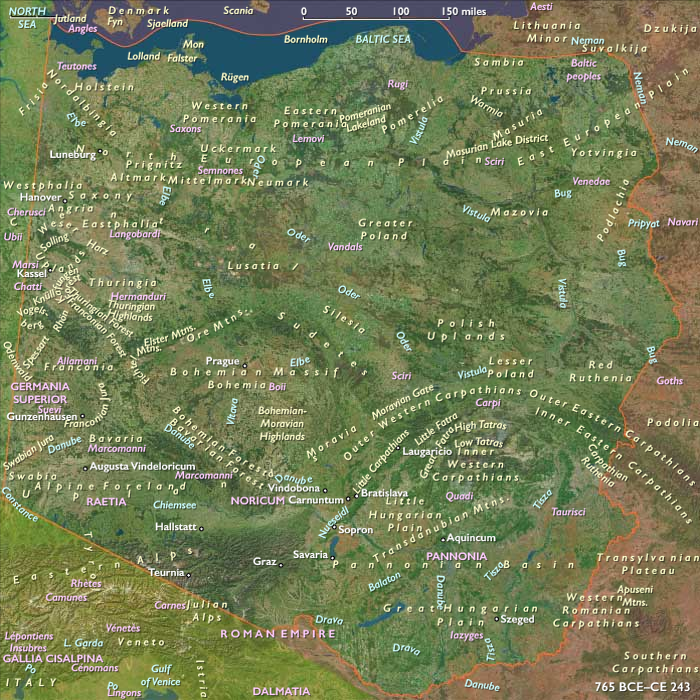
The Quadi again rebel,soon followed by their …
Years: 177 - 177
The Quadi again rebel,soon followed by their neighbors, the Marcomanni, and Marcus Aurelius once again heads north in 177 to begin his second Germanic campaign (secunda expeditio germanica).
Locations
People
Groups
- Germania
- Marcomanni (Germanic tribe)
- Quadi (Germanic tribe)
- Roman Empire (Rome): Nerva-Antonine dynasty
- Pannonia Superior (Roman province)
Topics
Subjects
Regions
Subregions
Related Events
Filter results
Showing 10 events out of 60938 total
The eunuchs continue their corrupt ways, and the people are burdened with increasingly heavy taxes.
As Emperor Ling grows older, not only does he take no remedial actions, he continues to tolerate, for the most part, the eunuchs' corruption.
The major defeat of the Han cavalry by the Xianbei in 177 further drains the imperial treasury.
The Hou Hanshu records a memorial submitted in 177 CE: Ever since the [northern] Xiongnu ran away, the Xianbei have become powerful and populous, taking all the lands previously held by the Xiong-nu and claiming to have 100,000 warriors.
… Refined metals and wrought iron have come into the possession of the [Xianbei] rebels.
Han deserters also seek refuge [in the lands of the Xianbei] and serve as their advisers.
Their weapons are sharper and their horses are faster than those of the Xiong-nu.
The Xianbei reach their peak under Tanshihuai Khan (reigned 156-181) who expands the vast, but short lived, Xianbei Empire.
Tanshihuai was born in 141.
According to the Hou Hanshu, his father Touluhou had been serving in the Southern Xiongnu army for three years.
Returning from his military duties, Touluhou was furious to discover that his wife had become pregnant and given birth to a son.
He ordered the child put to death.
His wife replied: “When I was walking through the open steppe a huge storm developed with much lightning and thunder. As I was looking upward a piece of hail fell into my mouth, which I unknowingly swallowed. I soon found out I had gotten pregnant. After ten months this son was born. This must be a child of wonder. It is better to wait and see what happens.”
Touluhou did not heed her words, however, so Tanshihuai had been brought up secretly in the ger (yurt) of relatives.
When Tanshihuai was around fourteen or fifteen years old, he had become brave and sturdy, showing talent and ability.
Once, when people from another tribe robbed his maternal grandparent’s herds, Tanshihuai pursued them alone, fought the robbers and managed to retrieve all the lost herds.
His fame spread rapidly among the Xianbei tribes and many came to respect and trust him.
He then placed some laws and regulations in force, which none dared violate, and decided between litigants.
Because of this, he was elected supreme leader of the Xianbei tribes at the age of fifteen and established his ordo (palace) at Mount Darkhan.
He has defeated the Dingling to the north (around Lake Baikal), the Kingdom of Buyeo to the east (north of Korea), and the Wusun to the west (Xinjiang and Ili River).
His empire stretches seven thousand kilometers and includes all the lands of the former Xiongnu.
Tanshihuai according to the Records of the Three Kingdoms, regarded as the official and authoritative historical text on the Three Kingdoms period of Chinese history covering the years 184-280 CE, divided his territory into three sections: the eastern, the middle and the western.
Uneasiness at the Han court about this development of a new power on the steppes finally results in a campaign on the northern border to annihilate the confederacy.
Tthirty thousand Han cavalry in 177 attack the confederacy.
The Han commanders are Xia Yu, Tian Yan, and Zang Min, each of whom had commanded units sent respectively against the Wuhuan, the Qiang, and the Southern Xiongnu before the current campaign.
Each military officer commands ten thousand cavalrymen and advances north on three different routes, aiming at each of the three federations.
Xianbei cavalry units commanded by chieftains of each of the three federations almost annihilate the invading forces.
Eighty percent of the troops are killed and the three officers, who bring only tens of men safely back from the front, are stripped of their commands.

Celsus criticizes the Christian belief in Jesus as the incarnation of God and attacks Christianity as a threat to the state in The True Word, or The True Discourse (now lost; known through the reply made in the third century by Origen in his Contra Celsum) written around 177. (Origen will consider it a fabricated story.)
He writes at a time when Christianity is being actively persecuted and when there seems to have been more than one emperor.
Celsus writes that Jesus's father was a Roman soldier named Panthera.
Celsus seems to have been interested in Ancient Egyptian religion, and he seems to know of Jewish logos-theology, both of which suggest The True Word was composed in Alexandria.
Celsus shows himself familiar with the story of Jewish origins.
Origen will write in 248, bringing to light again a book written in the days of Marcus Aurelius but still in circulation.
Sometimes quoting, sometimes paraphrasing, sometimes merely referring, Origen will reproduce and reply to Celsus' arguments.
Since accuracy is essential to his refutation of The True Word, most scholars agree that Origen is a reliable source for what Celsus said.
It is an earnest and striking appeal on behalf of the Empire, and shows the terms offered to the Christian sects, as well as the importance of the various sects at the time.
It is not known how many are Christians at the time of Celsus but, as a comparison, the estimation of Wilken of the Jewish population of the empire to have been about ten percent may be quoted. (Robert Louis Wilken, The Christians as the Romans Saw Them, [Yale: University Press, 2nd edition, 2003])
The Christians are certainly fewer.
It is unlikely their influence throughout CE 100-400 was greater than what the physical evidence reveals.
The cosmopolitan hospitality to eastern religions may have allowed the first attested Christian community in Gaul to be established in Lugdunum in the second century, led by a bishop with the eastern name of Pothinus.
In 177 it also becomes the first in Gaul to suffer persecution and martyrdom.
The event is described in a letter from the Christians in Lugdunum to counterparts in Asia, later retrieved and preserved by Eusebius.
There is no record of a cause or a triggering event but mob violence against the Christians in the streets culminates in a public interrogation in the forum by the tribune and town magistrates.
The Christians publicly confess their faith and are imprisoned until the arrival of Legate of Lugdonensis, who gives his authority to the persecution.
About forty of the Christians are martyred—dying in prison, beheaded, or killed by beasts in the arena as a public spectacle.
Among the latter are Bishop Pothinus, Blandina, Doctor Attalus, Ponticus, and the deacon Sanctus of Vienne.
Their ashes are thrown into the Rhône.
Nevertheless, the Christian community either survives or is reconstituted, and under Bishop Irenaeus it continued to grow in size and influence.
Commodus becomes consul on January 1, 177, for the first time, which makes him, at fifteen, the youngest consul in Roman history up to this time.
Marcus Aurelius grants Commodus the title Augustus in the middle of 177, giving his son the same status as his own and formally sharing power.
The emperor on December 23 of the same year celebrates a joint triumph for his German victories ("de Germanis" and "de Sarmatis") together with Commodus.
In commemoration of this, a triumphal column is planned, in imitation of Trajan's Column.
Because the original dedicatory inscription has been destroyed, it is not known whether it was built during the emperor’s reign (on the occasion of the triumph over the Marcomanni, Quadi and Sarmatians in the year 176) or after his death in 180; however, an inscription found in the vicinity attests that the column was completed by 193.
The emperor’s respite is to be brief.
Marcus soon embarks on another Danubian expedition against the Marcomanni.
Emperor Ling's wife Empress Song, whom he had made empress in 171 but has never favored, falls victim to the eunuchs in 178.
Her aunt, Lady Song, is Prince Kui's wife, and the eunuchs have been concerned that if she were to become powerful, she would avenge her aunt.
In alliance with the imperial consorts who wish to replace Empress Song, the eunuchs falsely accused her of using witchcraft to curse the emperor.
Emperor Ling believes them and deposes Empress Song, who, imprisoned, dies in despair.
Her father Song Feng and her brothers are executed.
Emperor Ling carries out a plan in 178 that greatly damages the authority of the imperial government and harms the people even more by selling offices of all kinds.
The people who purchases these offices then become extremely corrupt while in office—this, in fact, is according to the Emperor’s plan, for he allows people without the necessary resources to set up installment payment plans after they are placed in office.
The emperor arrives at Carnuntum in August 178, and sets out to quell the rebellion in a repeat of his first campaign, moving first against the Marcomanni.
The Montanist movement, which originated in Asia Minor, has made its way to Rome and Gaul in the second half of the second century, around the reign of Eleuterus.
Its nature does not diverge so much from the orthodoxy of the time for it to initially be labeled heresy.
During the violent persecution at Lyon, in 177, local confessors had written from their prison concerning the new movement to the Asiatic and Phrygian communities, and also to Pope Eleuterus.
The bearer of their letter to the pope is the presbyter Irenaeus, soon to become Bishop of Lyon.
It appears from statements of Eusebius concerning these letters that the Christians of Lyon, though opposed to the Montanist movement, advocated patience and pleaded for the preservation of ecclesiastical unity.
Exactly when the Roman Catholic Church takes its definite stand against Montanism is not known with any certainty.
It would seem from Tertullian's account (adv. Praxeam, I) that a Roman bishop did send some conciliatory letters to the Montanists, but these letters, says Tertullian, were subsequently recalled.
He probably refers to Pope Eleuterus, who long hesitated, but after a conscientious and thorough study of the situation, is supposed to have declared against the Montanists.
At Rome, the Gnostics and Marcionites continue to preach against the orthodox church.
The Liber Pontificalis ascribes to Pope Eleutherius a decree that no kind of food should be despised by Christians (Et hoc iterum firmavit ut nulla esca a Christianis repudiaretur, maxime fidelibus, quod Deus creavit, quæ tamen rationalis et humana est).
Possibly he did issue such an edict against the Gnostics and Montanists; it is also possible that on his own responsibility, the writer of the Liber Pontificalis attributed to this pope a similar decree current about the year 500.
Years: 177 - 177
Locations
People
Groups
- Germania
- Marcomanni (Germanic tribe)
- Quadi (Germanic tribe)
- Roman Empire (Rome): Nerva-Antonine dynasty
- Pannonia Superior (Roman province)