
The Queen’s financial agent, Sir Thomas Gresham, …
Years: 1560 - 1560
September
The Queen’s financial agent, Sir Thomas Gresham, educated at the University of Cambridge and later trained as a lawyer, had in 1558 advised Elizabeth to re-coin the currency following her father's debasement of it with inferior metal.
Thus, his name would later be associated with the monetary principle, hence known as Gresham's law, which may be summarized by the aphorism that “bad money drives out good.” More exactly, if coins containing metal of different value have the same value as legal tender, the coins composed of the cheaper metal will be used for payment, while those made of more expensive metal will be hoarded or exported and thus tend to disappear from circulation.
(Gresham is not the first to recognize this monetary principle, but his elucidation of it prompted the economist H.D.
Macleod to suggest the term Gresham's law in the nineteenth century.)
Thus, England replaces its old silver coins with a new coinage system in 1560.
Already in April 1559 court observers had noted that Elizabeth never let Dudley from her side; but her favor did not extend to his wife.
Lady Amy Dudley, neé Robsart, has lived in different parts of the country since her ancestral manor house is uninhabitable.
Her husband had visited her for four days at Easter 1559 and she spent a month around London in the early summer of the same year.
They were never to see each other again; Dudley is with the Queen at Windsor Castle and possibly planning a visit to her, when his wife is found dead at her residence Cumnor Place near Oxford on September 8, 1560.
Retiring to his house at Kew, away from court as from the putative crime scene, he presses for an impartial inquiry, which had already begun in the form of an inquest.
The jury finds that it was an accident: Lady Dudley, staying alone "in a certain chamber", had fallen down the adjoining stairs, sustaining two head injuries and breaking her neck.
It is widely suspected that Dudley had arranged his wife's death to be able to marry the Queen.
The scandal plays into the hands of nobles and politicians who desperately try to prevent Elizabeth from marrying him.
Some of these, like William Cecil and Nicholas Throckmorton, make use of it, but do not themselves believe Dudley to be involved in the tragedy, which will affect the rest of his life.
Most historians have considered murder to be unlikely.
The coroner's report will come to light in The National Archives in the late 2000s and is compatible with a fall as well as other violence.
In the absence of the forensic findings of 1560, it was often assumed that a simple accident could not be the explanation —on the basis of near-contemporary tales that Amy Dudley was found at the bottom of a short flight of stairs with a broken neck, her headdress still standing undisturbed "upon her head", a detail that will first appear as a satirical remark in the libel Leicester's Commonwealth of 1584 and will ever since been repeated for a fact.
To account for such oddities and evidence that she was ill, Ian Aird, a professor of medicine, will suggest in 1956 that Amy Dudley might have suffered from breast cancer, which through metastatic cancerous deposits in the spine, could have caused her neck to break under only limited strain, such as a short fall or even just coming down the stairs.
This explanation has been widely accepted.
Suicide has also often been considered an option, motives being Amy Dudley's depression or mortal illness.
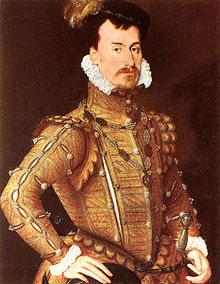
Lord Robert Dudley (c. 1560) Oak Panel. 91.2cm x 71cm. Now in the Wallace Collection.
Locations
People
Groups
Topics
Commodoties
Subjects
Regions
Subregions

Years: 1560 - 1560
September
Lord Robert Dudley (c. 1560) Oak Panel. 91.2cm x 71cm. Now in the Wallace Collection.
Locations
People
Groups
Topics
Commodoties
Subjects
Regions
Subregions