
The rapid progress of the French has …
Years: 1667 - 1667
July
The rapid progress of the French has greatly alarmed the United Provinces, who are desperate to maintain the Spanish Netherlands as a buffer state.
The Netherlands therefore hurriedly end their war with England, and despite the very successful conduct of the war, sign the Treaty of Breda on July 31, 1667, together with England, France, and Denmark.
The Dutch secure a worldwide monopoly on nutmeg by forcing England to give up their claim on Run, the most remote of the Banda Islands.
The Act of Navigation is moderated in that the Dutch are now allowed to ship German goods, if imported over the Rhine, to England.
As communications are slow, special dates are established for the different parts of the world, on which legal hostilities would end: September 5 for the English Channel and the North Sea, October 5 for the other European seas, November 2 for the African coast north of the equator and April 24, 1668, for the rest of the world.
Acadia is returned to France, without specifying what North American territories are actually involved on the ground.
Thomas Temple, the proprietor, residing in Boston, had been given a charter by Cromwell, which is ignored in the Treaty, and the actual handing off is delayed at the site until 1670.
In addition, the conquest of New Netherland by the English is confirmed on July 21, 1667, producing the Colonies of New York, New Jersey, and Delaware.
The Caribbean island of Saint Kitts is repartitioned between English and French forces.
The parties agree to postpone a discussion of the pawnings of Orkney (1468) and Shetland (1469) until a future occasion.
Locations
People
Groups
- Flanders, County of
- Denmark-Norway, Kingdom of
- Franche-Comté (province of the Spanish Empire)
- Spain, Habsburg Kingdom of
- Netherlands, Southern (Spanish)
- Netherlands, United Provinces of the (Dutch Republic)
- France, (Bourbon) Kingdom of
- Habsburg Monarchy, or Empire
- Saint Kitts (English Colony)
- St. Christophe (French Colony)
- Portugal, Bragança Kingdom of
- Acadia, English colony of
- England, (Stewart, Restored) Kingdom of
- New York, Province of (English Colony)
- Delaware Bay, Lower Counties on the (English Colony)
- New Jersey (English Colony)
Topics
- Colonization of Asia, English
- Colonization of Asia, French
- Colonization of Asia, Dutch
- Colonization of the Americas, French
- Colonization of the Americas, English
- Colonization of the Americas, Dutch
- Spanish-Portuguese War of 1657-68
- Anglo-Dutch War, Second
- Devolution, War of
Commodoties
Subjects
Regions
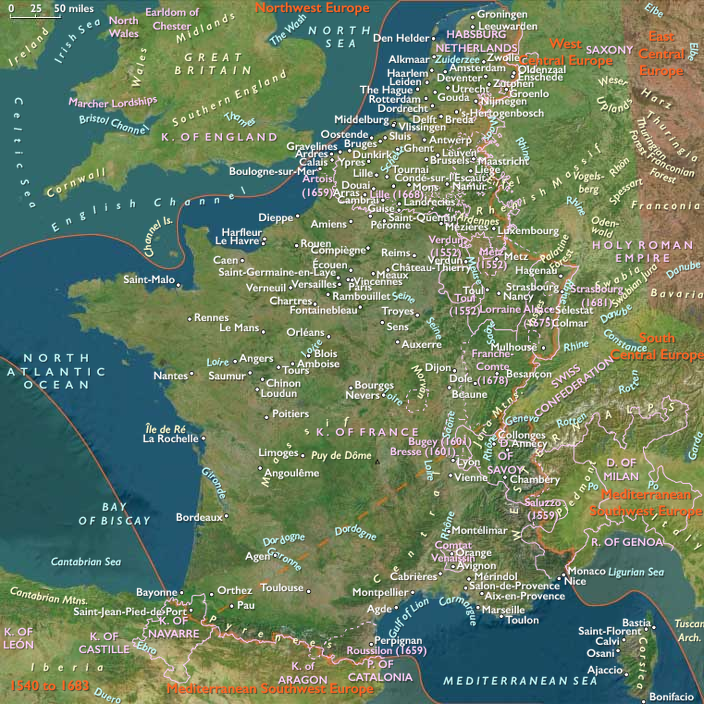
Subregions
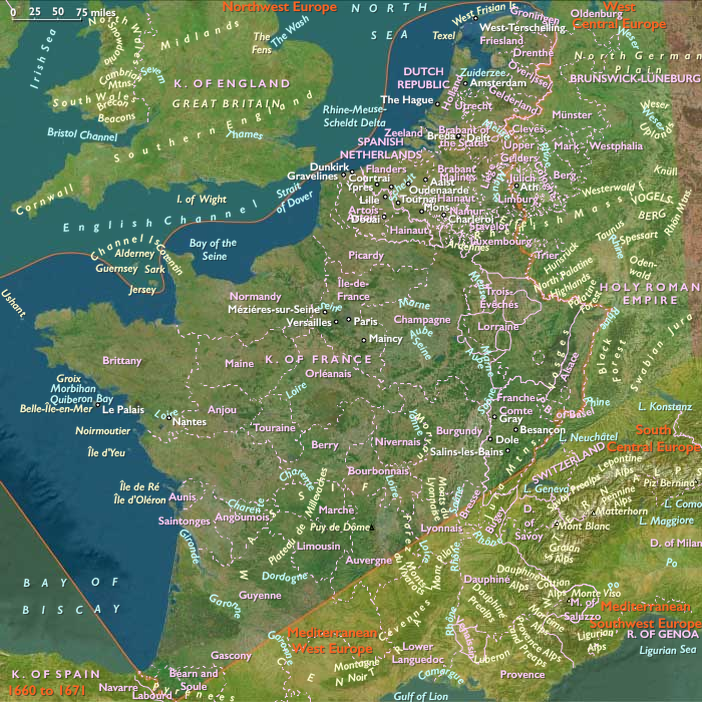
Years: 1667 - 1667
July
Locations
People
Groups
- Flanders, County of
- Denmark-Norway, Kingdom of
- Franche-Comté (province of the Spanish Empire)
- Spain, Habsburg Kingdom of
- Netherlands, Southern (Spanish)
- Netherlands, United Provinces of the (Dutch Republic)
- France, (Bourbon) Kingdom of
- Habsburg Monarchy, or Empire
- Saint Kitts (English Colony)
- St. Christophe (French Colony)
- Portugal, Bragança Kingdom of
- Acadia, English colony of
- England, (Stewart, Restored) Kingdom of
- New York, Province of (English Colony)
- Delaware Bay, Lower Counties on the (English Colony)
- New Jersey (English Colony)
Topics
- Colonization of Asia, English
- Colonization of Asia, French
- Colonization of Asia, Dutch
- Colonization of the Americas, French
- Colonization of the Americas, English
- Colonization of the Americas, Dutch
- Spanish-Portuguese War of 1657-68
- Anglo-Dutch War, Second
- Devolution, War of
Commodoties
Subjects
Regions
Subregions