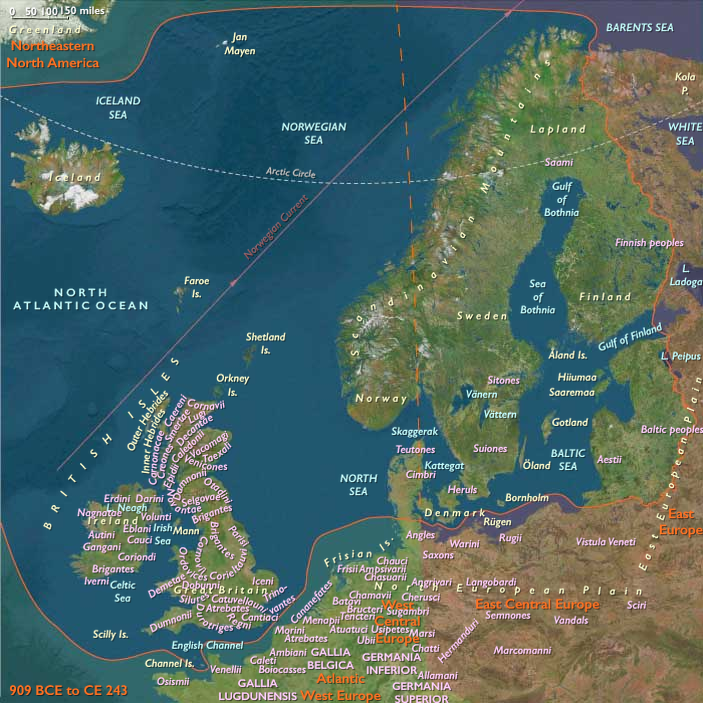
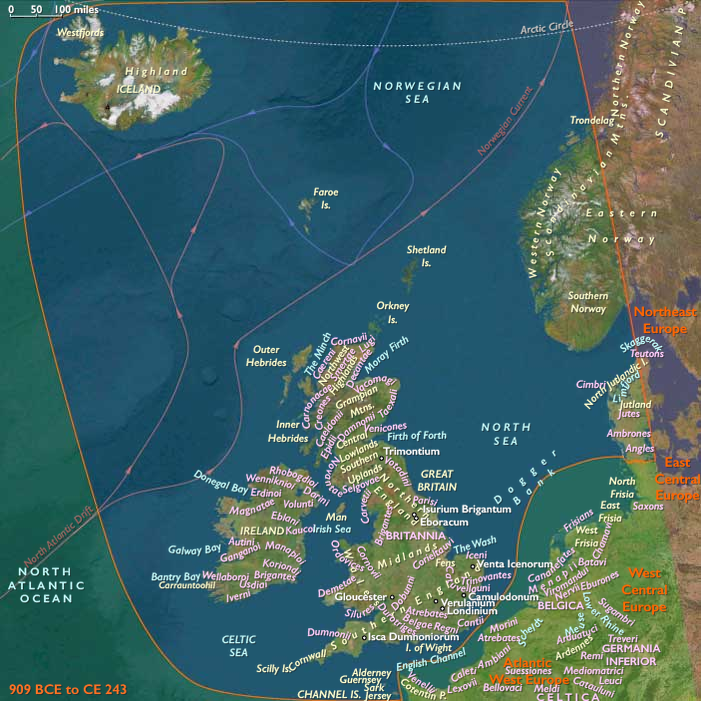
…the region of present London but suffer …
Years: 43 - 43
…the region of present London but suffer a second defeat near Durobrivae (present Rochester).
Locations
People
Groups
- Trinovantes (Celtic tribe)
- Catuvellauni (Celtic tribe)
- Silures (Celtic tribe)
- Ordovices (Celtic tribe)
- Roman Empire (Rome): Julio-Claudian dynasty
Topics
- Classical antiquity
- Pre-Roman Iron Age of Northern Europe
- Roman Age Optimum
- Pax Romana
- Aulus Plautius' Roman invasion of Britain
- Roman Conquest of Britain
Commodoties
Subjects
Regions
Subregions
Related Events
Filter results
Showing 10 events out of 39 total
The Near and Middle East (1828–1971 CE)
Empires in Decline, Nations in Transition, and Oil in Ascendancy
Geography & Environmental Context
The Near and Middle East includes three fixed subregions:
-
The Near East — Israel, Egypt, Sudan, western Saudi Arabia, Yemen, Jordan, southwestern Turkey, and southwestern Cyprus.
-
The Middle East — Iraq, Iran, Syria, Armenia, Georgia, Azerbaijan, Qatar, Bahrain, the United Arab Emirates, eastern Jordan, eastern Saudi Arabia, and northern Oman.
-
Southeast Arabia — southern Oman, eastern Yemen, and the island of Socotra.
This vast region links the Mediterranean, Red Sea, Persian Gulf, and Caspian Basin, bridging Africa, Europe, and Asia. It is dominated by deserts and highlands, punctuated by fertile river valleys (the Nile, Tigris, and Euphrates) and strategic straits — the Suez Canal, the Bab el-Mandeb, and the Strait of Hormuz — that define global trade and geopolitics.
Climate & Environmental Shifts
Aridity remained the defining condition. The 19th century brought episodes of famine and epidemic following droughts in Egypt, Iran, and the Arabian Peninsula. Irrigation schemes and canal building, such as the Suez Canal (opened 1869) and the Assiut Barrage (1902), transformed riverine agriculture. Petroleum exploration and urban expansion in the 20th century accelerated desertification and water demand. Monsoon moisture sustained oases in Oman and Yemen, while seasonal Nile floods continued until the Aswan High Dam (1960–70) reshaped the river’s ecology.
Subsistence & Settlement
-
Agrarian bases persisted in the Nile Valley, the Fertile Crescent, and the Iranian Plateau, producing wheat, cotton, dates, and fruits.
-
Nomadic and pastoral tribes in Arabia, the Levant, and Sudan maintained camel and sheep herding, adapting to modern markets.
-
Urbanization surged in Cairo, Istanbul, Tehran, Baghdad, Beirut, and Jeddah, intensified by European trade and oil wealth.
-
Port cities—Aden, Basra, Kuwait City, Manama, and Doha—grew into nodes of global commerce.
Technology & Material Culture
European imperial penetration introduced telegraphs, railways (notably the Hejaz Railway, 1908), and modern weaponry. In the 20th century, oil extraction and refining brought pipelines, tankers, and industrial zones. Traditional crafts—carpets, calligraphy, metalwork, and ceramics—remained vital symbols of identity. Concrete architecture and Western education transformed cities, while mosques and bazaars continued as cultural anchors.
Movement & Interaction Corridors
-
Trade routes: The Suez Canal reoriented world shipping; the Persian Gulf became an oil artery.
-
Pilgrimage: The Hajj connected Muslims globally through Mecca and Medina.
-
Migration: Rural–urban drift filled cities; labor migration later linked Yemenis, Egyptians, and Iranians to Gulf oil fields.
-
Military corridors: The Near and Middle East served as theaters of imperial rivalries—British in the Gulf and Egypt, Russians in the Caucasus, Ottomans across Anatolia and Arabia.
Cultural & Symbolic Expressions
-
Religion and reform: Islamic modernists such as Jamal al-Din al-Afghani and Muhammad Abduh sought synthesis of faith and reason; Christian minorities in Lebanon and Armenia fostered education and journalism.
-
Literature and art: The Nahda (Arab Renaissance) revived Arabic prose and poetry; Persian and Turkish writers blended realism with nationalism.
-
Architecture: Cairo’s modern boulevards, Tehran’s avenues, and oil-era Gulf skylines redefined urban form while domed mosques and minarets remained emblems of continuity.
-
Music and media: Radio and cinema from Cairo, Tehran, and Istanbul spread popular culture across linguistic and sectarian boundaries.
Environmental Adaptation & Resilience
Desert agriculture expanded through artesian wells and canals; the introduction of cash crops like cotton in Egypt and tobacco in Iran restructured rural economies. Oases sustained date-palm and grain cultivation, while pastoralists adjusted routes to motor transport and border restrictions. In coastal cities, desalination and modern infrastructure emerged to offset water scarcity.
Political & Military Shocks
-
Imperial decline and reform:
-
The Ottoman Empire weakened, culminating in its dissolution after World War I.
-
Egypt’s Muhammad Ali dynasty modernized administration and industry but fell under British occupation (1882).
-
Iran’s Qajar dynasty faced constitutional revolution (1905–11) and later Pahlavi modernization (from 1925).
-
-
World Wars and mandates: British and French mandates carved up former Ottoman territories; Iraq, Syria, Lebanon, Transjordan, and Palestine emerged under European oversight.
-
Nationalism and revolution:
-
Turkey’s Republic (1923) under Mustafa Kemal Atatürk secularized and industrialized Anatolia.
-
Arab nationalism surged—Nasser’s Egypt championed anti-imperial unity.
-
Iran underwent the 1951 oil nationalization crisis and the White Revolution (1963).
-
The Zionist movement culminated in the creation of Israel (1948) and successive Arab–Israeli wars (1948, 1956, 1967).
-
-
Oil and Cold War: The discovery of major oil fields (Iran 1908; Iraq 1927; Saudi Arabia 1938; Kuwait 1938) made the region central to global power politics. U.S. and Soviet rivalry deepened through alliances and arms races.
Transition
Between 1828 and 1971, the Near and Middle East transformed from imperial provinces and desert sultanates into a mosaic of nation-states, revolutionary republics, and monarchies bound by oil and ideology. The collapse of Ottoman and colonial empires unleashed nationalist movements, while petroleum wealth and Cold War geopolitics redefined economies and alliances. In the deserts of Arabia and the deltas of the Nile and Tigris-Euphrates, modernization coexisted with faith, and cities like Cairo, Tehran, and Riyadh became centers of a region poised between deep tradition and global transformation

The Near East (1828–1971 CE): Canals, Mandates, Revolutions, and Wars of State-Building
Geography & Environmental Context
The Near East comprises Israel, Egypt, Sudan, western Saudi Arabia (the Hejaz), most of Jordan, southwestern Cyprus, southwestern Turkey, and Yemen. Anchors include the Nile Valley and Delta; Sinai; the Suez Isthmus and canal corridor; the Levantine coast from Gaza to Haifa; the Jordan Valley/Dead Sea basin; the Hejaz mountains and holy cities; Adana–Antalya and the Taurus foothills; southwestern Cyprus; and the Yemeni highlands and Tihāmah coast. River corridors, oases, and pilgrimage routes tied deserts, littorals, and mountain terraces into one strategic web.
Climate & Environmental Shifts
Late Little Ice Age variability gave way to warmer 20th-century trends, but water remained fate: Nile flood failures (e.g., 1877–78) and later regulation under the Aswan Low Dam (1902, raisings) and High Dam (1960–70) re-timed flows, sediments, and fisheries. Dust storms and drought pulses hit Jordan and the Negev; the Hejaz depended on erratic wadis and wells. In Sudan, Sahelian rainfall swings stressed grazing and Gezira canal allocations. Yemen’s terrace agriculture rose and fell with monsoon irregularity; cyclones occasionally lashed the Red Sea and Arabian coasts.
Subsistence & Settlement
-
Egypt & Sudan: From the cotton boom (Crimean War, U.S. Civil War) to state irrigation and the Gezira Scheme (from 1925), export agriculture reoriented peasant fellahin labor. Cairo, Alexandria, and canal towns (Port Said, Ismailia, Suez) surged; Khartoum–Omdurman and riverine Sudanese towns became administrative and trade hubs, then capitals at independence (Sudan, 1956).
-
Levant & Jordan: Mixed cereals, olives, and citrus persisted; irrigated citrus at Jaffa and valley schemes in Jordan expanded. After 1948, refugee camps, new towns, and state farming projects reshaped settlement on both sides of the Jordan.
-
Israel (from 1948): Rapid urbanization (Tel Aviv, Haifa), coastal citrus and cotton, irrigated Negev schemes, and collective kibbutzim and moshavim reconfigured land use.
-
Hejaz (western Saudi Arabia): Mecca–Medina economies centered on hajj provisioning, construction, and services; Jidda grew as the gateway port.
-
Yemen: Highland terraces (sorghum, coffee, qat) supported dense villages; Aden (British, 1839–1967) was a coaling and bunkering hub, later a refinery port.
-
SW Turkey & SW Cyprus: Citrus, tobacco, cotton, and coastal trade tied Antalya–Adana basins and Cypriot ports into Mediterranean circuits; SW Cyprus shifted from mixed farming to remittance- and tourism-adjacent services by mid-century.
Technology & Material Culture
Irrigation barrages, canals, and later high dams transformed the Nile and Gezira. The Suez Canal (opened 1869) revolutionized global shipping, spawning company towns and a cosmopolitan dockside material culture. Railways (Cairo–Aswan; Haifa lines; Hejaz Railway to Medina, partial after 1908), and later highways and pipelines, re-mapped mobility. Urban crafts modernized into mills, ginneries, refineries, cement works, and shipyards (Alexandria, Suez, Aden, Haifa). Print, records, cinema, radio, and then television spread from Cairo and Jaffa to remote valleys; domestic life pivoted from mud-brick and courtyard houses toward apartment blocks and concrete terraces.
Movement & Interaction Corridors
-
Canal & Red Sea trunk: The Suez Canal fused Mediterranean and Indian Ocean worlds; bazaars, souks, and shipping firms connected Port Said to Bombay and Marseille.
-
Pilgrimage highways: Annual hajj flows—by steamer and road—underwrote Hejazi economies; 20th-century health, water, and transport investments scaled the pilgrimage.
-
Mandates & air routes: British and French mandate systems (to the north and east) touched this subregion via ports and pipelines; air corridors (Cairo, Lydda/Lod, Jidda, Aden) knitted it to empire and, later, post-imperial networks.
-
Refuge and labor: After 1948, Palestinian displacement reshaped Gaza, Jordan, and Israel; Sudanese and Egyptian workers circulated along river and canal fronts; Yemeni and Hejazi workers moved between Aden, Jidda, and the Gulf.
Cultural & Symbolic Expressions
Cairo’s presses, al-Azhar reforms, and the Nahda (Arab renaissance) seeded newspapers, novels, and constitutional ideas; Umm Kulthūm, ʿAbd al-Wahhāb, and film studios made Egypt the Arabic world’s cultural capital. Zionist revival in Hebrew letters, schools, and settlement institutions culminated in Israeli state culture after 1948. Coptic institutions in Egypt, Jewish and Christian communities in Palestine/Israel, Greek communities in Cyprus, and Zaydi religious life in Yemen signaled deep pluralism. The hajj remained the ritual axis of the Hejaz. Street murals, political posters, and radio speeches (from Nasser to King ʿAbdullāh, from Imam Yahyā to President al-Sallāl, the first head of the Yemen Arab Republic) turned modern media into public ritual.
Environmental Adaptation & Resilience
-
Water mastery: Barrages, canals, and later the High Dam stabilized irrigation but altered silt, fisheries, and disease ecologies; drainage and sāqiya replacement reduced water-borne burdens even as schistosomiasis lingered.
-
Terrace care: In Palestine, Jordan, and Yemen, stone terraces and cisterns conserved soil and water; spring captures and wadis were regulated for villages and kibbutzim.
-
Pastoral pivots: In Sudan and the Hejaz, herders shifted routes with drought; market sedentarization advanced along roads and rail.
-
Urban services: Public health campaigns (malaria control, vaccination), modern hospitals, and grain boards buffered shocks; rationing and port provisioning sustained cities during wars and closures.
Political & Military Shocks
-
Egypt & Sudan: ʿUrābī Revolt (1881–82) and British occupation (1882); Anglo-Egyptian Condominium in Sudan (1899); Egyptian Revolution (1952); Suez Crisis (1956) after canal nationalization; Sudanese independence (1956) and post-colonial realignments.
-
Hejaz & western Arabia: Hashemite control ended with Saudi conquest (1925); pilgrimage administration and urban growth accelerated under the new state.
-
Israel–Arab wars: 1948–49 war and armistices; 1956 Suez War; 1967 Six-Day War (Sinai, Gaza, West Bank, Golan outside our strict list but West Bank affects Jordan); War of Attrition (1969–70) along the Suez.
-
Jordan: Emirate (1921), independence (1946), refugee integration after 1948, and Black September (1970) tensions.
-
Cyprus (SW): British administration (from 1878), enosis debates, and independence (1960) set the stage for later crises.
-
Yemen: Imamate rule in the north; Aden under Britain; North Yemen Civil War (1962–70) pitted republicans and royalists with Egyptian and Saudi intervention; South Yemen independence (1967) transformed Aden.
-
Turkey (SW): From Ottoman to Republic (1923); land and port development in Adana–Antalya, integration with national reforms.
Transition
Between 1828 and 1971, the Near East shifted from an Ottoman-provincial world of canals, caravans, and terraces into a mosaic of post-imperial states and mass politics. The Suez Canal remade global trade; British occupation, mandate-era corridors, and Zionist settlement recast demographics and power; 1948, 1956, and 1967 etched borders through cities and fields. Nasserist high modernism—dams, factories, land reform—collided with cold-war alignments and regional wars. In the Hejaz, the hajj scaled into a modern infrastructural pilgrimage; in Yemen, revolutions and decolonization closed the imperial coaling age of Aden. By 1971, the subregion’s everyday life—from Nile canals and Jordan terraces to Hejazi hostels and Yemeni hill towns—was reordered by states, mass media, and wars, setting the stage for oil-era geopolitics and yet-deeper contests over water, land, and sovereignty.
The Red Sea is of strategic importance to the United Kingdom due to both trade and as a route for its navy to pass through in order to reach India among other places.
South of Yemen is the British Colony of Aden and Aden Protectorate, which are at considerable risk of anti-colonialist rebellions.
Italy has colonies of its own in the region: Eritrea and Somaliland, both of low profitability.
There is considerable belief that increased ties with the Mutawakkilite Kingdom of Yemen would fuel increased trade with the colonies and bring the region under the Italian sphere.
The Yemeni Kingdom at this point has its eye on annexing Aden and, with the advent of Imam Yahya, also has aspirations for a Greater Yemen.
In September 1926 the Italo-Yemeni Treaty, also known as the Treaty of San'a, is signed.
Described as a friendship treaty, it recognizes Yahya as King of Yemen and his claims to Aden.
Ibn Sa'ud forces the encircled rebels to surrender to the British in Kuwait in January 1930.
The Ikhwan leaders, ad-Dawish and Ibn Hithlayn's cousin Nayif, are subsequently incarcerated in Riyadh.
Power in Arabia thus passes definitively into the hands of townspeople rather than the tribes.
Not all of the Ikhwan had revolted.
Those that had stayed loyal to Ibn Sa'ud remain on the hijrahs, continue to receive government support, and continue as an influential religious force.
Because Arabian sovereignty is traditionally expressed in the form of suzerainty over certain tribes rather than in fixed territorial boundaries, Ibn Sa'ud regards the demarcation of land frontiers with suspicion.
Nevertheless, by 1930, the majority of the frontiers with Iraq, Kuwait, and Jordan have been demarcated.
In the south, however, no agreement is reached on the exact site of the Saudi frontiers with the Trucial States and with the interior of Yemen, Muscat, and Oman.
The 1934 Anglo-Yemeni Treaty of Friendship and Mutual Cooperation defers final settlement of the question, leaving the border dispute unresolved.
The border between the Aden Protectorate and Yemen had originally been established during 1902-1904.
Over the past several years, Yemen has raised a claim to nine regions in the border area.
Yahya had recovered al-Hudaydah and other ports from Asir (1925) but had been evicted from the Aden Protectorate in 1928.
Emboldened by an Anglo-Indian-Yemeni treaty of February 11, 1934, signed on the same day that the Saudi and British governments conclude a treaty of friendship for 40 years between the two countries, Yajyao precipitates war with Saudi Arabia.
After summary defeat, he receives a generous treaty (May 1934).
Most of the boundaries of Saudi Arabia remain unmapped, unmarked, and undemarcated by treaty.
As a consequence of conflicts among tribes in the border areas between Saudi Arabia, and Yemen, the Idrissi of Asir has recanted his previous allegiance to ibn Saud and fled to Yemen to join the Zaydi Imam of Yemen, Yahya Muhammad Hamid ed-Din.
A peace delegation sent by ibn Saud is jailed by Yahya, who then sends the Idrissi back to his lands with an army.
When the Saudis send in their own army, equipped with modern rifles and vehicles, they quickly win control and advance as far as Hodeida.
The episode spurs Western powers to send warships to Hodeida to evacuate their nationals.
The Saudi Yemeni War officially ends on May 20, 1934, with the signing of the Treaty of Taif between ibn Saud and Yahya, which asserts Saudi Arabia's sovereignty over territories "(formerly) in the possession of the Idrisis or the Al-Aidh, or in Najran, or in the Yam country".
The covenant of the League of Arab States, or Arab League, formed in March 22, 1945, contains an annex emphasizing the Arab character of Palestine and proclaiming its intent to defend it.
The founding member states are Egypt, Syria, Lebanon, Iraq, Transjordan, Saudi Arabia, and Yemen.
The aims of the league in 1945 are to strengthen and coordinate the political, cultural, economic, and social programs of its members and to mediate disputes among them or between them and third parties.
Initially these forces consist of approximately eight thousand to ten thousand Egyptians, two thousand to four thousand Iraqis, four thousand to five thousand Transjordanians, three thousand to four thousand Syrians, one thousand to two thousand Lebanese, and smaller numbers of Saudi Arabian and Yemeni troops; about twenty-five thousand in all.
Goldie Myerson, a signatory of Israel's independence declaration and newly appointed minister to Moscow, had personally attempted to dissuade King Abdullah of Transjordan from joining the invasion of Israel decided on by other Arab states.
Israeli forces composed of the Haganah, such irregular units as the Irgun and the Stern Gang, and women's auxiliaries, number thirty-five thousand or more, armed with Czechoslovakian weapons sent at the behest of the Soviet Union.
Moshe Dayan commands the Jerusalem area; Yitzhak Rabin directs the defense of Jerusalem (and also fights the Egyptians in the Negev).
The invading Arab League forces occupy the areas in southern and eastern Palestine not apportioned to the Jews, then capture the small Jewish quarter of the Old City of Jerusalem.
The Israelis, meanwhile, win control of the main road to Jerusalem through the Yehuda Mountains (Judaean Hills) and successfully beat off Arab attacks.
The Arab League has fielded only a few well-trained units.
In addition, some Arab logistical lines are long, making resupply and communication difficult.
The most formidable Arab force is Transjordan's Arab Legion, commanded by Glubb Pasha, but Abdullah has secret relations with the Zionists and strongly opposes a Palestinian state led by his enemy al-Husseini.
Other states, such as Egypt and Iraq, also have different objectives, and this internal strife, disorganization, and military ineptitude prevents the Arabs from mounting a coordinated attack.
Abdullah's primary purpose, which he has spelled out in secret discussions with Jewish envoys, is to extend his rule to include the area allotted to the Palestinian Arabs under the United Nations partition resolution of November 1947.
Accordingly, he engages his forces in the area of Palestine popularly known as the West Bank and expels Jewish forces from East Jerusalem (the Old City).
Years: 43 - 43
Locations
People
Groups
- Trinovantes (Celtic tribe)
- Catuvellauni (Celtic tribe)
- Silures (Celtic tribe)
- Ordovices (Celtic tribe)
- Roman Empire (Rome): Julio-Claudian dynasty
Topics
- Classical antiquity
- Pre-Roman Iron Age of Northern Europe
- Roman Age Optimum
- Pax Romana
- Aulus Plautius' Roman invasion of Britain
- Roman Conquest of Britain