
Filters:
A new dynasty comes to power in …
Years: 1108 - 1251
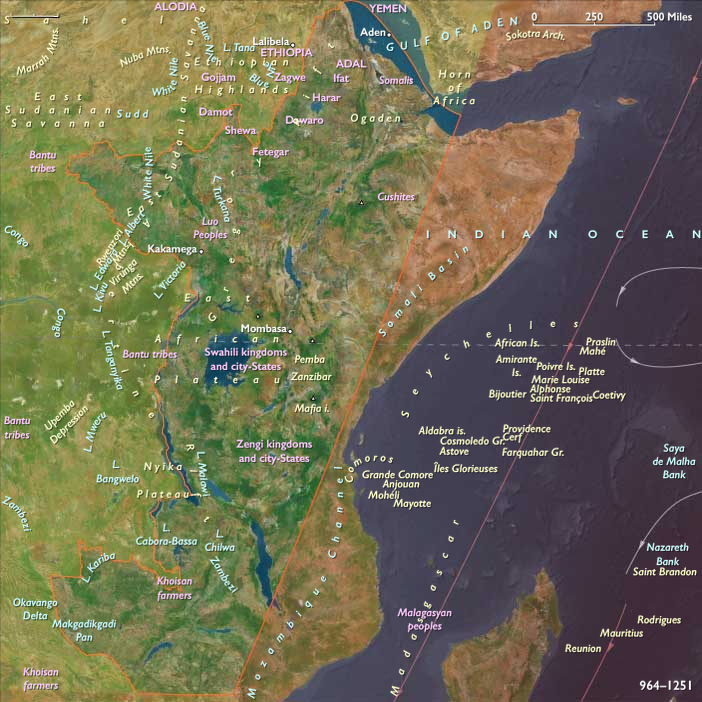
A new dynasty comes to power in Ethiopia's Christian highlands in about 1137.
Known as the Zagwe and based in the Agew district of Lasta, it develops naturally out of the long cultural and political contact between Cushitic- and Semitic-speaking peoples in the northern highlands.
Staunch Christians, the Zagwe devote themselves to the construction of new churches and monasteries.
These are often modeled after Christian religious edifices in the Holy Land, a locale the Zagwe and their subjects hold in special esteem.
Patrons of literature and the arts in the service of Christianity, the Zagwe kings are responsible, among other things, for the great churches carved into the rock in and around their capital at Adefa.
In time, Adefa becomes known as Lalibela, the name of the Zagwe king to whose reign the Adefa churches' construction has been attributed.
By the time of the Zagwe, the Ethiopian church is showing the effects of long centuries of isolation from the larger Christian and Orthodox worlds.
After the seventh century, when Egypt succumbed to the Arab conquest, the highlanders' sole contact with outside Christianity had been with the Coptic Church of Egypt, which periodically supplied a patriarch, or abun, upon royal request.
During the long period from the seventh to the twelfth century, the Ethiopian Orthodox Church come to place strong emphasis upon the Old Testament and on the Judaic roots of the church.
Christianity in Ethiopia becomes imbued with Old Testament belief and practice in many ways, which differentiates it not only from European Christianity but also from the faith of other Monophysites, such as the Copts.
Under the Zagwe, the highlanders maintain regular contact with the Egyptians.
Also, by now the Ethiopian church has demonstrated that it is not a proselytizing religion but rather one that by and large restricts its attention to already converted areas of the highlands.
Not until the fourteenth and fifteenth centuries will the church demonstrate real interest in proselytizing among nonbelievers, and then it will do so via a reinvigorated monastic movement.
Known as the Zagwe and based in the Agew district of Lasta, it develops naturally out of the long cultural and political contact between Cushitic- and Semitic-speaking peoples in the northern highlands.
Staunch Christians, the Zagwe devote themselves to the construction of new churches and monasteries.
These are often modeled after Christian religious edifices in the Holy Land, a locale the Zagwe and their subjects hold in special esteem.
Patrons of literature and the arts in the service of Christianity, the Zagwe kings are responsible, among other things, for the great churches carved into the rock in and around their capital at Adefa.
In time, Adefa becomes known as Lalibela, the name of the Zagwe king to whose reign the Adefa churches' construction has been attributed.
By the time of the Zagwe, the Ethiopian church is showing the effects of long centuries of isolation from the larger Christian and Orthodox worlds.
After the seventh century, when Egypt succumbed to the Arab conquest, the highlanders' sole contact with outside Christianity had been with the Coptic Church of Egypt, which periodically supplied a patriarch, or abun, upon royal request.
During the long period from the seventh to the twelfth century, the Ethiopian Orthodox Church come to place strong emphasis upon the Old Testament and on the Judaic roots of the church.
Christianity in Ethiopia becomes imbued with Old Testament belief and practice in many ways, which differentiates it not only from European Christianity but also from the faith of other Monophysites, such as the Copts.
Under the Zagwe, the highlanders maintain regular contact with the Egyptians.
Also, by now the Ethiopian church has demonstrated that it is not a proselytizing religion but rather one that by and large restricts its attention to already converted areas of the highlands.
Not until the fourteenth and fifteenth centuries will the church demonstrate real interest in proselytizing among nonbelievers, and then it will do so via a reinvigorated monastic movement.
Locations
Groups
- Egyptians
- Aksum (or Axum), Kingdom of
- Sidama people
- Agaw people
- Christians, Miaphysite (Oriental Orthodox)
- Coptic Orthodox Church of Alexandria
- Amhara people
- Ethiopia, Zagwe Dynasty of
Topics
Subjects
Regions

Subregions
Years: 1108 - 1251
Locations
Groups
- Egyptians
- Aksum (or Axum), Kingdom of
- Sidama people
- Agaw people
- Christians, Miaphysite (Oriental Orthodox)
- Coptic Orthodox Church of Alexandria
- Amhara people
- Ethiopia, Zagwe Dynasty of
Topics
Subjects
Regions
Subregions