
A set of epic struggles to create …
Years: 1876 - 1887
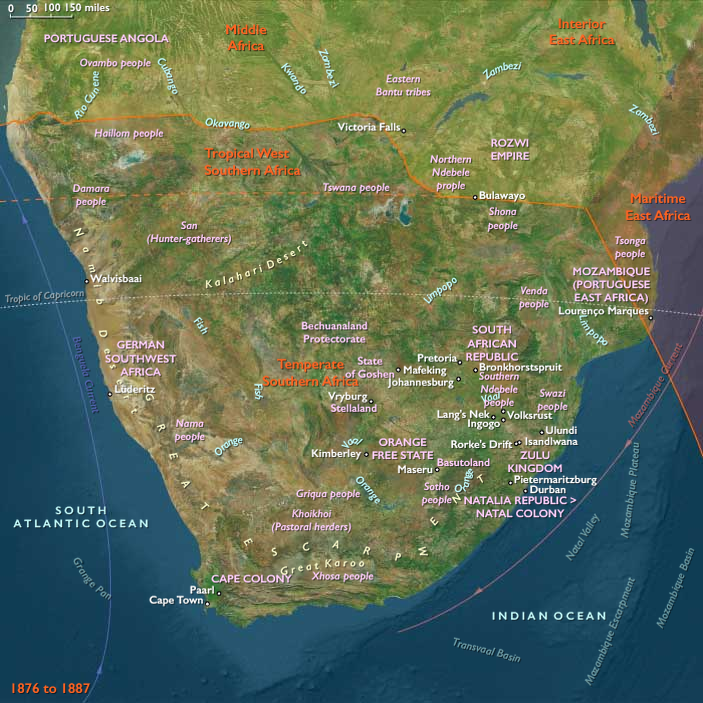
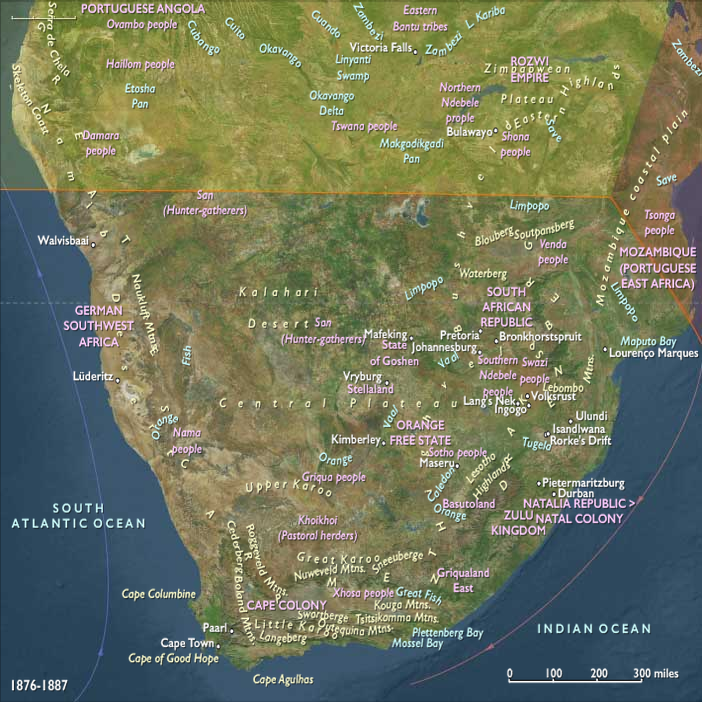
A set of epic struggles to create a single unified state dominates the southern part of the African continent in the nineteenth century.
British expansion into southern Africa is fueled by three prime factors: first, the desire to control the trade routes to India that pass around the Cape; second, the discovery in 1868 of huge mineral deposits of diamonds around Kimberley on the joint borders of the South African Republic (called the Transvaal by the British), Orange Free State and the Cape Colony, and thereafter in 1886 in the Transvaal of a major gold find, all of which offer enormous wealth and power; and thirdly the race against other European colonial powers, as part of a general colonial expansion in Africa.
Other potential colonizers include Portugal, who already control West Africa (modern day Angola) and East Africa (modern day Mozambique), Germany (modern day Namibia), and further north, Belgium (modern day Democratic Republic of the Congo) and France (West and Equatorial Africa, and Madagascar).
Groups
- Portuguese Mozambique
- Angola (Portuguese colony)
- Portugal, Bragança Kingdom of
- Boers
- Britain (United Kingdom of Great Britain and Ireland)
- Cape Colony, British
- Zulu, Kingdom of the
- Belgium, Kingdom of
- South African Republic (the Transvaal)
- Orange Free State, Republic of the (Boer Republic)
- Transvaal, Republic of the
- German Empire (“Second Reich”)
- France (French republic); the Third Republic
- Transvaal, Crown Colony of the
- South African Republic (the Transvaal) (restored)
- German Southwest Africa
- Congo Free State (King Leopold's Congo)
Topics
Commodoties
Subjects
Regions
Subregions
Years: 1876 - 1887
Groups
- Portuguese Mozambique
- Angola (Portuguese colony)
- Portugal, Bragança Kingdom of
- Boers
- Britain (United Kingdom of Great Britain and Ireland)
- Cape Colony, British
- Zulu, Kingdom of the
- Belgium, Kingdom of
- South African Republic (the Transvaal)
- Orange Free State, Republic of the (Boer Republic)
- Transvaal, Republic of the
- German Empire (“Second Reich”)
- France (French republic); the Third Republic
- Transvaal, Crown Colony of the
- South African Republic (the Transvaal) (restored)
- German Southwest Africa
- Congo Free State (King Leopold's Congo)
Topics
Commodoties
Subjects
Regions
Subregions