
The Spanish had begun to create permanent …
Years: 1510 - 1510
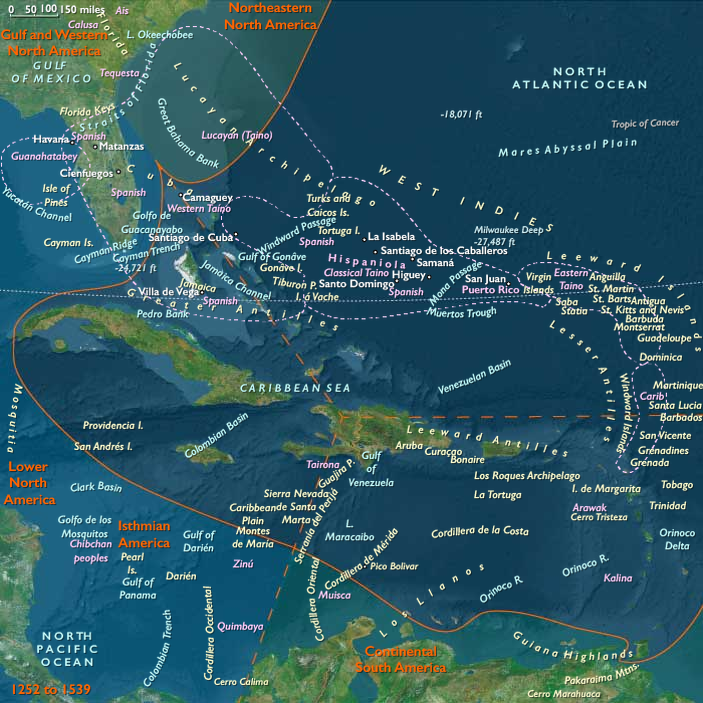
The Spanish had begun to create permanent settlements on the island of Hispaniola, east of Cuba, soon after Columbus' arrival in the Caribbean, but the coast of Cuba is not fully mapped until 1509, when Sebastián de Ocampo completes this task.
Under the authority of the Governor of Hispaniola, Ocampo had sailed along the northern coast of the island through the Old Bahama Channel and around the western point, Cape San Antonio.
The voyage has taken eight months, and is against the Gulf Stream.
Europeans had already frequented Cuba by the time Ocampo embarked on his journey, but his circumnavigation has confirmed that the area is indeed surrounded by water, and not a peninsula as was speculated.
Ocampo returns to Hispaniola with news of the body of water that lies beyond.
Before that, and after Christopher Columbus's discovery of the Antilles, several maps portray what latter-day interpreters have assumed to be the Gulf of Mexico, thereby disputing the actual discovery date.
Hundreds of thousands Tainos living on the island of Hispaniola had been enslaved to work in gold mines.
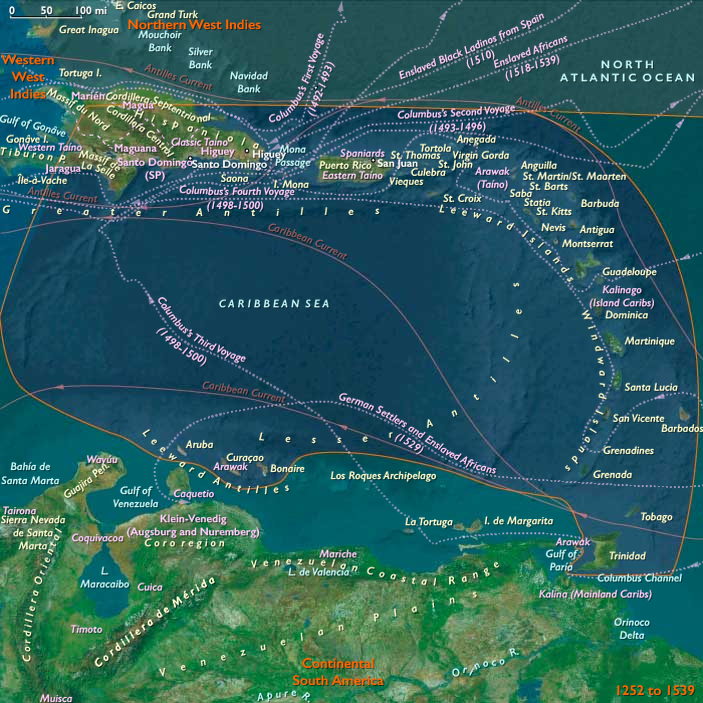
In 1501, the Spanish monarchs, Ferdinand I and Isabella, had first granted permission to the colonists of the Caribbean to import African slaves, which began arriving to the island in 1503.
In 1510, the first sizable shipment, consisting of two hundred and fifty Black Ladinos, arrives in Hispaniola from Spain.
Locations
People
Groups
Topics
Commodoties
Subjects
Regions
Subregions
Related Events
Showing 3 events out of 3 total
Years: 1510 - 1510
Locations
People
Groups
Topics
Commodoties
Subjects
Regions
Subregions