
The Spanish Infanta Maria Theresa brings cocoa …
Years: 1659 - 1659
The Spanish Infanta Maria Theresa brings cocoa to Paris in 1659, the year Diego Velázquez's portrait of the Infanta is first exhibited.
Considered one of the artist's best late portraits, it shows its subject in a majestic pose, illuminated in a light dress against a dark background.
Its seriousness and formality is added to by the two watches she carries, while the handkerchief in her left hand is one of the painting's highlights.
(Now in the Kunsthistorisches Museum in Vienna, it has been cut down at the top and bottom.)
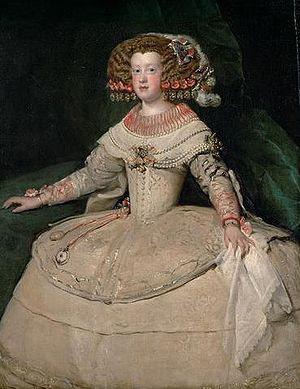
Diego Velázquez: The infanta Maria Theresa of Spain or The infanta Maria Theresa aged 14 (1652-3) Oil on canvas, 127 x 98,5 cm, Kunsthistorisches Museum, Vienna. Here, the princess wears her hair in a popular style at the Spanish royal court, and also wears extremely wide panniers, also popular in Spain.
Locations
People
Groups
Commodoties
Subjects
Regions
Subregions
Related Events
Filter results
Showing 10 events out of 22 total
Robert Holmes had first appeared in 1643 on the Cavalier side of the Civil War, in Prince Maurice's regiment of horse as a cornet in the troop of Captain Richard Atkyns.
Thus began a lifelong friendship with Maurice's brother, Prince Rupert, whom he accompanied onto the battlefields of the continent once the Royalists had been defeated.
When in 1648 a part of the fleet went over to the exiled king, Holmes (now an army captain), following Maurice and Rupert, had come into his first contact with the navy, participating in the epic cruise of the Royalist fleet of 1649 – 1652 to Kinsale, the Mediterranean, West Africa (where, between the Gambia and Cape Verde, he was temporarily captured by the natives), and the West Indies.
The drain of manpower, through storm, action, and mutiny, was so large that at the end of the cruise, Holmes had advanced to commanding the four prizes the force brought back to France.
With Rupert returning to the exiled court, it had fallen to Holmes to see the fleet paid off.
Subsequently, Cromwell's intelligence service reported Holmes having obtained a privateer commission from the King of Spain (Thurloe State Papers VII, p. 248, 18 July 1658.
N.S.
), although the total absence of other evidence makes his actually setting out as a privateer improbable.
He may, like other Royalist, and notably Irish, officers, have taken up service with the Imperial army.
Immediately before the Restoration, Holmes had acted as a courier between Charles II and Edward Montagu, by whose commission he had obtained his first command in the navy, the Medway guardship Bramble.
Upon Charles II's return to England, Holmes had been rewarded for his services with the captaincy of Sandown Castle, Isle of Wight together with a new commission (for another guardship), this time from the Duke of York himself, who had assumed the position of Lord High Admiral.
Rupert’s initial report from the Gambia of a "Mountain of Gold" for the taking prompted the Royal African Company, whose director is the Duke of York (and whose paperwork is carried out by William Coventry) to launch an expedition to the Guinea Coast, at this time mostly in Dutch hands.
Holmes is appointed captain of the flagship, Henrietta, and a squadron of four other of the King's ships: Sophia, Amity, Griffin, and Kinsale.
His orders (drafted by Coventry) are to assist the company's factors in every way conceivable and to construct a fort.
Privately, he is instructed to gather intelligence as to the expected "Mountain of Gold".
Touching at Goree, Holmes bluntly informs the Dutch governor that the King of England claims the exclusive right of trade and navigation between Cape Verde and the Cape of Good Hope (which the King and Treasury Secretary Sir George Downing are to disavow after protests from the States General and retaliatory action against English shipping).
The Dutch Spice Fleet, laden with fabulous riches, had managed to return home safely after the Battle of Vågen.
The Dutch navy has been enormously expanded through the largest building program in its history.
Already in August 1665 the English fleet had again been challenged, though no large battles resulted.
The English in 1666 have become anxious to destroy the Dutch navy completely before it can grow too strong and are desperate to end the activity of Dutch raiders as a collapse of English trade threatens.
On learning that the French fleet intends to join the Dutch at Dunkirk, the English decide to prevent this by splitting their fleet.
Their main force will try to destroy the Dutch fleet first, while a squadron under Prince Rupert is sent to block the Strait of Dover against the French—who don't show up.
At the start of the battle the English fleet of fifty-six ships commanded by Monck, who also commands the Red Squadron, is outnumbered by the eighty-four-strong Dutch fleet commanded by de Ruyter.
The battle, fought from June 1 to 4 June 4 in the Julian or Old Style calendar used at this time in England (June 11 to 14, New Style) off the Flemish and English coast ends with a successful English disengagement after both fleets have expended most of their ammunition.
The Dutch have inflicted significant damage on the English fleet.
The English had gambled that the crews of the many new Dutch ships of the line would not have been fully trained yet but were deceived in their hopes: they have lost ten ships, with slightly over one thousand men killed including two Vice-Admirals, Sir Christopher Myngs and Sir William Berkeley, while about two thousand English have been taken prisoner.
Dutch losses are four ships destroyed by fire and over fifteen hundred and fifty men killed, including Lieutenant-Admiral Cornelis Evertsen, Vice-Admiral Abraham Van der Hulst and Rear-Admiral Frederik Stachouwer.
Christopher Myngs himself had been severely wounded during the pirate attack on Campeche Bay, and in 1664 had returned to England to recover.
He had in 1665 been made Vice-Admiral in Prince Rupert's squadron.
As Vice-Admiral of the White under the Lord High Admiral James Stewart, Duke of York and Albany, he had flown his flag during the Second Anglo-Dutch War at the Battle of Lowestoft in 1665, and for his share in that action has received the honor of knighthood.
He subsequently served in the same year under Edward Montagu, 1st Earl of Sandwich, as Vice-Admiral of the Blue and after the disgrace of Montagu under the next supreme fleet commander, George Monck, 1st Duke of Albemarle.
He was on detachment with Prince Rupert's Green squadron when the great Four Days' Battle began, but returned to the main fleet in time to take part on the final day, and in this action when his flotilla was surrounded by that of Vice-Admiral Johan de Liefde he had received a wound—being hit first through the cheek and then in the left shoulder by musket balls fired by a sharpshooter when his Victory was challenged by De Liefde's flagship, the Ridderschap van Holland—of which he dies shortly after returning to London.
The Dutch having inflicted considerable damage on the British fleet in the Four Days Battle, de Witt orders de Ruyter to carry out a plan that has been prepared for over a year: to land in the Medway to destroy the British fleet while it is being repaired in the Chatham dockyards.
For this purpose, ten fluyt ships (an inexpensive Dutch type of sailing vessel originally designed as a dedicated cargo vessel) and one that can be built in large numbers carry twenty-seven hundred man of the newly created Dutch Marine Corps, one of the first in history to be specialized in amphibious landings.
Also, de Ruyter is to combine his fleet with the French one.
The French, however, don't show up and bad weather prevents the landing.
De Ruyter has to limit his actions to a blockade of the Thames.
He observes on the 1st of August that the British fleet is leaving port—earlier than expected.
Next, a storm drives the Dutch fleet back to the Flemish coast.
De Ruyter on July 3 again crosses the North Sea, leaving behind the troop ships.
The St. James Day Battle (also known as the St. James' Day Fight, the Battle of the North Foreland and the Battle of Orfordness) takes place on July 25, 1666—St. James' day in the Julian calendar currently in use in England (August 4, 1666 in the Gregorian calendar).
The English fleet is commanded jointly by Rupert and Monck; the fleet of the United Provinces is commanded by de Ruyter.
The battle is known in The Netherlands as the Two Days' Battle.
The battle is a clear English victory, though the separate clash of the two rears is a victory for Tromp.
Dutch casualties are enormous, estimated immediately after the battle at about five thousand men, compared with three hundred British killed; later, more precise information will show that only about twelve hundred of these have been killed or seriously wounded.
However, the Dutch only lose two ships: de Ruyter had been successful at saving almost the complete van, only Sneek and Tholen have struck their flag, and they can quickly repair the damage.
The twin disasters of the Great Plague of London and the Great Fire of London, however, combined with his financial mismanagement, have left Charles II without the funds to continue the war.
In fact, he had had only enough reserves for this one last battle.
Radisson and des Groseilliers had approached a group of businessmen in Boston, Massachusetts to help finance their explorations.
The Bostonians agreed on the plan's merits, and brought the two to England to elicit financing.
The English had in 1668 commissioned two ships, the Nonsuch and the Eaglet, to explore possible trade into Hudson Bay.
The Nonsuch is commanded by Captain Zachariah Gillam and accompanied by des Groseilliers, while the Eaglet is commanded by Captain William Stannard and accompanied by Radisson.
Both ships had left port on June 5, 1668, from Deptford, England, but the Eaglet had been forced to turn back off the coast of Ireland.
The Nonsuch, bypassing the land route from New France, continues on all the way to the southern portion of James Bay, where Fort Rupert is founded at the mouth of the Rupert River.
Both the fort and the river are named after the sponsor of the expedition, Prince Rupert of Bavaria.
After a successful trading expedition over the winter of 1668–9, the Nonsuch returns to England.
Following the successful expedition to Hudson’s Bay, Charles II grants a charter on May 2, 1670, to “the Governor and Company of Adventurers in England trading in Hudson’s Bay”, thereby granting them “the sole trade and commerce” and ownership of “all the lands and territories” drained by the waters that flow into Hudson’s Bay.
The vast region, completely unexplored by Europeans, is called Rupert’s Land after the king’s cousin, Prince Rupert, a prominent shareholder in the company.
Colonel Thomas Blood, disguised as a clergyman, attempts to steal the Crown Jewels from the Tower of London.
He is immediately caught because he is too drunk to run with the loot.
Following his capture Blood refuses to answer to anyone but the king and is consequently taken to the palace, bound in chains, where he is questioned by King Charles, Prince Rupert, the Duke of York, and other members of the royal family.
The King asks Blood, "What if I should give you your life?" and Blood replies humbly, "I would endeavor to deserve it, Sire!"
To the disgust of Lord Ormonde, Blood is not only pardoned, but also given land in Ireland worth five hundred pounds a year.
The reasons for the king's pardon are unknown.
Some historians have speculated that the king may have feared an uprising in revenge by followers of Blood, who are thought to have taken an oath to their leader.
Others speculate that the king had a fondness for audacious scoundrels such as Blood, and that he was amused by the Irishman's claim that the jewels were worth only six thousand pounds as opposed to the one hundred thousand pounds at which the Crown had valued them.
There is also a suggestion that the king was flattered and amused by Blood's revelation that he had previously intended to kill the king while Charles was bathing in the Thames but had been swayed otherwise, having found himself in "awe of majesty.
It has also been suggested that his actions may have had the connivance of the king himself, because the king was very short of money at the time.
De Witt tends to believe the repeated diplomatic assurances by the French and English that they have no invasion in mind, but many Dutch politicians and military men interpret the French diplomatic activities in the German principalities, the preparing of the English Navy and the raising of large armies as sure signs of an imminent war.
William III, despite his youth, is on February 25, 1672, appointed Captain-General of the confederate Dutch army.
Factional strife and uncertainty about the French strategy prevent a strong field army from being created; most of the eighty-three thousand troops (seventy thousand seven hundred infantry and twelve thousand seven hundred and ten cavalry in June 1672) are assigned to the fortresses.
Whereas the Dutch Republic is thus ill-prepared for a land campaign, the situation at sea is much more favorable, even though the States-General decides to limit the naval budget to four million seven hundred and seventy-six thousand two hundred and forty-eight guilders (down from an original projected budget of seven million eight hundred and ninety-three thousand nine hundred and ninety-two guilders) in order not to provoke the English.
The Dutch navy, after having destroyed the core of the English navy at Chatham in 1667, had been the strongest in the world.
This has again changed in 1672, with the English having replaced the capital ships lost, while few Dutch ships have been built
One of the five autonomous Dutch admiralties, that of Friesland, is unable to contribute many ships because that province is being attacked by Münster.
The Dutch, however, will successfully prevent a blockade of their coast and any landing of enemy troops, despite being outnumbered by a third by the combined Anglo–French fleet.
The reason for this success are the much improved training standards.
The Dutch navy in the major battles of 1666 still had to get used to its brand-new, much heavier, warships and some costly tactical mistakes had been made; also personal conflict between Lieutenant-Admirals Michiel de Ruyter and Cornelis Tromp had damaged the unity of the fleet.
De Ruyter had used the summer of 1671 to execute many training maneuvers employing the line-of-battle, perfecting the fire drill and installing a new sense of coherence and discipline.
As a result, the Republic is in 1672 at the apex of its naval power; in the English navy however, Admiral Edward Spragge had grown jealous of supreme commander Prince Rupert of the Rhine.
Also, Spragge had broken formation in two battles to seek out his personal enemy Tromp, having vowed to kill him for having insulted his wife.
Cooperation between the English and the French navies is poor, plagued by misunderstandings and suspicions.
As had happened in the previous conflict, even before the formal outbreak of war, the English try to intercept the Dutch Smyrna Fleet, a yearly convoy of Dutch merchants from the Levant sailing with a flotilla to protect them from the Barbary Corsairs.
Admiral Robert Holmes attacks the convoy in the English Channelfrom March 12, 1672 (Old Style), but is beaten back by Cornelis Evertsen the Youngest, capturing only a limited number of prizes.
The surprise attack by Dutch naval commander Michiel de Ruyter in June 1672, resulting in the Battle of Solebay, has prevented the allies from establishing naval superiority on the North Sea, keeping open the sea lanes so vital to Dutch trade.
The Orangist party had taken power when the French invaded, falsely accusing the former leading politician Johan de Witt and his personal friend de Ruyter of plotting to betray the Republic to the French.
The Orangists themselves are in fact subsidized by the English.
Both England and France hope to create a Dutch puppet state, using the enormous Dutch mercantile assets to gain world trade dominance, each expecting that any moment the Dutch might surrender to either one of them, but each greatly fearing that the other would be the main beneficiary.
Therefore during the battles mutual suspicion between the French and the English as enormous: the English are wary that de Ruyter might suddenly team up with the French; the French think the Orangist Lieutenant-Admiral Cornelis Tromp, readmitted to the Dutch fleet early in 1673, might well do the same with the English.
De Ruyter is not so sure about Tromp’s allegiances, but his fears prove to be unfounded, as Tromp cares for battle honors above anything else.
De Ruyter, since February 1673 Lieutenant-Admiral-General of the confederate Dutch fleet, plans to blockade the main English fleet in the River Thames by sinking blockships in its narrowest part, and then to deal with the remaining English squadrons at his leisure.
But the English fleet takes to sea in time to prevent the blocking operation, and de Ruyter retreats on May 15 to the Schooneveld, the coastal waters at the mouth of the Schelde River, near the island of Walcheren, to prevent the allies from establishing the naval superiority needed for the transport and landing of a force of six thousand soldiers waiting at Yarmouth.
The Schooneveld basin, between two shoals, is so narrow the allies can't take advantage of their numerical superiority.
Here he is joined by Tromp, adding the squadrons of the admiralties of Amsterdam and the Northern Quarter to that of the Admiralty of de Maze and the Zealandic fleet.
Years: 1659 - 1659
Diego Velázquez: The infanta Maria Theresa of Spain or The infanta Maria Theresa aged 14 (1652-3) Oil on canvas, 127 x 98,5 cm, Kunsthistorisches Museum, Vienna. Here, the princess wears her hair in a popular style at the Spanish royal court, and also wears extremely wide panniers, also popular in Spain.
