
The successor of Khafra (Chephren) is Menkaura …
Years: 2505BCE - 2494BCE
The successor of Khafra (Chephren) is Menkaura (or Men-Kau-Re; Mycerinus in Latin; Mykerinos in Greek), the pharaoh of the Fourth dynasty (around 2620 BCE–2480 BCE) who orders the construction of the third and smallest of the Pyramids of Giza.
His main queen is Khamerernebty II.
Some authors date his rule between 2532 BCE–2504 BCE or twenty-eight years but the Turin King List data of eighteen years for him is regarded as being closer to the truth since several of his statues were unfinished upon his death (suggesting a much shorter reign) while his pyramid is the smallest of all the three royal pyramids at Giza.
His name means "Last long (Men) the vital forces (Kau) of Ra."
Menkaura, according to Herodotus, is the son of Khufu (Greek Cheops), and alleviated the suffering his father's reign had caused the inhabitants of ancient Egypt.
Herodotus adds that he suffered much misfortune: his only daughter died before him, whose corpse was interred in a wooden bull (which Herodotus claims survived to his lifetime); and that the oracle at Buto predicted he would only rule six years, but through his shrewdness, Menkaura was able to rule a total of twelve years and foil the prophecy (Herodotus, Histories, 2.129-133).
Other conflicting sources state that Menkaura was not the son of Khufu, but of Khafra, who in turn is the son of Khufu.
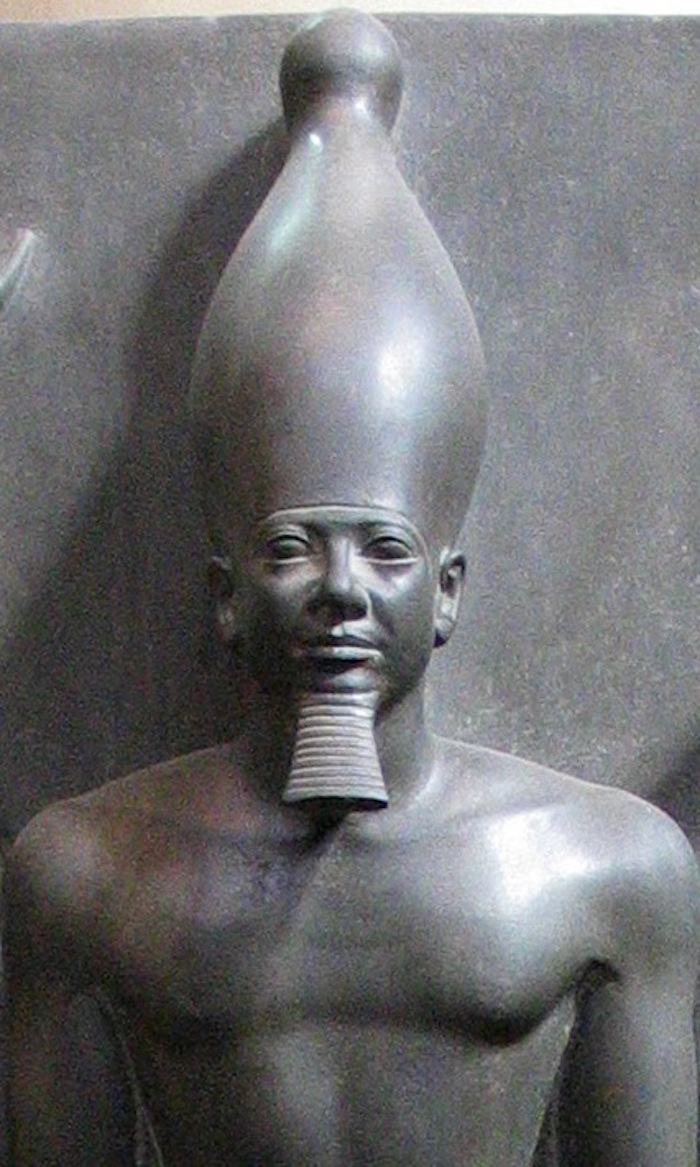
Closeup of Menkaure's graywacke statue, Egyptian Museum, Cairo. (Photo taken by Iry-Hor on 28 December 2008)
Locations
People
Groups
Topics
- Subboreal Period
- Portraits, Ancient Egyptian
- Early Bronze Age III (Near and Middle East)
- Abrolhos Transgression
Subjects
Regions

Subregions

Related Events
Showing 1 events out of 1 total
Years: 2505BCE - 2494BCE
Closeup of Menkaure's graywacke statue, Egyptian Museum, Cairo. (Photo taken by Iry-Hor on 28 December 2008)
Locations
People
Groups
Topics
- Subboreal Period
- Portraits, Ancient Egyptian
- Early Bronze Age III (Near and Middle East)
- Abrolhos Transgression
Subjects
Regions
Subregions