
The Tanguts’ founding father, Li Deming, had …
Years: 1043 - 1043
The Tanguts’ founding father, Li Deming, had not been a very conservative ruler, and thus the Tangut people have begun to absorb more and more of the Chinese culture that surrounds them, but will never lose their actual identity, as is proven by the vast amount of literature that will survive the Tangut state itself.
Li Deming's more conservative son, Li Yuanhao, seeks to restore and strengthen the Tangut people's identity by ordering the creation of an official Tangut script and by instituting laws that reinforce traditional cultural customs.
One of the laws he mandates calls for citizens to wear traditional ethnic apparel, and another requires wearing hair short or shaving the head, as opposed to the Chinese custom at the time of wearing hair long and knotted.
Rejecting the common Chinese surname of "Li" (given to the Xia-xia by the Tang) and "Zhao" (give to the Xia-xia by the Sung) he adopts the Tangut surname "Weiming".
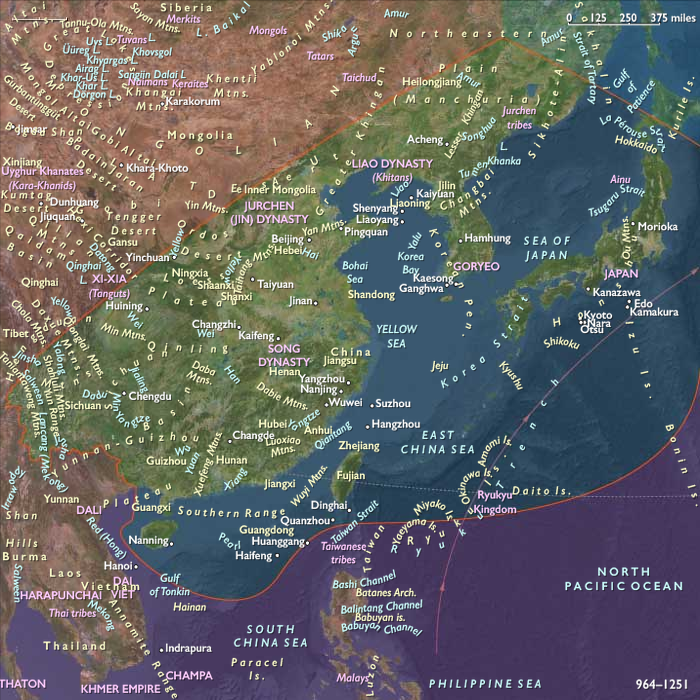
He makes "Xingqing" (present day Yinchuan) his capital city.
At times, the Tangut kingdom operates in the shadow of the Chinese to the East.
Several times, the Chinese are able to mobilize Tibetan tribes against the Tangut state.
However, it is not until 1038 that Li Yuanhao had named himself emperor of Da Xia, and demanded of the Sung emperor recognition as an equal.
The Song court accepts the recognition of Li Yuanhao as 'governor', but not 'emperor', a title considered exclusive to the Sung emperor.
After intense diplomatic contacts, in 1043 the Tangut state accepts the recognition of the Sung emperor in exchange for annual tribute, which implies tacit recognition on the part of the Sung of the military power of the Tangut.
Li nevertheless claims the title of emperor for himself, taking the reign name Jingzong.
Locations
Groups
- Chinese (Han) people
- Tanguts
- Chinese Empire, Pei (Northern) Song Dynasty
- Western Xia, or Tangut Kingdom
Topics
Commodoties
Subjects
Regions

Subregions
Related Events
Showing 10 events out of 27 total
Years: 1043 - 1043
Locations
Groups
- Chinese (Han) people
- Tanguts
- Chinese Empire, Pei (Northern) Song Dynasty
- Western Xia, or Tangut Kingdom
Topics
Commodoties
Subjects
Regions
Subregions