
The troubadours Bernart de Ventadorn, Guiraut de …
Years: 1195 - 1195
The troubadours Bernart de Ventadorn, Guiraut de Bornelh, and Folquet de Marseille, who flourish at the end of the twelfth century, represent the pinnacle of troubadour skill.
Bernart has gained renown for his texts dealing with unrequited love.
Bernart is known for being able to portray his woman as a divine agent in one moment and then in a sudden twist, portraying her as Eve, the cause of man's initial sin.
Bernart is unique among secular composers of the twelfth century in the amount of music which has survived: of his forty-five poems, eighteen have music intact, an unusual circumstance for a troubador composer (music of the trouvères has a higher survival rate, usually attributed to them surviving the Albigensian Crusade, which will scatter the troubadours and destroy many sources).
His work probably dates between 1147 and 1180.
Bernart is often credited with being the most important influence on the development of the trouvère tradition in northern France, since he was well known there, his melodies were widely circulated, and the early composers of trouvère music seem to have imitated him.
Bernart's influence also extended to Latin literature.
Guiraut is credited with the formalization, if not the invention, of the "light" style, or trobar leu.
About ninety of his poems and four of his melodies survive.
One of his best pieces is a planh (lament) on the death of Raimbaut of Orange.
In a tenso with king Alfonso II of Aragon, Giraut contributes to the poetical debate as to whether a lady is dishonored by taking a lover who is richer than herself.
Folquet had begun composing songs in the 1170s and was known to Raymond Geoffrey II of Marseille, Richard Coeur de Lion, Raymond V of Toulouse, Raimond-Roger of Foix, Alfonso II of Aragon and William VIII of Montpellier.
He is known primarily for his love songs, which will be lauded by Dante; there are 14 surviving cansos, one tenson, one lament, one invective, three crusading songs and possibly one religious song (although its authorship is disputed).
Folquet's life and career abruptly changes around 1195 when he experiences a profound religious conversion and decides to renounce his former life.
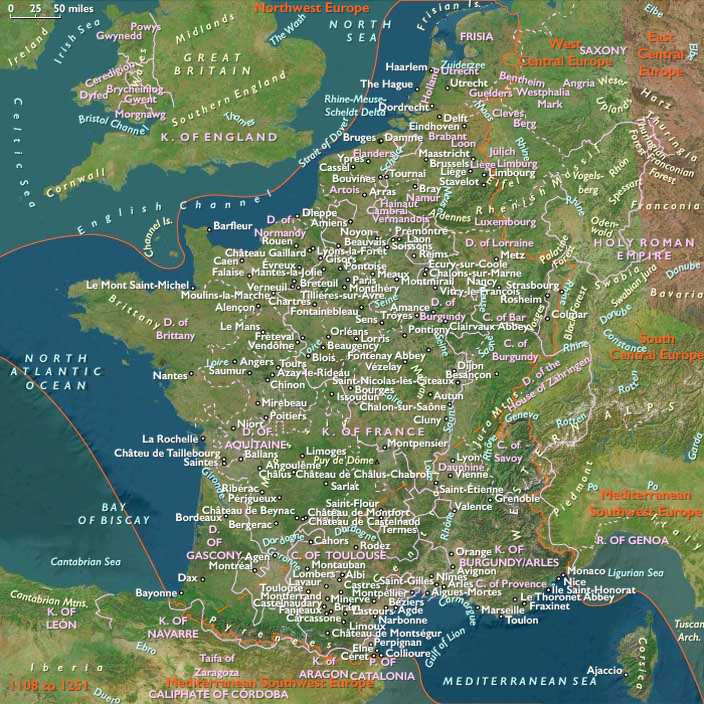
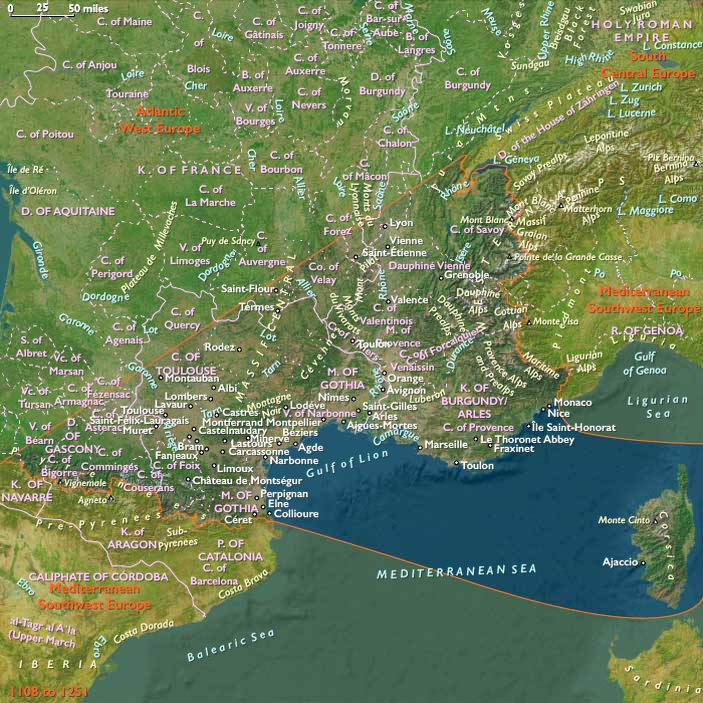
He joins the strict Cistercian Order, entering the monastery of Thoronet (Var, France), and appears to have placed his wife and two sons in monastic institutions as well.
He soon rises in prominence and is elected abbot of Thoronet, which allows him to help found the sister house of Géménos to house women, quite possibly including his wife.
Locations
People
Groups
Topics
Subjects
Regions
Subregions
Years: 1195 - 1195
Locations
People
Groups
Topics
Subjects
Regions
Subregions