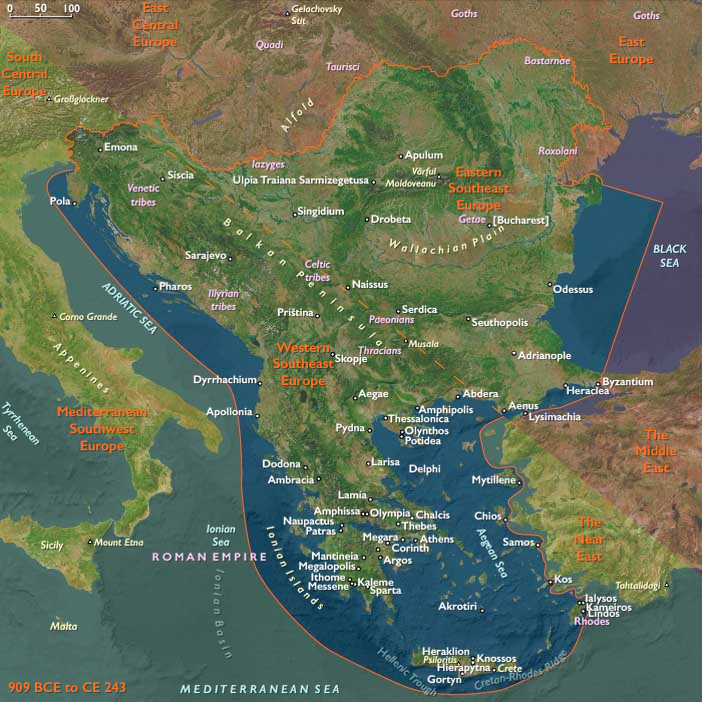
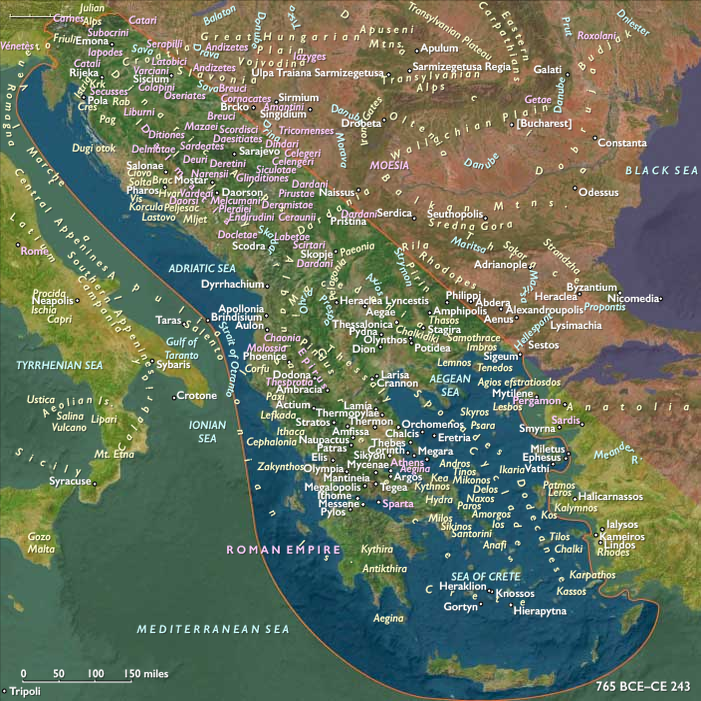
…to Athens, where Paul preaches to the …
Years: 49 - 49
…to Athens, where Paul preaches to the Jews and God-fearing Greeks in the synagogue and to the Greek intellectuals in the Areopagus.
Locations
People
Groups
- Jews
- Greeks, Hellenistic
- Greece, Roman
- Roman Empire (Rome): Julio-Claudian dynasty
- Christians, Jewish
- Christians, Early
Topics
Commodoties
Subjects
Regions
Subregions
Related Events
Filter results
Showing 10 events out of 61765 total
Paul had left for his second missionary journey from Jerusalem, in late Autumn 49, after the meeting of the Jerusalem council where the circumcision question had been debated.
On their trip around the Mediterranean sea, Paul and his companion Barnabas stop in Antioch where they have a sharp argument about taking John Mark with them on their trips.
The book of Acts says that John Mark had left them in a previous trip and gone home.
Unable to resolve the dispute, Paul and Barnabas decide to separate; Barnabas takes John Mark with him, while Silas joins Paul.
Paul and Silas initially visit Tarsus (Paul's birthplace), Derbe and …
…Lystra, where they meet Timothy, a well-regarded young member of the Christian church here, born of a pagan father and a Jewish mother; he becomes an assistant and disciple of Paul in his missionary activities (his name appears with Paul's in the greetings of seven of the Pauline epistles).
The movement continues to grow, adding believers, and strengthening their faith daily.
[Acts 16:5]
Jesus’ brother James has become a leader in the Jerusalem church, according to Paul’s Epistle to the Galilieans and the Acts of the Apostles; tradition describes him as Jerusalem's first bishop).
As a minister to the Jews, James opposes the imposition of Jewish law on gentile converts, but encourages Jews to observe it.
The Epistle of James (traditionally ascribed to James, which would date the letter between 45 and 50, but some scholars claim that it comes much later from the hand of another and date the letter from late first century to early second century), exhorts Christians to be patient and obedient.
More sermon than letter, the Epistle of James employs fifty-four imperatives in one hundred and eight verses to call its readers to responsible living that fits with what they profess. (Roman Catholic tradition identifies James with Saint James the Lesser, the Apostle James, who (according to Mark) is the son of Alphaeus and disciple of Jesus.
His mother, Mary, was one of the women at the crucifixion and at the tomb (according to Matthew, Mark, and the Acts of the Apostles).
Peter (according to Acts) is also a leader in the Jerusalem church and engages in missionary activity in Samaria, Galilee, Lydda, Sharon, and Joppa.
He favors admission of Gentiles into the church but occupies a middle position between James, who wishes to keep Christianity very Jewish in practice, and Paul, who wants to minimize requirements for Gentile converts.
According to the New Testament (Acts 15-58;2-35), a conference of the Christian Apostles convenes in Jerusalem in about CE 49 or 50, occasioned by the insistence of certain Judaic Christians from Jerusalem that Gentile Christians from Antioch in Syria obey the Mosaic custom of circumcision.
A delegation led by the apostle Paul and his companion Barnabas, is appointed to confer with the elders of the church in Jerusalem, led by the apostle Peter and James, “the Lord's brother”.
The Jerusalem faction emphasizes continuity between ancient Judaism and its law and the community that has gathered around Christ.
The Antioch faction stresses the mission of Christians to the entire inhabited world, with its preponderance of Gentiles, and defends the right of Gentile Christians to be free from the Jewish law, particularly from circumcision.
Paul's group apparently prevails, with Paul emerging as a leading champion of Gentile Christianity, denying the need for Christians to observe the Levitical ceremonial regulations of the Jews, except for the provisions of the so-called apostolic decree “abstention from what has been sacrificed to idols and from blood and from what is strangled and from unchastity”.
The Judaic Christians acknowledge the success of Paul's missionary activities, but the militant Judaizers, those who believe in the necessity of circumcision, continue to oppose him.

Paul and Silas, completing their missionary activity in Anatolia, travel to Philippi, in Greece, where certain men are not happy about the liberation of their soothsaying servant girl, who had been possessed with a spirit of divination.
They turn the city against the missionaries, who are put in jail.
After a miraculous earthquake, the gates of the prison fall apart.
Paul and Silas are able to escape but remain; this event leads to the conversion of the jailer.
They resume their travels, …
…going first to Berea, then …
Seneca has spent his exile in philosophical and natural study (a life counseled by Roman Stoic thought) and written the Consolations, fulfilling a request for the text made by his sons for the sake of posterity.
During his several years of exile in Corsica, Seneca has written twelve works entitled Moral Essays and 124 so-called Moral Letters, as well as a work on natural phenomena and several tragedies.
Seneca’s letters, which contain some of his finest discussions of Stoic problems, aim to educate their recipients in Stoicism.
Regarding Stoicism as a practical doctrine, he subordinates logic and physics to ethics, maintaining that "the true philosopher is the teacher of humanity."
Urging people to become indifferent to the transient goods of the world, valuing only the virtue within themselves, he maintains that to become truly virtuous, the wise person must learn to curb his emotions, which are, or involve, false judgments concerning the value of externals.
Exploring the nature and effects of the passions at length, he shows how they can be mastered, and lauds the blissful state of the person who cannot be swayed by fortune.
In addition to his essays, letters, and a work on natural phenomena, Seneca has penned several poetic tragedies such as Thyestes, whose bloody plots are based on Greek models.
His tragedies, although overburdened with rhetoric, feature striking declamatory passages and fascinating portraits of intense emotional states.
In the satirical Apocolocyntosis (or Pumpkinification), an expression of his bitter resentment of Claudius, Seneca mocks the deification of Claudius and makes fun of his physical defects.
In 49, Claudius' fourth wife, Agrippina the Younger, has Seneca recalled to Rome to tutor her 12-year-old son Nero.
Agrippina and Claudius are married on New Year’s Day, 49.
This marriage causes widespread disapproval.
This is a part of Agrippina’s scheming plan to make Lucius the new emperor.
Her marriage to Claudius is not based on love, but on power.
She quickly eliminates her rival Lollia Paulina.
In 49, shortly after marrying Claudius, Agrippina charges Paulina with black magic.
Paulina does not receive a hearing.
Her property is confiscated, she leaves Italy and on Agrippina's orders, she commits suicide.
Claudius accepts Agrippina’s inducements to adopt the twelve-year-old son Lucius, the product of her first marriage to Domitius Ahenobarbus; Nero, as he will become known, is older than Britannicus and a direct descendant of Augustus.
In the months leading up to her marriage to Claudius, Agrippina's maternal second cousin, the praetor Lucius Junius Silanus Torquatus, had been betrothed to Claudius’ daughter Claudia Octavia.
This betrothal had been broken off in 48 when Agrippina, scheming with the consul Lucius Vitellius the Elder, the father of the future Emperor Aulus Vitellius, had falsely accused Silanus of incest with his sister Junia Calvina.
Agrippina did this hoping to secure a marriage between Octavia and her son.
Consequently, Claudius had broken off the engagement and forced Silanus to resign from public office.
Silanus had committed suicide on the day that Agrippina married her uncle, and Calvina is exiled from Italy in early 49.
Calvina will be called back from exile after the death of Agrippina.
Towards the end of 54, Agrippina will order the murder of Silanus' eldest brother Marcus Junius Silanus Torquatus without Nero's knowledge, so that he would not seek revenge against her over his brother's death.
Ostorius initiates further Romanization during his command in the safer southern lands, founding Britain's first colony of military veterans at Camulodunum in 49 and …
…probably establishing a municipium at Verulamium (St. Albans).
His tactical skill rather than his political acumen is his strength, however.
He has received a difficult brief as the Claudian lowlands are economically unspectacular and Britain's mineral wealth lies in the barbarian lands instead.
Capture of these will have to wait until later years.
Years: 49 - 49
Locations
People
Groups
- Jews
- Greeks, Hellenistic
- Greece, Roman
- Roman Empire (Rome): Julio-Claudian dynasty
- Christians, Jewish
- Christians, Early