Thirty more men arrive in 1639 to …
Years: 1639 - 1639
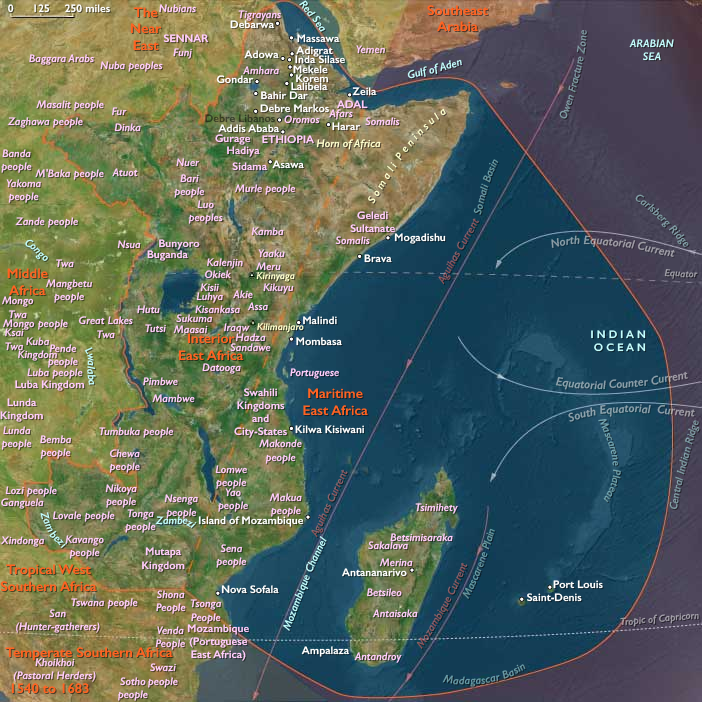
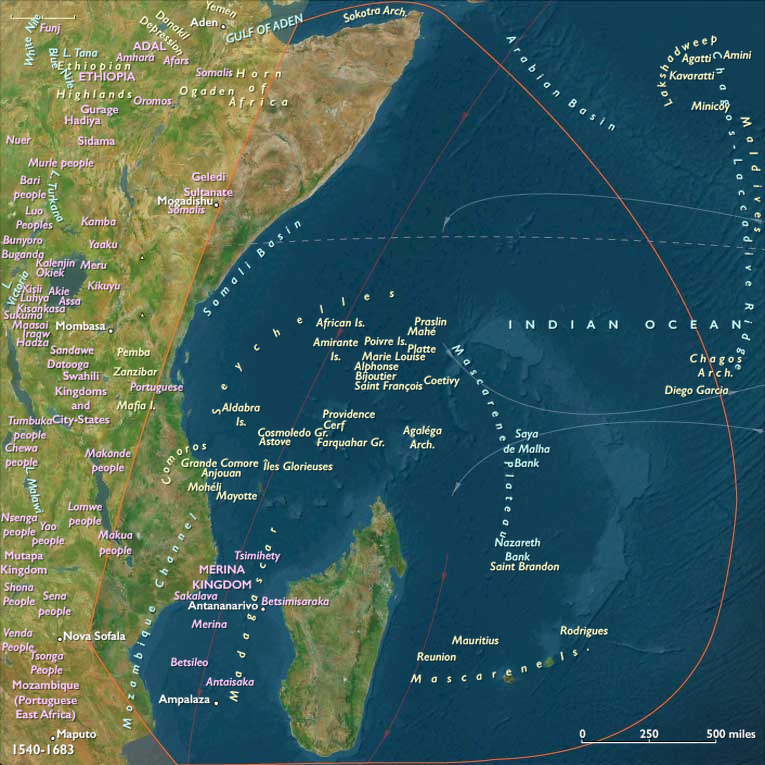
Thirty more men arrive in 1639 to reinforce the Dutch colony on Mauritius.
Locations
Groups
Topics
Subjects
Regions
Subregions
Related Events
Filter results
Showing 10 events out of 32235 total
The shogunate, in another part of its actions after the rebellion, had excused the clans that had aided its efforts militarily from the building contributions that it routinely requires from various domains.
Matsukura Katsuie commits suicide, and his domain is given to another lord, Kōriki Tadafusa.
The Terazawa clan survives, but will die out almost ten years later, due to Katataka's lack of a successor.
On the Shimabara peninsula, most towns experience a severe to total loss of population as a result of the rebellion.
In order to maintain the rice fields and other crops, immigrants are brought from other areas across Japan to resettle the land.
All inhabitants are registered with local temples, whose priests are required to vouch for their members' religious affiliation.
Following the rebellion, Buddhism is strongly promoted in the area.
Certain customs are introduced which remain unique to the area today.
Towns on the Shimabara peninsula also continue to have a varied mix of dialects due to the mass immigration from other parts of Japan.
With the exception of periodic, localized peasant uprisings, the Shimabara Rebellion, Catholicism's last gasp as an open religion, is to be the last large-scale armed clash in Japan until the Meiji Restoration.
Murad, a man of courage, determination, and violent temperament, does not follow closely the precepts of the Shari'ah (Islamic law): he is the first Ottoman sultan to execute a shaykh al-islam (the highest Muslim dignitary in the empire).
He is able to restore order, however, and to straighten out state finances.
Peace is concluded with Persia following the Ottoman capture of Baghdad by the Treaty of Kasrı Şirin in May 1639, which permanently restores Mesopotamia to the Ottomans, allowing the Turks to keep the city while ...
...the Persians retain Erivan.
The accord ends the war that had begun in 1623 and is the last conflict in almost one hundred and fifty years of intermittent wars between the two states over territorial disputes.
The border of Mesopotamia with Persia becomes the eastern boundary of the Ottoman Empire.
Nevertheless, border disputes between Persia and the Ottoman Empire do not end.
Between 1555 and 1918, Persia and the Ottomans will sign no less than eighteen treaties that readdress their disputed borders.
The exact demarcation according to this treaty will not begin until the nineteenth century, essentially laying out the rough outline for the frontier between modern day Iran and the states of Turkey and Iraq (the former Ottoman-Persian border until 1918, when the Ottoman Turks lost their territories in the Middle East following their defeat in the First World War.)
Most of the fresco cycles so numerous in early seventeenth century-Rome represent framed episodes imitating canvases such as found in the Sistine Chapel ceiling or in Carraccis' The Loves of the Gods in the Farnese gallery, completed in 1601.
Pope Urban VIII (Maffeo Barberini) had in 1633 commissioned Pietro da Cortona to paint a fresco cycle for the ceiling of their family palace.
The huge Allegory of Divine Providence and Barberini Power, completed six years later, marks a watershed in Baroque painting.
Containing endless number of heraldic symbols and subthemes, the fresco is an illusion with the central field apparently open to the sky and scores of figures seen 'al di sotto in su' apparently coming into the room itself or floating above it.
By this time recognized among the top artists of his generation, Cortona had been elected during 1634-38 as director of Rome's Academy of St. Luke.A Puritan minister named John Davenport had led his flock from exile in the Netherlands back to England and finally to America in the spring of 1637.
The group had arrived in Boston on the ship Hector on June 26, but decided to strike out on their own, based on their impression that the Massachusetts Bay Colony is lax in its religious observances.
That fall, London merchant Theophilus Eaton had led an exploration party south to the north shore of Long Island Sound in search of a suitable site.
He had purchased land from the natives at the mouth of the Quinnipiac River.
The group of five hundred colonists had set out in the spring of 1638, and on April 14 they had arrived at their 'New Haven' on the Connecticut shore.
The site seemed ideal for trade with a good port between Boston and New Amsterdam and access to the furs of the Connecticut River valley.
However, while the colony success as a settlement and religious experiment, its future as a trade center is some years away.
The colonists adopt a set of Fundamental Articles for self-government in 1639, partly as a result of a similar action in the river towns.
A governing council of seven is established, with Eaton as chief magistrate and Cunningham as pastor.
The articles require that "...the word of God shall be the only rule..." and this is maintained even over English common law tradition.
Since the Bible contains no reference to trial by jury, they have eliminated it and the council sits in judgment.
Only members of their church congregation are eligible to vote.
The colony's success soon attracts other believers, as well as those who are not Puritans.

King Charles, who had married France’s Henrietta Maria, agrees to return Acadia and New France to the control of his wife’s compatriots.
The colony of Maryland, which King Charles I had granted to the Catholic Lord Baltimore in 1632, joins the Virginia colony on Chesapeake Bay.
Many of Baltimore’s co-religionists emigrate there to escape persecution, as was his hidden intention.
The French seize the islet of Tortuga off the northwest coast of Hispaniola in 1639.
The shogunate suspects that Western Catholics had been involved in spreading the rebellion and Portuguese traders are driven out of the country.
While there is no evidence that Europeans had directly incited the rebellion, Shimabara Domain had been a Christian han for several decades, and the rebels had adopted many Portuguese motifs and Christian icons.
Consequently, in Tokugawa society the word "Shimabara" solidifies the connection between Christianity and disloyalty, constantly used again and again in Tokugawa propaganda.
The policy of national seclusion is by 1639 made more strict .
An already existing ban on the Christian religion is now enforced stringently, and Christianity in Japan survives only by going underground.
Iemitsu officially closes off Japan from the rest of the world, limiting trade to the Dutch and English merchants ensconced on ...