
Three Muslim kingdoms—Ahmednagar (Nizamshahi), Bijapur (Adilshahi) and …
Years: 1660 - 1660
January
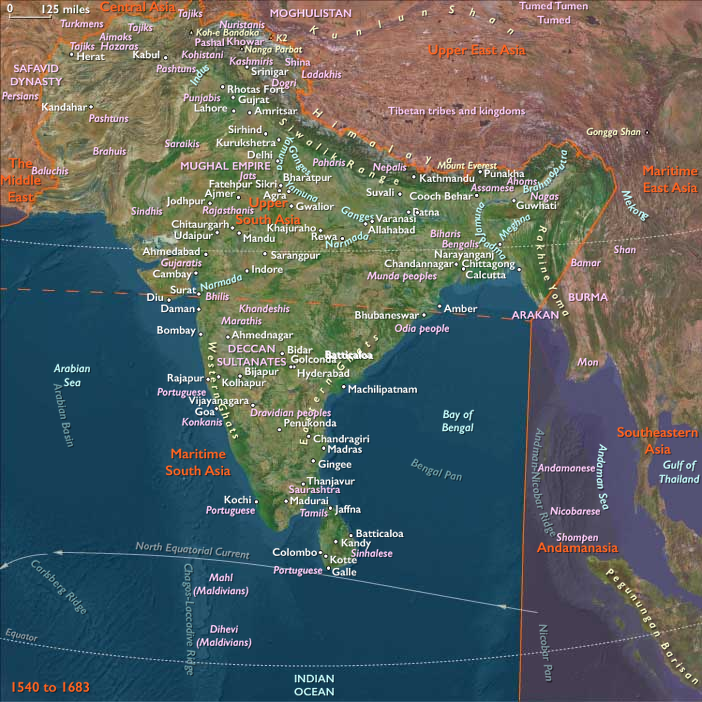
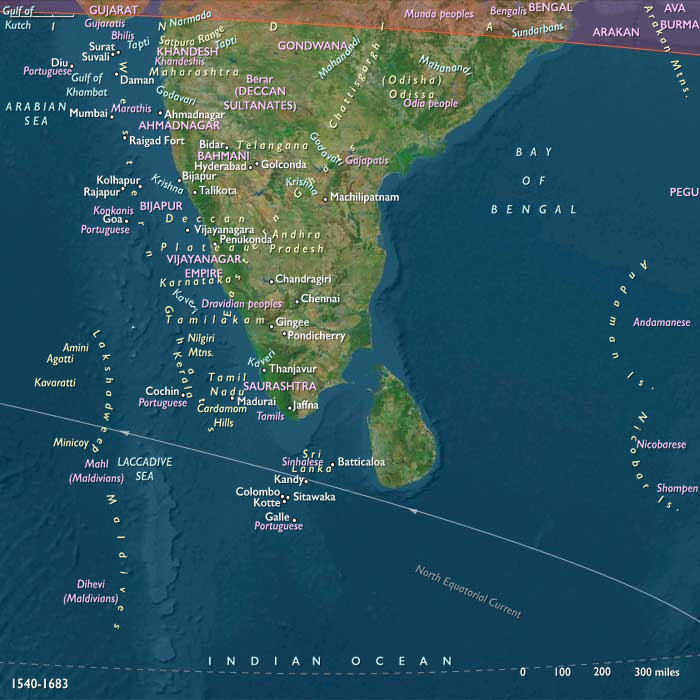
Three Muslim kingdoms—Ahmednagar (Nizamshahi), Bijapur (Adilshahi) and Golconda (Qtubshahi)—had controlled the Deccan in the time of Shah Jahan, the fifth Moghul emperor, who had from 1628 to 1658 ruled North India.
Ahmendnagar, following a series of battles, had been effectively divided in 1636, with large portions of the kingdom ceded to the Mughals and the balance to Bijapur.
One of Ahmednagar's generals, a Hindu Maratha named Shahaji Bhosle, had joined the Bijapur court.
Shahaji had sent his wife Jijabai and young son Shivaji in Pune to look after his Jagir.
While Shah Jahan’s son Aurangzeb attacked Golconda and Bijapur in 1657, Shivaji, using guerrilla tactics, took control of three Adilshahi forts formerly controlled by his father.
With these victories, Shivaji had assumed de facto leadership of many independent Maratha clans.
The Marathas have harried the flanks of the warring Adilshahi and Mughals, gaining weapons, forts, and territories.
Shivaji's small and ill-equipped army had survived an all-out Adilshahi attack, and Shivaji personally killed the Adilshahi general, Afzal Khan.
This event had transformed the Marathas into a powerful military force, which captured more and more Adilshahi and Mughal territories.
Shivaji Raje Bhosle, popularly known as Chatrapati Shivaji Maharaj, espouses the ideology of Hindavi Swarajya (native autonomy).
He had taken a solemn oath in a Shiva temple with his friends and soldiers to directly challenge the Muslim rule of the Bijapur Sultanate.
His impressive victories over Bijapur in 1659 have alarmed the mighty Mughal empire, whose officials now derisively refer to Shivaji as the "Mountain Rat".
Aurangzeb, having recently acceded to the Mughal throne, actively prepares to bring the full might and resources of the Mughal Empire to bear down on the potential Maratha threat.
Responding in January 1660 to the request of Badi Begum of Bijapur, Aurangzeb dispatches an army numbering over one hundred thousand along with a powerful artillery division, commanded by his maternal uncle (brother to the late Queen Mumtaz Mahal) Shaista Khan, governor of Bengal, accompanied by eminent commanders and notable Rajputs.
Shaista Khan, an experienced commander who had defeated Shahaji in the same region in 1636, is ordered to attack the Maratha kingdom in conjunction with Bijapur's army led by Siddi Jauhar.
Aurangzeb intends to deceive the Adilshah, having ordered Khan to capture the Maratha kingdom to add to the empire after Shivaji's expected defeat by Jauhar.
Shivaji now prepares to face a dual attack of Mughals and Adilshahi forces.
Shaista Khan, arriving at Aurangabad, quickly advances to seize Pune, making Shivaji's childhood residence Lal Mahal his own.
He also captures the forts of Chakan, Kalyan and north Konkan.
Locations
People
Groups
Topics
Commodoties
Subjects
Regions
Subregions
Years: 1660 - 1660
January
Locations
People
Groups
Topics
Commodoties
Subjects
Regions
Subregions