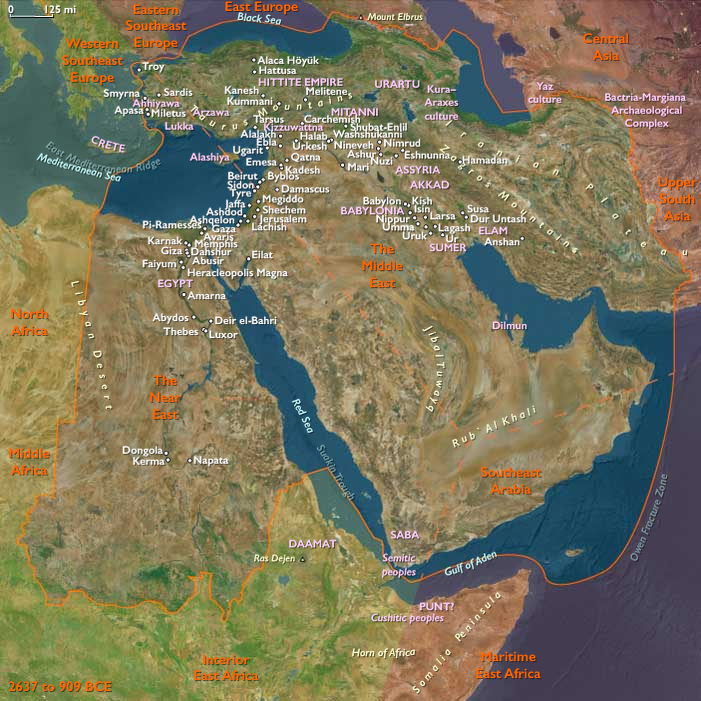
Tiglath-Pileser overruns Kummukh (Commagene) and eastern Cappadocia …
Years: 1113BCE - 1102BCE
Tiglath-Pileser overruns Kummukh (Commagene) and eastern Cappadocia in the fifth year of his reign, attacking Comana in Cappadocia and …
Locations
People
Groups
Topics
Commodoties
Subjects
Regions
Subregions
Related Events
Filter results
Showing 9 events out of 9 total
Visconti manages to be reconciled with Amadeus by ceding him Vercelli and marrying his daughter, Marie of Savoy.
However, as Sforza is defeated by some Genoese and exiled and Sigismund's help is wanting, Visconti sues for a treaty.
Duke Amadeus VIII of Savoy retires after forty-two years on the throne to a monastery at Ripaille, near Geneva, in 1434.
His retirement is only partial, however, and he continues to exercise power, with his son Louis (Ludovico) acting as his lieutenant.
During this period Amadeus' daughter Margherita is betrothed to Louis III of Anjou, pretender to the throne of Naples.
When Louis dies suddenly in 1434, Amadeus briefly claims Naples for Margherita but in the end abandons the kingdom to Alfonso V of Aragon.
Louis' forces have gained most of the kingdom, however, and are about to drive out Alfonso when Louis dies suddenly on November 15, 1434, leaving his brother René of Anjou as his successor.
The successors of Count Humbert the Whitehanded, the eleventh-century founder of the house of Savoy, have expanded their territories to include parts present of France, Italy, and Switzerland.
Amadeus VIII, the thirty-three-year-old count of Savoy, is granted ducal status in 1416.
Plague forces the council at Ferrara to move to Florence on January 10, 1439, and is thus known as the Council of Ferrara-Florence.
Here, the Council affirms the so-called Peterine theory, according to which Jesus Christ conferred the position of primacy in the church upon Peter alone, thus grounding his successors' claim to jurisdictional primacy in the church.
After protracted and difficult discussion of their theological differences, the Greeks agree to accept the Filioque and also the Latin statements on purgatory, the Eucharist, and papal primacy.
Isidore of Kiev has attended the council, first in Ferrara, then in Florence, at which he is one of six Greek spokesmen.
Together with the Greek cardinal John Bessarion, he draws up the document of unification, Laetentur Caeli, under which the two churches are formally reunited on July 6, 1439, Constantinople agreeing to submit to the authority of Rome.
The Orthodox leaders will have trouble, however, winning approval from the clergy at home.
The council also negotiates reunion with several smaller eastern churches, such as the Armenian church, Nestorian church, Jacobite church, and Eastern Rite churches, and challenges the conciliar theory enunciated at the councils of Constance and Basel.
Cosimo de' Medici and Pope Eugene IV had requisitioned the decaying convent of San Marco in 1436 and invited the Dominicans to build and decorate a new monastery.
In collaboration with the architect Michelozzo, Fra Angelico and his assistants have frescoed numerous scenes from the life of Christ in the forty-four monks' dormitory cells and connecting corridors.
Angelico has designed each of these clearly drawn frescoes, such as the San Marco “Annunciation,” to enhance the contemplative, religious setting.
In the (now overcleaned) altarpiece for San Marco, painted by Angelico in 1438-39 and entitled “Madonna and Saints in a Sacred Conversation” (he has created the form called “Sacra Conversazione”), the artist employs natural light and Alberti's systematic perspective to produce a remarkable rendering of the human figure.
The versatile Alberti, better known as an architect, publishes a lengthy treatise, “On the Family,” written from 1433 to 1439; its wisdom and rationality mirror the abiding concern of Italian letters with social and ethical topics.
Franco-Flemish composer Guillaume Dufay, highly respected not only for his music but also for his learning, has attained influential appointments in the church, taking part in the Council of Basel as a delegate from Cambrai.
He had remained a member of the papal choir in Rome until 1434 when, because of a crisis in the finances of the papal choir, and to escape the turbulence and uncertainty during the struggle between the papacy and the Council of Basel, he had entered the service of Duke Amadeus VIII of Savoy for a year.
In 1435 he was again in the service of the papal chapel, but this time it was in Florence.
In 1436, Dufay had composed the festive motet Nuper rosarum flores, one of his most famous compositions, which is sung at the dedication of Brunelleschi's dome of the cathedral in Florence, where Eugenius lives in exile.
During this period Dufay also begins his long association with the d'Este family in Ferrara, some of the most important musical patrons of the Renaissance, and with which he probably had become acquainted during the days of his association with the Malatesta family; Rimini and Ferrara are not only geographically close, but the two families are related by marriage, and Dufay composes at least one ballade for Niccolò III, Marquis of Ferrara.
In 1437, Dufay had visited the town.
The struggle between the papacy and the rump Council of Basel has continued: when the rump council had suspended Eugenius, he had excommunicated its members.
The council, with only seven bishops present, had declared Eugenius deposed and in 1439 elects as his successor a layman, Duke Amadeus himself, who takes the name Pope Felix V.

Guillaume Dufay Returns to Cambrai (1439)
By late 1439, the renowned Franco-Flemish composer Guillaume Dufay, sensing the instability posed by the intensifying papal conflicts in Italy, decided to leave his prestigious position at the Council of Florence and return to his homeland. He arrived back in Cambrai by December of that year, where he sought to consolidate his position as a canon—an ecclesiastical appointment requiring formal academic credentials.
Anticipating this requirement, Dufay had obtained a law degree in 1437, potentially studying at the University of Turin around 1436. His careful preparation for ecclesiastical office underscores both his political acumen and his adaptability amid the shifting religious and political circumstances of mid-15th-century Europe.
Dufay’s return to Cambrai, strategically timed, allowed him to secure a stable and influential position within the church hierarchy, ensuring continued patronage and protection at a time when Italian conflicts threatened the security of artists and intellectuals associated with the papacy. This move not only safeguarded Dufay’s career but also positioned him to exert substantial influence on the musical culture of Atlantic West Europe, further enhancing Cambrai's reputation as an important center for ecclesiastical music and liturgical innovation.
Enea Silvio de'Piccolomini, after studying at the universities of Siena and Florence, had settled in the former city as a teacher, but in 1431 had accepted the post of secretary to Domenico Capranica, bishop of Fermo, then on his way to the Council of Basel (1431–39).
Capranica had been protesting against the new Pope Eugene IV's refusal of a cardinalate for him, which had been designated by Pope Martin V. Arriving at Basel after enduring a stormy voyage to Genoa and then a trip across the Alps, Enea had successively served Capranica, who ran short of money, and then other masters.
He had been sent by Cardinal Albergati, Eugenius IV's legate at the council, on a secret mission to Scotland in 1435, the object of which is variously related, even by himself.
He had visited England as well as Scotland, had undergone many perils and vicissitudes in both countries, and has left a valuable account of each.
The journey to Scotland had proved so tempestuous that Piccolomini swore that he would walk barefoot to the nearest shrine of Our Lady from their landing port.
This proved to be Dunbar; the nearest shrine was ten miles distant at Whitekirk.
The journey through the ice and snow had left Aeneas afflicted with pain in his legs for the rest of his life.
It is only once he arrived in Newcastle that he had felt he had returned to a civilized part of the world and the inhabitable face of the Earth, Scotland and the far north of England being "wild, bare and never visited by the sun in winter".
In Scotland, he had fathered his second natural child, the other one having been born in Strasbourg.
Upon his return to Basel, Enea had sided actively with the council in its conflict with the Pope, and, although still a layman, had eventually obtained a share in the direction of its affairs.
He had supported the creation of the Antipope Felix V (Amadeus, Duke of Savoy) and had participated in his coronation.
Enea then withdrew to the court of Holy Roman Emperor Emperor Frederick III court in Vienna.
Crowned imperial poet laureate in 1442, he has obtained the patronage of the emperor's chancellor, Kaspar Schlick.
Some identify the love adventure at Siena that Enea related in his romance The Tale of the Two Lovers with an escapade of the chancellor.
Enea’s character had hitherto been that of an easy and democratic-minded man of the world with no pretense to strictness in morals or consistency in politics.
He now begins to be more regular in the former respect, and in the latter had adopted a decided line by making his peace between the Empire and Rome.
Being sent on a mission to Rome in 1445, with the ostensible object of inducing Pope Eugene to convoke a new council, he had been absolved from ecclesiastical censures and returned to Germany under an engagement to assist the Pope.
This he did most effectually by the diplomatic dexterity with which he had smoothed away differences between the papal court of Rome and the German imperial electors.
He plays a leading role in concluding a compromise in 1447 by which the dying Pope Eugene accepts the reconciliation tendered by the German princes.
As a result, the council and the antipope are left without support.
He had already taken orders, and one of the first acts of Pope Eugene's successor, Pope Nicholas V (1447–1455), is to make him Bishop of Trieste.
Basel has eight thousand residents in the mid-fifteenth century.
The rump Council of Basel, in accepting Pope Nicholas V’s 1448 Concordat of Vienna, expires ingloriously in 1449.
The abdication of the antipope Felix V ends the schism within the Roman Catholic church.
The pontificate of Nicholas V is important in the political, scientific, and literary history of the world.
Politically, he had on February 17, 1448, concluded the Concordat of Vienna, or Aschaffenburg, with the German King, Frederick III, by which the decrees of the Council of Basel against papal annates and reservations were abrogated so far as Germany was concerned.
In the following year, he had secured a still greater tactical triumph with the resignation of the Antipope Felix V on April 7 and his own recognition by the rump of the Council of Basel that assembled at Lausanne.
Nicholas V holds a Jubilee at Rome in 1450, and the offerings of the numerous pilgrims who throng to Rome give him the means of furthering the cause of culture in Italy, which he has so much at heart.