
Tomislav, the local ruler (zupan) …
Years: 924 - 924
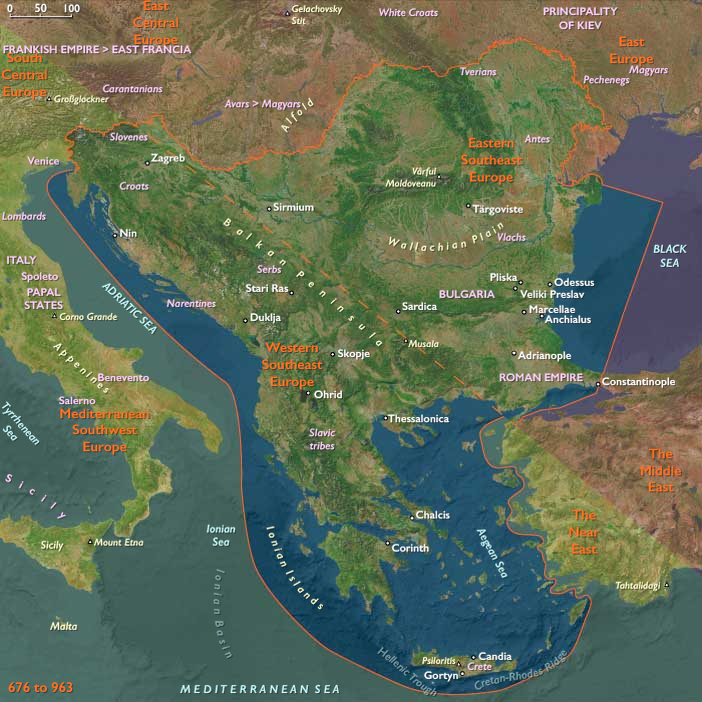
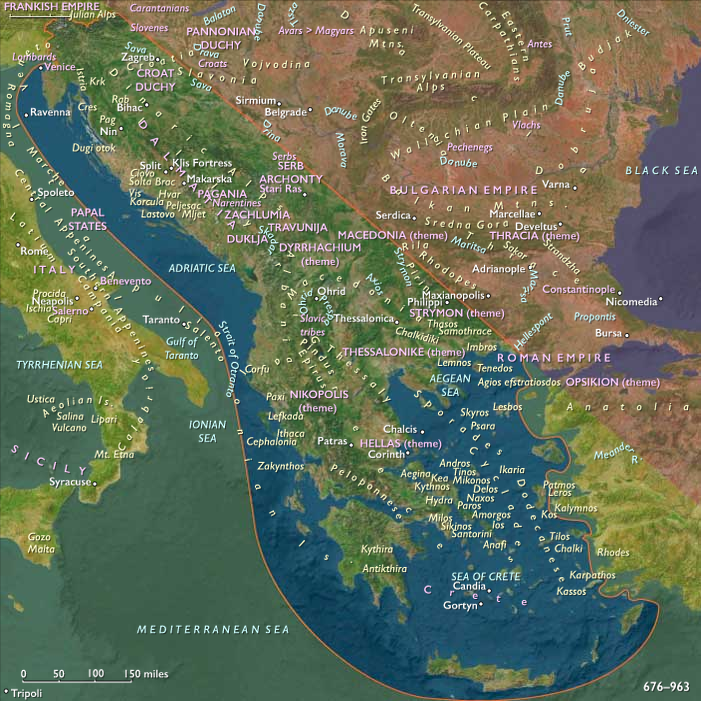
Tomislav, the local ruler (zupan) of Nin, unites the Croat tribes of Dalmatia and Pannonia to form a kingdom in 924.
Locations
People
Groups
- Christianity, Chalcedonian
- Papal States (Republic of St. Peter)
- Croats (South Slavs)
- Croatia, Kingdom of
Subjects
Regions
Subregions
Related Events
Filter results
Showing 10 events out of 53258 total
Gao Jichang, also known as Gao Jixing, had been appointed the regional military governor of Jiangling in 907 by the Later Liang Dynasty, which had taken over northern China in the wake of the Tang Dynasty.
He declares the foundation of the Kingdom of Jingnan (or Nanping) in 924 after the Later Liang Dynasty falls to the Later Tang Dynasty.
Li Maozhen, the sole ruler of the state of Qi, submits in 924 to the Later Tang Dynasty.
After Li Maozhen’s death in this year, his son Li Congyan will continue to govern Fengxiang until 926, when he is removed by the Later Tang's Emperor Zhuangzong, although he will serve two later stints as governor of Fengxiang.
Simeon arrives at Constantinople in the summer of 924 and demands to see the patriarch and the emperor.
He converses with Romanos on the Golden Horn on September 9, 924 and arranges a truce, according to which Constantinople will pay Bulgaria an annual tax, but will be ceded back some cities on the Black Sea coast.
During the interview of the two monarchs, two eagles are said to have met in the skies above and then to have parted, one of them flying over Constantinople and the other heading to Thrace, as a sign of the irreconcilability of the two rulers.
In his description of this meeting, Theophanes Continuatus mentions that "the two emperors... conversed", which may indicate renewed Constantinople’s recognition of Simeon's imperial claims.
Zaharije, who has been persuaded by Constantinople to revolt against Simeon, is supported by many Bulgarians exhausted from Simeon's endless campaigns against the Empire.
The Bulgarian emperor sends a punitive force under Sigrica and Marmais, but they are routed and the two commanders beheaded, which forces Simeon to conclude an armistice with Constantinople in order to concentrate on the suppression of the uprising.
Simeon sends an army led by Časlav Klonimirović in 924 to depose Zaharije.
He is successful, as Zaharije flees to Croatia.
The Serbian zhupans are then summoned to recognize Caslav as the new Prince.
When they come, however, they are all imprisoned and taken to Bulgaria, as is Časlav.
Much of Serbia is ravaged, and many people flee to Croatia, Bulgaria and Constantinople.
Simeon makes Serbia into a Bulgarian province, so that Bulgaria now borders Croatia and Zahumlje.
He then resolves to attack Croatia, because it is an ally of the Empire and had sheltered the Serbian prince.
Yusuf had been released in 922 and the caliph had invested him with the governorship of Azerbaijan and the provinces that he had conquered from the Samanids.
Returning to Azerbaijan, he found that Subuk had died.
In 924, he conquers Rey from its governor, who had rebelled against the Samanids.
After Yusuf leaves the area and occupies Hamadan, the people of Rey expel his officials.
In 925, the Sajid will briefly return to Ray.
Yusuf has received information that Armenian ruler Ashot II had retired on the island of Sevan, and ends a chief, Nusir, to capture him.
Nusir marches to Dvin, and takes several captives.
Nusir is succeeded by Beshir, who sends one thousand of his men to attack the island and capture the king.
Beshir is met by George the Marzbedunian, who, with his small army, attacks and kills many of the invaders, causing the rest to flee.
Beshir gathers reinforcements and goes after George, but fails to capture him.
He then approaches Lake Sevan, where Ashot has prepared ten boats, placing skilled archers in the bows.
Beshir's army ultimately flees in defeat.
Damian of Tarsus, one of the main leaders of naval raids against the Empire, dies in 924 while leading an attack against the imperial fortress of Strobilos in the Cibyrrhaeot Theme.
His death, along with the probable death of Leo of Tripoli the year before, bring to an end the era of Muslim naval supremacy and of constant raids against the Empire’s coasts.
Williiam II of Aquitaine makes war on the Burgundians and Normans, who have refused to accept Rudolph as king of France.
His support of the king, however, is insincere.
He will later revolt and Rudolph will lead an army into Aquitaine until soon called back to defend the Rhine from the Magyars.
William dies soon after.
Berengar is murdered in 924, possibly at the instigation of Rudolph.
He leaves no sons, only a single surviving daughter (the aforementioned Bertha) and an anonymous epic poem, the Gesta Berengarii Imperatoris, about the many happenings of his troublesome reign.
Rudolph now rules Upper Burgundy and Italy together, residing alternately in both kingdoms.
Viking Raids in West Francia and Rudolph’s Ambush at Fauquembergues (924)
By 924, Viking raiders launch a fresh wave of attacks on West Francia, continuing their persistent threat to the weakened Frankish kingdom. Their incursions target key regions, forcing King Rudolph of West Francia to finally take action. However, his delayed response, lack of noble support, and personal injury in battle expose the fragility of his rule.
The Viking Raids of 924
-
Initial Raids on the Loire Valley
- The Vikings launch a new round of raids, advancing from their strongholds in the Loire Valley.
- Their movements threaten Hugh the Great, the powerful Duke of the Franks and brother of Queen Emma, but Rudolph does nothing to intervene.
-
The Viking Assault on Burgundy
- The Norsemen shift their attacks toward Burgundy, the domain of Rudolph’s own brother, but they are repulsed.
- Pushed back, the Vikings move north toward Melun, dangerously close to the royal demesne, forcing Rudolph to act.
Years: 924 - 924
Locations
People
Groups
- Christianity, Chalcedonian
- Papal States (Republic of St. Peter)
- Croats (South Slavs)
- Croatia, Kingdom of
