Voltaire, united with other thinkers of his …
Years: 1726 - 1726
Voltaire, united with other thinkers of his day—literary men and scientists—in the belief in the efficacy of reason, is a Philosophe, as the eighteenth century terms it.
In the salons, he professes an aggressive Deism, which scandalizes the devout.
He has become interested in England, the country that tolerates freedom of thought; he has visited the Tory leader Viscount Bolingbroke, exiled in France—a politician, an orator, and a philosopher whom Voltaire admires to the point of comparing him to Cicero.
On Bolingbroke's advice, he learns English in order to read the philosophical works of John Locke.
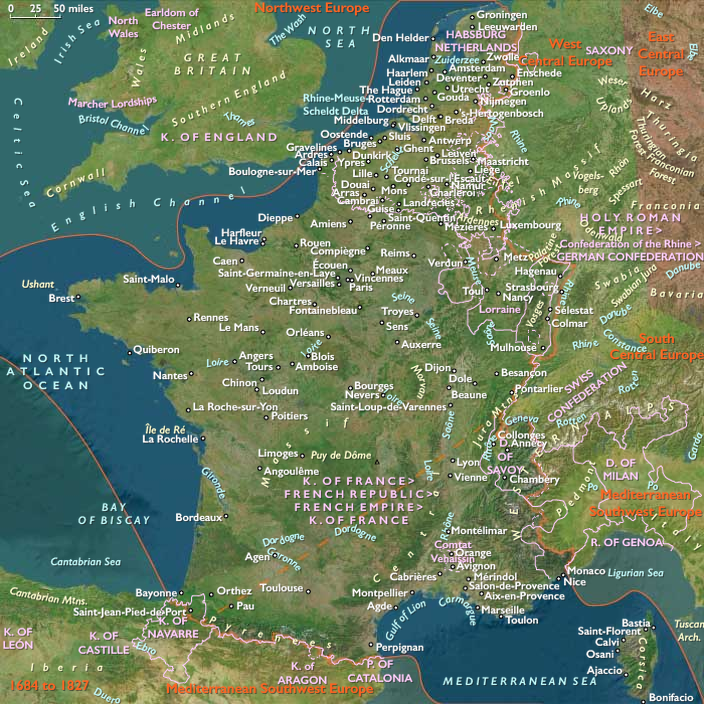
His intellectual development is furthered by an accident: as the result of a quarrel with a member of one of the leading French families, the Chevalier de Rohan, who had made fun of his adopted name, he is beaten up, taken to the Bastille, and then conducted to Calais on May 5, 1726, whence he sets out for London.
His destiny is now exile and opposition.
Locations
People
Groups
Topics
Subjects
Regions
Subregions
Related Events
Filter results
Showing 10 events out of 27781 total
Sultan Mahmud Shah II of Johor had died in 1699 without an heir, but the succession problem had been quickly solved when the viceroy, Bendahara Abdul Jalil, declared himself the new sultan, styling himself Sultan Abdul Jalil IV.
Many, however, feel that the declaration had been illegal.
Daing Parani, a leader of adventurers from the Celebes, has spearheaded the political penetration of the Malay Peninsula by the Buginese.
Apart from the Malays, another influential faction in Johor at this time is the Minangkabau.
Both the Bugis and the Minangkabau had realized that the death of Sultan Mahmud II had provided them with the chance to exert power in Johor.
The Minangkabau had introduced a Minangkabau prince, Raja Kecil from Siak, who claims he is the posthumous son of Sultan Mahmud II.
The prince had met with the Daing Parani and promised the Bugis wealth and political power if they helped the prince to win the throne.
However, Raja Kecil had broken his promise and installed himself as the new sultan of Johor (Sultan Abdul Jalil Rahmat Shah) without the knowledge of the Bugis.
Sultan Abdul Jalil IV had fled to Pahang where he was later killed by an assassin hired by Raja Kecil.
Daing Parani had in 1722 shifted allegiance and aided Sulaiman, son of the deposed sultan, in winning back his father's throne.
In return, the Buginese had been put in control of a specially created office of under-king, a post that has made them effective rulers of Johor.
Daing Parani is killed in 1726 while interfering in a dynastic conflict in the northern Malay state of Kedah, but his family and followers will continue to expand their influence throughout the Malay Peninsula in the eighteenth century until the only groups that remain free of Buginese control are the Dutch at Malacca and the Minangkabau people in the area that will become the state of Negri Sembilan.
Nian’s crimes are enumerated under ninety-two headings, and early in 1726 he is sentenced to be executed.
The Emperor grants him the privilege of committing suicide but his eldest son, Nian Fu, is beheaded and his other sons are banished.
Nian Gengyao is credited with three works on military tactics: General Nian's Art of War among others, but all were apparently written by others and falsely attributed to him.
Sixty-six copies of the five thoisand and twenty-volume long Gujin Tushu Jicheng (Complete Collection of Illustrations and Writings from the Earliest to Current Times) are printed in 1726, necessitating the crafting of two hundred and fifty thousand movable type characters cast in bronze, spanning around ten thousand rolls.
Catherine is the first woman to rule Imperial Russia, opening the legal path for a century almost entirely dominated by women including her daughter Elizabeth, and Catherine the Great, all of whom are to continue the policies of Peter the Great in modernizing Russia.
She is said to be a just and even-handed ruler.
The Supreme Privy Council concentrates power in the hands of one party, and for this reason is an executive innovation.
In foreign affairs, Russia joins the Austro-Spanish league to reluctantly defend the interests of Catherine's son-in-law Charles Frederick, the Duke of Holstein, against England.
She continues the work of Peter in establishing the Russian Academy of Sciences, gives her name to Catherinehof near St. Petersburg, and builds the first bridges in the new capital.
She is also the first royal owner of the Sarskoje Selo estate, where the Catherine Palace still bears her name.
In general, her policies are reasonable and cautious.
Nadr Qoli Khan (or Beg), an Afsharid Turkmen from northern Khorasan, had served under a local chieftain, then formed and led a band of robbers, showing marked powers of leadership.
As head of this group of bandits, he leads five thousand followers in support of the uncrowned Safavid shah Tahmasp II, who is seeking to regain the throne his father had lost four years earlier to the usurper Mahmud.
The ministry of the Duke of Bourbon has been marked by several monetary manipulations, the creation of new taxes such as the fiftieth (cinquantième) in 1725, the persecution of Protestants in 1726, and the high price of grain, all of which have created troubles and economic depression.
The king, who is now sixteen, has since his marriage shown a new health and authority noticed by everyone at court.
The extremely unpopular Duke is preparing a war against Spain and Austria, but Louis makes him recall Fleury, who on July 11, 1726, takes affairs into his own hands and secures the exile from court of Bourbon and of his mistress Madame de Prie, who had earlier sought the exile of Fleury.
He continues to refuse the formal title of first minister, but his elevation to cardinal, in 1726, confirms his precedence over any others.
Fleury is the right man for the moment; naturally cool and imperturbable in his demeanor, frugal and prudent, he carries these qualities into the administration.
With the help of the controller-general of finances Michel Robert Le Peletier des Forte, Fleury almost immediately stabilizes the currency and secures French credit by initiating regular payment of interest on the national debt.
The Academy of Vocal Music is founded in London in 1726 for the purpose of studying and performing "old" music—defined initially as anything composed at least a century earlier (it will soon grow to include more contemporary composers, most notably Handel, and in 1731 change its name to the Academy of Ancient Music.)
English typefounder William Caslon, having begun his career as an apprentice to an engraver of gunlocks and barrels, had in 1716 opened his own engraving shop in London and soon began to make tools for bookbinders and silver chasers.
When his work came to the attention of the printer John Watts, Caslon had been given the task of cutting type punches for various presses in London.
He had designed an “English Arabic” typeface used in 1720 in a psalter and a New Testament.
Two years later, he had cut excellent roman, italic, and Hebrew typefaces for the printer William Bowyer; the roman typeface, which had first been used in 1726, will come to be called Caslon.
The success of Caslon's new typefaces in England is almost instantaneous, and, as a result, he receives loans and sufficient trade to enable him to set up a complete typefoundry.
Few books are printed in England from 1720 to 1780 that do not use type from his foundry.
His work helps to modernize the book, making it a separate creation rather than a printed imitation of the old hand-produced book.
The Tories had become a ruined party and the career in England of Anglo-Irish pamphleteer Jonathan Swift had ended in August 1714 with the death of Queen Anne and the accession of George I.
Swift had withdrawn to Ireland, where he is to pass most of the remainder of his life.
After a period of seclusion in his deanery, Swift had gradually regained his energy and returned to verse, which he continues to write throughout the 1720s and early '30s, producing the impressive poem Verses on the Death of Doctor Swift, among others.
He had by 1720 also been displaying a renewed interest in public affairs.
In his Irish pamphlets of this period, he has come to grips with many of the problems, social and economic, now confronting Ireland.
His tone and manner vary from direct factual presentation to exhortation, humor, and bitter irony.
Swift blames Ireland's backward state chiefly on the blindness of the English government; but he also insistently calls attention to the things that the Irish themselves might do in order to better their lot.
Of his Irish writings, the Drapier's Letters (1724–25) and A Modest Proposal (1729) are the best known, and have earned him the status of an Irish Patriot.
The first is a series of letters attacking the English government for its scheme to supply Ireland with copper halfpence and farthings.
A Modest Proposal is a grimly ironic letter of advice in which a public-spirited citizen suggests that Ireland's overpopulation and dire economic conditions could be alleviated if the babies of poor Irish parents were sold as edible delicacies to be eaten by the rich.
Swift's greatest satire, Travels into Several Remote Nations of the World, in Four Parts, by Lemuel Gulliver, first a surgeon, and then a captain of several ships, better known as Gulliver's Travels, had been published in November 1726.
It is uncertain when he began this work, but it appears from his correspondence that he was writing in earnest by 1721 and had finished the whole by August 1725.
Its success was immediate, with a total of three printings in 1726 and another in early 1727.
French, German, and Dutch translations had appeared in 1727 and pirated copies had been printed in Ireland.
Then, and since, it has succeeded in entertaining (and intriguing) all classes of readers.
Swift had returned to England once more in 1727 and stayed again with Alexander Pope, but the visit had been cut short when he received word that Esther Johnson, with whom he has maintained a close, but ambiguous, relationship, was dying.
Swift had rushed back home to be with her, and on January 28, 1728, Esther died.
Though he prayed at her bedside, even composing prayers for her comfort, Swift could not bear to be present at the end, but on the night of her death he had begun to write his The Death of Mrs. Johnson.
He was too ill to attend the funeral at St. Patrick's. (Many years later, a lock of hair, assumed to be Esther Johnson's, was found in his desk, wrapped in a paper bearing the words, "Only a woman's hair.")

During this time, they acquire horses and hunt buffalo.
The French explorer Étienne de Veniard, Sieur de Bourgmont had visited the Missouria people in the early 1720s and married the daughter of a Missouria chief.
They had settled nearby, and Veniard has created alliances with the people.
He built Fort Orleans in 1723 as a trading post near present-day Brunswick, Missouri; it is occupied until 1726.
Settlement after Father Rales’ War continues to increase northeastward from coastal New Hampshire.
The land of present Hampton Falls, New Hampshire, had been first settled by Europeans in 1638, the same time as Hampton, of which it was then part.
The settlement of Hampton had joined Norfolk County, Massachusetts Colony, in 1643, along with Exeter, Dover, Portsmouth, and Salisbury and Haverhill of Massachusetts.
The county had existed until 1679, when the modern-day New Hampshire towns separated from Massachusetts Bay Colony.
The seven thousand four hundred acre town receives its grant as an independent town with the name "Hampton falls" in 1726.
A French naval officer, Gabriel de Clieu, had procured a coffee plant seedling from the Royal Botanical Gardens in Paris in 1720 and transported it to Martinique.
Transplanting it on the slopes of Mount Pelée, he is able to harvest his first crop in 1726, or shortly thereafter.