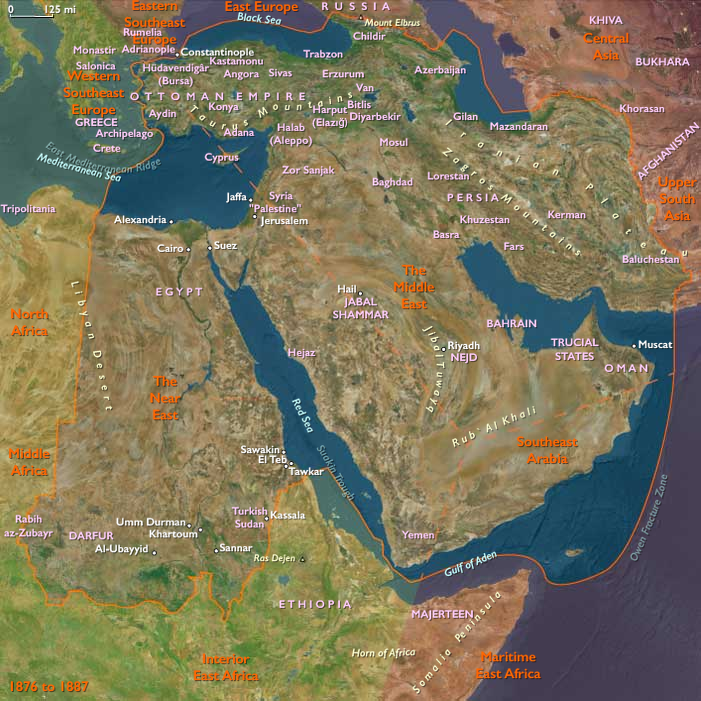
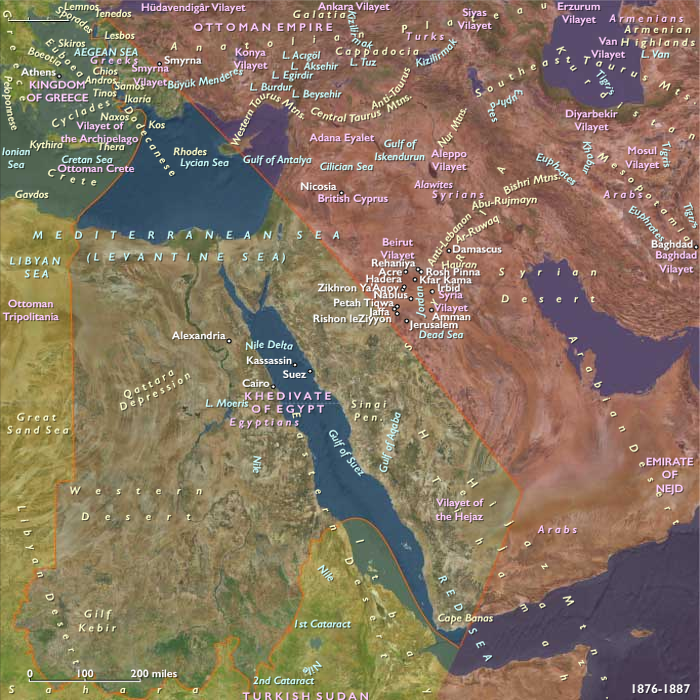
...Wadi Halfa on the northern frontier remain …
Years: 1885 - 1885
December
...Wadi Halfa on the northern frontier remain in Anglo-Egyptian hands.
Locations
People
Groups
- Muslims, Sunni
- Ottoman Empire
- Britain (United Kingdom of Great Britain and Ireland)
- Sudan, Turco-Egyptian
- Egypt, Khedivate of
- Egypt, British Protectorate of
Topics
Subjects
Regions
Subregions
Related Events
Filter results
Showing 10 events out of 11039 total
Chief Joseph and two hundred and sixty-eight surviving Nez Perce are finally allowed to return to the Pacific Northwest in 1885.
Joseph, however, is not permitted to return to the Nez Perce reservation but instead settles at the Colville Reservation in Washington, where he will die in 1904.
The Colonial Office accepts an offer by New Zealand in October 1885 to pay for a British Consul for Rarotonga on condition that he be nominated by New Zealand, which is at this time a self-governing British colony, for New Zealand and act as the country's official agent.
This "Resident" is also to act as adviser to the ariki in drafting and administering laws; he will sign all acts of the local legislature in the name of the Governor of New Zealand.
He will also have the right to reject proposed legislation.
A German trading company settles in 1885 on the Marshall Islands, which will become part of the protectorate of German New Guinea some years later.
The islands, recognized as part of the Spanish East Indies in 1874, had been sold to Germany in 1884 through papal mediation.
Prospector Charles Hall and others find alluvial gold in the eastern Kimberly region in 1885, creating the first gold rush in Western Australia.
In terms of gold yield, the rush is not particularly successful, but is the first significant find in the Northern and Western parts of Australia, occurring nearly forty years after the Victorian rushes.
News of the discovery draws more than fifteen thousand people to what is now Old Halls Creek to try their luck.
It proves an inhospitable land for these people and the graves of some can be found in Old Town's small cemetery.
The gold rush lasts less than three months and Halls Creek becomes a trading center for cattle stations, aboriginal communities and miners who stay in the area.
The post office with its telegraph line that terminate here, the police station, government office, racecourse and stores give the town a purpose.
The Broken Hill Proprietary Company (BHP) (later BHP Billiton) is founded by the Syndicate of Seven in 1885 to mine the ore body of Broken Hill, the largest and richest of its kind in the world.
Boundary rider Charles Rasp, who patrols the Mount Gipps fences, had discovered what he thought was tin in 1883, but the samples proved to be silver and lead.
Great Britain and Germany recognize the Dutch claims on western New Guinea in an 1885 treaty.
The Dutch East India Company (VOC) had recognized the Sultan of Tidore's sovereignty over the Papuans, the inhabitants of New Guinea, in 1660.
Probably this had referred to some Papuan islands near the Moluccas, although Tidore never exercises actual control over New Guinea.
New Guinea had thus become notionally Dutch, as the Dutch hold power over Tidore.
In 1793, Britain had established a settlement near Manokwari, which had failed.
Britain and the Netherlands had agreed by 1824 that the western half of the island would become part of the Dutch East Indies.
In 1828, the Dutch had established a settlement in Lobo (near Kaimana), which also failed.
Tidore had recognized Dutch sovereignty in 1872 and granted permission to the Kingdom of the Netherlands to establish administration in its territories whenever the Netherlands Indies authorities would want to do so.
This had allowed the Netherlands to legitimize a claim to the New Guinea area.
Sugar production in the Dutch East Indies has doubled between 1870 and 1885; new crops such as tea and cinchona have flourished, and rubber has been introduced, leading to dramatic increases in Dutch profits.
Changes have not been limited to Java, or agriculture; oil from Sumatra and Kalimantan has become a valuable resource for industrializing Europe.
Dutch commercial interests have expanded off Java to the outer islands, with increasingly more territory coming under direct Dutch control or dominance in the latter half of the nineteenth century.
However, the resulting scarcity of land for rice production, combined with dramatically increasing populations, especially in Java, has led to further hardships.
China is probably growing twice as much opium as it is importing by 1885, although estimates vary widely.
The British consul at Yichang in 1881 had estimated the total opium production in the southwest at thirteen thousand five hundred and twenty-five tons, a figure that at first seems exaggerated. (Twenty-five years later, however, the first official statistics will show that Sichuan and Yunnan were in fact producing nineteen thousand one hundred tons tons, equivalent to fifty-four percent of China's total harvest.)
Japan organizes its first cabinet along the lines of the German model in 1885.
The Transcaspian Railway had been started from the shores of the Caspian in 1879 in order to secure Russian control over the region and provide a rapid military route to the Afghan border.
A crisis is precipitated in 1885 by the Russian annexation of the Pandjeh oasis, to the south of Merv, on a territory of modern Afghanistan north of the Oxus River.
An Afghan force is encamped on the west bank of the Kushk River, with a Russian force on the east bank.
The leader of the Russian forces, General Alexander Komarov, sends an ultimatum on March 29, 1885, demanding an Afghan withdrawal.
On their refusal, the Russians attack them at 3 a.m. on March 30 and drive them across the Pul-i-Khishti Bridge with a loss of some forty men.
Afghan troops are reported to have been 'wiped out to a man' in their trenches, with losses of up to six hundred.
This nearly leads to war with Britain, as it is thought that the Russians are planning to march on to Herat in Afghanistan.
The incident sours the relations between Britain and Russia, but the Emir Abdur Rahman, who had been present at the Rawalpindi conference with Lord Dufferin at the time, regardst he matter as a mere frontier scuffle.
However, members of Gladstone's cabinet, namely Lord Ripon (the previous Indian Viceroy), believe withdrawal could lead to a breakdown in law and order and possible intervention from Russia.
Outright war is averted with diplomacy, and Lord Dufferin manages to secure a settlement in which Russia keeps the Merv Oasis, but relinquishes further territories taken in their advance, and promises to respect Afghan territorial integrity in the future.
Following the incident, the Anglo-Russian Boundary Commission is established to delineate the northern frontier of Afghanistan.
The commission does not have any Afghan involvement, and effectively leads to Afghanistan becoming a buffer state between British India and the Russian Empire.
The incident brings the southward expansion of Imperial Russia to a halt.
The Russians establish the border town of Kushka in the conquered territory; it is the southernmost settlement of both the Russian Empire and the Soviet Union.

Years: 1885 - 1885
December
Locations
People
Groups
- Muslims, Sunni
- Ottoman Empire
- Britain (United Kingdom of Great Britain and Ireland)
- Sudan, Turco-Egyptian
- Egypt, Khedivate of
- Egypt, British Protectorate of