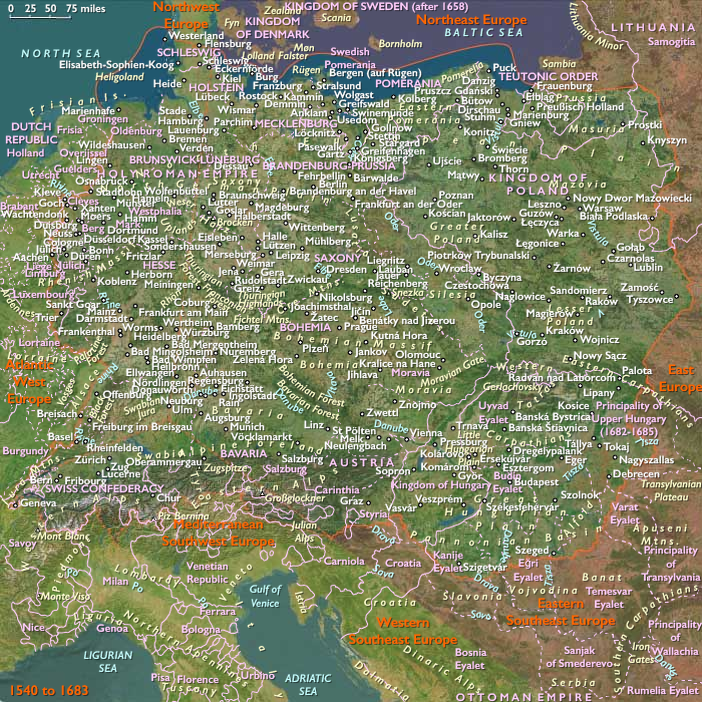
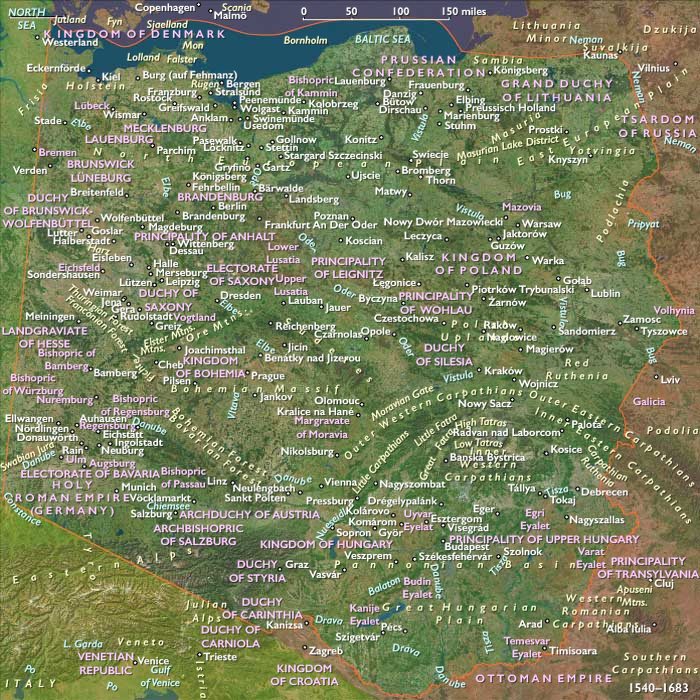
...western Poland, making their centers of activity …
Years: 1549 - 1549
...western Poland, making their centers of activity Poznán and ...
Locations
Groups
Topics
Subjects
Regions
Subregions
Related Events
Filter results
Showing 10 events out of 16 total
The return to Scotland of the widowed Mary, who lands at Leith on August 19, 1561, leads to a famous series of face-to-face confrontations between the young queen and the outspoken Knox.
Immediately taking the advice of the moderates—her half-brother Lord Abernethy and Sir William Maitland of Lethington, who she has named secretary of state—Mary recognizes the Reformed (Presbyterian) church and allows it a modest endowment but not full establishment.
The Protestant reformers, including Knox, are appalled because she has Mass in her own chapel, and the Roman Catholics are concerned about her lack of zeal for their cause.
Mary attempts to placate the Protestants and befriend England’s Queen Elizabeth, her cousin.
At the same time, in order to prod Elizabeth into naming Mary as her successor, Maitland approves of negotiations seemingly intended to result in Mary's marriage to Don Carlos of Spain, the sickly, mentally disturbed teenage son of Habsburg monarch Philip II of Spain.
This would be an alliance that Elizabeth cannot risk.
Queen Mary’s secretary of state William Maitland has a hand in the unsuccessful proposals of a marriage between Mary and Robert Dudley, earl of Leicester.
Nineteen-year-old Henry Stewart, Lord Darnley, the son of Matthew, fourth earl of Lennox, meanwhile begins in February 1565 to court the widowed twenty-two-year-old queen, who is his first cousin.
Thomas Randolph, the English ambassador to Scotland, is in early 1565 told by the Scottish queen that she would accept the proposal.
To his amazement, Dudley is not to be moved to comply: But a man of that nature I never found any ... he whom I go about to make as happy as ever was any, to put him in possession of a kingdom, to lay in his naked arms a most fair ... lady ... nothing regardeth the good that shall ensue unto him thereby ... but so uncertainly dealeth that I know not where to find him.
Dudley had indeed made it clear to the Scots at the beginning that he was not a candidate for Mary's hand and forthwith has behaved with passive resistance.
He also works in the interest of Lord Darnley, Mary's eventual choice of husband.
Elizabeth herself had wavered as to declaring Mary her heir; still, she finally tells the Spanish ambassador that the proposal fell through because the Earl of Leicester had refused to cooperate.

Negotiations on both the English succession and the Spanish marriage result in refusals, and Mary opts for a marriage of love with the handsome Darnley over a purely political match.
A dynastic argument for the union can certainly be made, however, as their marriage will unite the branches of the powerful Stewart family.
Moreover, Darnley, whose mother is the former Margaret Douglas, daughter of Margaret Tudor and the sixth earl of Angus, stands next to Mary in the English succession.
The couple wed on July 29 according to Roman Catholic rites, to the great displeasure of Moray, the prominent Hamilton family, and John Knox, head of the Scottish Reformed church, to say nothing of her Protestant subjects.
Elizabeth, meanwhile, disapproves of Mary marrying another Tudor descendant.
Moray is jealous of the Lennox family's rise to power and from August to October has attempted to arouse Edinburgh citizens against Mary's authority.
Aided by other nobles, he raises a rebellion that she quickly suppresses with the help of twenty-nine-year-old James Hepburn, 4th earl of Bothwell, despite his support of the Protestant faction in Scottish politics.
She outlaws Moray and personally leads the force that drives him and his supporters across the border.
Feeling betrayed, however, by her Protestant advisors, Mary withdraws some of her support from the Reformed church.
The Queen’s marriage with the ambitious Darnley soon sours, and she refuses him the right to succeed if she dies without issue.
The disappointed young queen turns for comfort and advice to her secretary, David Riccio, whose influence the Protestant lords fear because they suspect him of being a papal agent.
Darnley is weak and vicious, and when his jealousy of the Italian becomes unmanageable, he openly states that Riccio is too intimate with the queen.
The Scottish Protestant nobles, encouraging Darnley’s jealousy, view Riccio as an arrogant parvenu and desire his removal as the preliminary to the virtual deposition of Mary.
A group of lords—the fourth Earl of Morton, Lord Ruthven, and other armed men—acting with the support of both Darnley and Maitland, on March 9, 1566, drag Riccio screaming from Mary’s skirts in her supper room at Holyrood Palace before callously stabbing him to death.
Mary is six months pregnant; Darnley apparently suspects Riccio of being the agent of her condition.
Mary, estranged from Darnley and his murderous allies, convinced that her vicious husband had aimed at her own life, gives birth to a son, James, on June 19, 1566, in Edinburgh Castle.
Mary had suffered a serious illness in October, which has left her low-spirited and in precarious health.
She has by year's end befriended Bothwell, who had helped her in suppressing the rebellion raised the previous year by the outlawed Moray, who had fled to England but is in this year pardoned and allowed to return to Scotland.
Now possessed of the heir she had craved, Mary seeks some means of dissolving her intolerable marriage. (According to Mary's detractors, she develops an adulterous liaison with Bothwell, and plans with him the death of Darnley and their own following marriage. No contemporary evidence of this love affair exists other than the highly dubious so-called Casket Letters, poems and letters supposedly written by Mary to Bothwell but now generally regarded by historians as inadmissible evidence.)
Mary’s loyalists allegedly concoct various schemes to eliminate her husband, but Mary is probably unaware of the actual plot to kill Darnley.
Bothwell is acquitted after a cursory, obviously rigged trial.
Maitland may also have had a hand in the murder.
There is no proof of Mary’s foreknowledge or complicity in the event, but she had in April 1567 gone off with Bothwell, who in early May secures a divorce from his wife.
He has possibly abducted and ravished the Scottish queen against her will but in any case, Mary, already living with Bothwell, agrees to wed him according to Protestant rites held on May 15, the day after his creation as duke of Orkney and Shetland.
Her mounting despair exacerbated by ill health, Mary possibly sees the need for a strong shoulder to aid her in managing the affairs of her fractious subjects, but at this point even some of the queen’s closest supporters become alienated, including Maitland, who had opposed the union with Bothwell.
The deposed queen, aided by a few brave friends, escapes from her incarceration in the castle of Loch Leven and immediately rallies behind her a six thousand-man force.
The Marian loyalists on May 13, 1568, confront the army led by the Protestant lords at Langside and are soundly beaten.
Mary immediately flees Scotland for ...